Category Archives: Articles

The Master of Disaster: Alternative Thinking – 19

One of the best things about tabletop role-playing games is just how much versatility a player has in any given situation. Any good GM should be able to accommodate any reasonable request from their players, but the real fun come in when a player completely sideswipes you with some genuine shenanigans. Having to adjust and improvise on-the-fly is an absolute thrill that really tests my abilities to honor the request of the player while adhering to the rules and story. It’s a tough thing to develop, but it’s a necessary skill to have when running a game.

During one of my first ever games I ran, the first thing that a player of mine did was just say they were doing something, which in this case was taking a pouch of gold off of an NPC. My first reaction was to prompt them for a sleight of hand check which seemed pretty reasonable in my mind, but then they clarified and said “no, I’m just taking it.” They made it clear that there was no intent for being sneaky or surreptitious at all, they just literally wanted to take a thing that belonged to another character without any resistance. Knowing what I know now, I shouldn’t have relented and instead made them roll a contested strength check or just tell them that wasn’t going to fly without a check, but when you’re starting out you just want to please everyone and let them run free.

Don’t do that. While it may seem counterintuitive to tell your players they can’t do something, sometimes you need to remind them that TTRPGs, while a great forum for wild improvisation, are by and large very rules-heavy games. It isn’t about just saying “no” to your players, rather you need to refocus their energy so they can work within the guard rails of whatever system you’re playing. Saying “no” repeatedly to a player might result in them just checking out entirely or feeling as if they’re being picked on, so usually I try to encourage my players to try a different tactic or work with them to accomplish whatever ridiculous thing they’re trying to do.

Because I play with my friends, there’s a built in level of respect between all of us. They know that I’m trying to give them as much flexibility as I can without completely throwing out the rule book, and I know that they’re going to respect me when I tell them that there’s going to be a couple of extra steps required in the insane shit they’re trying to pull off. I ultimately want their characters to succeed in whatever they’re doing, but that doesn’t mean I have to make it easy on them and let them dictate what rules are and aren’t enforced.

There are plenty of ways that you can help work with your players to accomplish their goals, but for my money I’ve found that just asking my players if they have any abilities that would aid them in their wild requests is something I’ve found not only reinforces the rules of the game, but makes sure they’re paying attention to their character’s unique abilities. But lets say you wanted to be fun for once in your life and just let the players have a good time, well that’s when luck checks, high dice checks and even some deus ex machina can help you loosen up.

Honestly, that’s kind of the secret. If the players want to do a near impossible thing, let them try it and set the DC at 30 and give them disadvantage if you have to. They’ll probably fail miserably if they actually try which could lead to even more hilarious situations. Or maybe they’ll succeed, which might ruin an encounter, but it’ll be a moment they talk about forever. In my experience, I’ve never been so happy to get fucked over by the dice thanks to a rogue natural 20, because the players eat that shit up.

Allowing your players to try something rather than just shutting them down is something that I truly believe you have to do in order to foster a positive gaming environment. If you don’t let your players have fun, they’ll eventually stop caring and stop playing, but if you let them get away with anything then you’ll probably want to stop playing. Having been on both sides of that divide I can attest to how difficult striking that balance can be, but I assure you that striving for that balance is well worth the effort.

The Master of Disaster: Holiday Havoc – 18

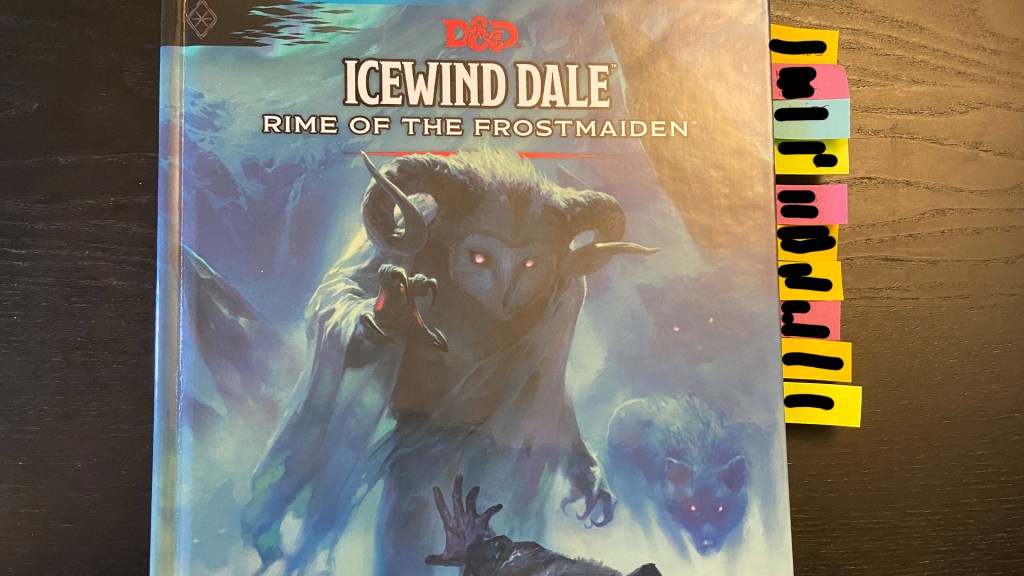
I currently play in two Dungeons & Dragons groups, one of which I run and the other I just play in. For my group, we’d been running the newly released Icewind Dale: Rime of the Frostmaiden, while my other was neck-deep in a Dragonlance campaign. However, as we crept closer towards the end of 2020, we found ourselves in the middle of one of the weirdest holiday seasons of all time. So with a lot of people unable to see family and get particularly festive this year, I wanted to do something special for them the only way I knew how to: A holiday themed one-shot. It was also an opportunity for me to move away from the lackluster module of Icewind Dale: Rime of the Frostmaiden, but that’s a story for another time. Instead, I’d like to tell you the story of Holiday Havoc: The Clausening, the holiday one-shot I ran for both of my D&D groups.

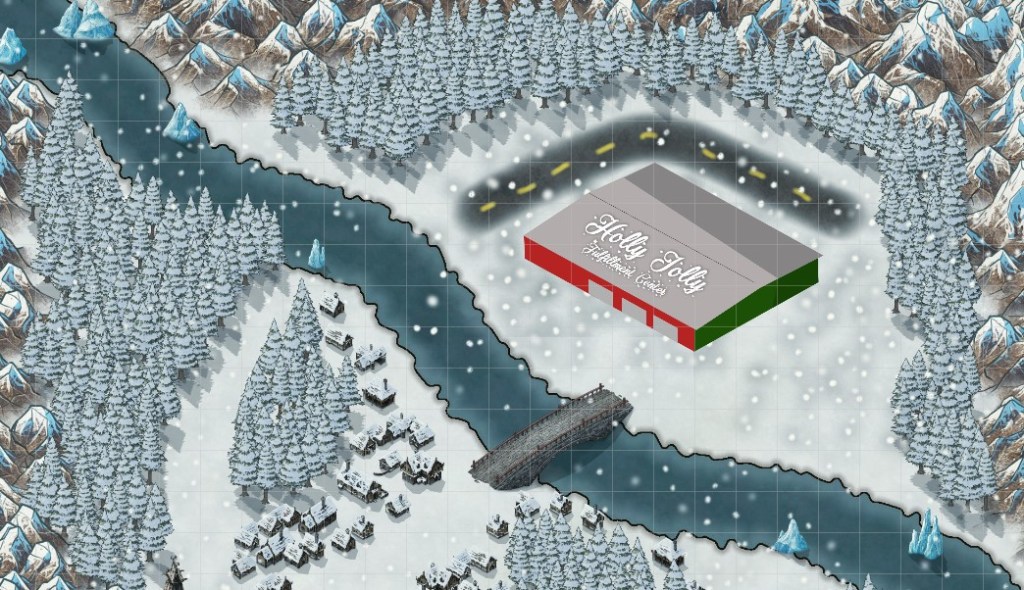
The main conceit of Holiday Havoc was that Santa Claus had essentially transformed his yearly package deliveries into a full, Amazon-esque logistics company called The Holly Jolly Corporation. How this was a sustainable business, I don’t know, but at the North Pole Santa had a big ol’ shipping and receiving center called The Holly Jolly Wish Fulfillment Center. The characters were all seasonal hires that were to be couriers for the evening, with the explanation that Santa is old and figured out a way to avoid doing the work himself. Adventurers were perfect for being holiday couriers, considering they have a knack for problem solving and Santa’s list might not be super accurate, resulting in the players wandering into dangerous situations.

They were outfitted with a sleigh, reindeer, and a magic Santa suit that had illusory capabilities that would make people think they were seeing the actual Santa in their house, and not just a goblin wearing a red jacket. I also needed a way to not have them murder everyone they encountered, cause you know, it’s a festive one-shot. So I gave them these magic bracers that transmutate all their spells into nicer and less deadly holiday themed variants of themselves. For instance, casting fire bolt would result in a piping hot beam of hot cocoa being lobbed at their face. Technically it’s still super deadly, but it’s hot cocoa so my players thankfully stopped asking questions at that odd logic. I also turned their weapons into candy canes, hard candies and peppermint bark, all of which still did the normal amount of weapon damage, but were all non-lethal variants of their armaments.

The general flow of the game was broken down into 3 different encounter types, all of which were important and added something positive or negative to the final scene of the campaign. The first encounter was your standard D&D dungeon crawl, where they would fight against enemies that I Photoshopped festive hats onto, and also find items that could help them later.

The second and most prevalent encounter was the delivery aspect of the game. I had around 10 handmade deliveries that I could send them on, but both groups only made it about 5 of them before we moved to finish the campaign. In these scenarios, I’d describe a home or locale where a present or present needed to be delivered. I made sure to let them know that deliveries weren’t complete until a present was under the tree in an effort to keep them in a situation rather than just run away from one. They could look at their bracers to see who the gift was for, their age, and what the present they wanted was. Here’s an example of what I’d read to them to get them started:

Your sleigh touches down on the rooftop of a modest two-story home.  The outside of which is decorated in rainbow colored glowing bulbs, garland lining the perimeter of the windows, and a sagging snowman in the front yard.  The lights on the inside appear to be off.  Your magic bag fills out a little bit, but is still easy to carry.  An illusory bubble surrounds the home, letting you know that you are shrouded and unable to be seen from the outside.  

And once they figure out a way inside of the house I’d read this:

You find yourself in a cozy living room with a bit too many effigies to Saint Nick himself littered everywhere.  The mantle is covered in holiday themed sundries with four stockings hanging from it.  Beside the fireplace is a large tree that’s been beautifully decorated with care.  A nearby end table has a plate of beautiful chocolate chip cookies on it, with a tall glass of milk as well.

Both simple descriptions that give you just enough information with being overly exhaustive. The idea was to essentially let the players help me fill in the blanks of this world via dice rolls and role playing. One of the later houses for instance had a dog inside of it, but the players wouldn’t have known that from the description I wrote of the place. So while they were scoping the perimiter of the house, one of the players gave me a perception check looking for something that I can’t quite remember, but they mentioned a dog. Since they rolled well, I manifested a “beware of dog” sign that was covered in snow that they had uncovered. Building off of that knowledge, they asked if there was a doggy door on the backdoor. They rolled an investigation check and thus found a doggy door that was big enough for their Kenku party member to fit through.

I kept encouraging each player to do something in these scenarios because it would help them in the third encounter type I had made for this campaign. The players were tasked with delivering to 100 houses and a minimum of 1 high-risk location (dungeon crawls). Since I had only made about 10 deliveries like the one described above, I needed a way to simulate their success in these ambiguous deliveries that felt like they had an impact on it, so I devised a new mechanic: the delivery roll. I figured it would be incredibly unfair if I picked a skill from the list and said that it was the delivery skill they’d roll for success, so the delivery roll would just be a straight d20 roll. Something needed to augment this roll though, and I figured tying a modifier to the success and participation level of the previous encounters would be just the thing.

So I told everyone that their successes and failures in the second encounter type would either grant them a +d6 or a -d6 to the ambiguous delivery rolls, and would keep track of their successful and unsuccessful skill checks during these scenes. I told them that not participating meant you’d just get no modifier on the ambiguous delivery rolls, along with the fact that doing well on those meant getting buffs or boons like a random potion or temp HP. There wasn’t an exact science to tracking this stuff, and usually if they ended up doing something hilariously funny or clever I’d reward them for it regardless of how the dice worked out for them.

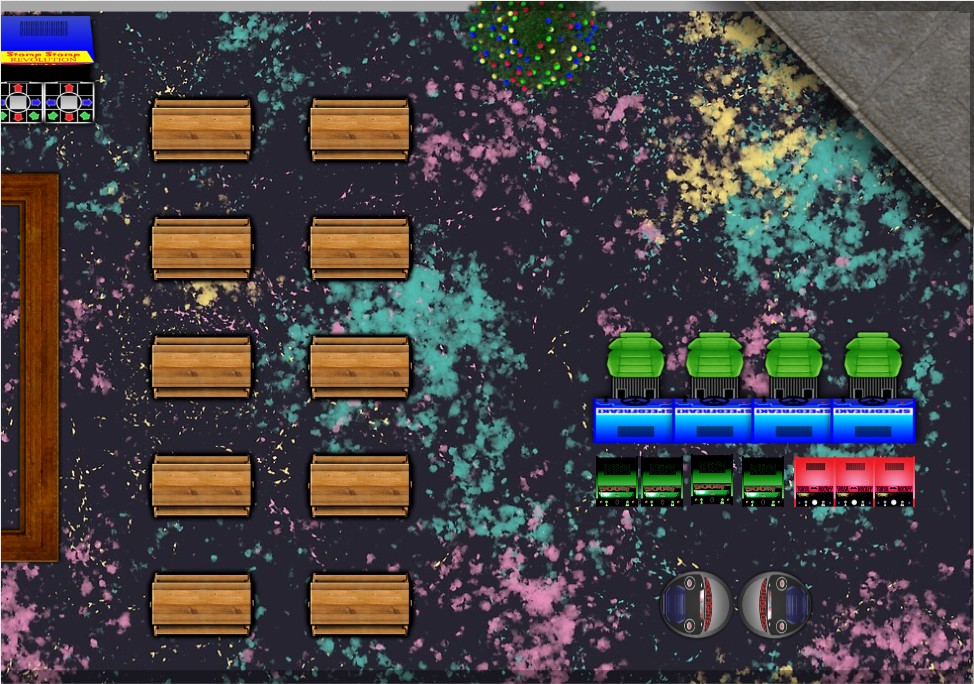
They had other narrative things to contend with like a rival courier group and the prospect of a prize from Santa for completing deliveries quickly, efficiently and safely as well to keep them engaged in the little story that there was. I also included a Chuck E. Cheese analog in the for of Cheddar Chandler’s Exploratorium, a place that was in the middle of renovations to become a more teen friendly affair called Cheddar Chandler’s Extreme Teen-a-torium. It was a place of dangerous and unfinished challenges like rope swings, scaling big walls, and vague obstacle courses, all of which culminated on the arcade and show floor of the establishment, where the party would face off against a monstrous version of Cheddar Chandler himself, along with his army of break dancing teens.

While that was a blast, there were some other missions that didn’t make the cut for time purposes. For instance, there was an abandoned guild hall that a bunch of goblins had turned into an evil snowman production facility, which seems really normal when you consider that the other scenarios were Home Alone and Die Hard related missions. I wanted to really hit those classic holiday themes hard.

The whole thing culminated in a showdown on the warehouse floor of the Holly Jolly Wish Fulfillment Center against the rival courier group and a bunch of Santa’s elves. They’d come to find that Santa had been corrupted by the magic of being Santa for so long and became just wildly evil, to the point where he had brainwashed the rival couriers into fighting the party. There were some cool things in the factory the party could mess with such as dangerously high speed conveyor belts, explosive barrels and forklifts which one player did try to use, but lacked a key to turn the thing on.

At the end of it all, they’d be tasked with picking a new Santa Claus for the next few centuries. I had no idea how that would end or who they would choose, so I just kind of didn’t write an ending outside of some flowery language around how beautiful the holidays were. Alas, neither group ever made it that far but I sure had a blast running this campaign anyway, and I know they did too. And that’s kind of the only thing that matters, isn’t it?

The Master of Disaster: God – 17

It’s been a bit since I’ve actually told a story from my D&D games, hasn’t it? Lately I’ve been prattling on about my ethos and how I prep for games, but sometimes all you need is a good story about players being overly confident. So buckle in everyone, cause this one is short but oh so sweet.

For context, our DM had a lot of affinity for the Dragonlance universe, so we ultimately decided to play through a module of their choosing using the D&D rule-set. I don’t know if Dragonlance is its own game or set of modules or something, but I was interested to play it regardless, and so was the rest of my party.

The story was mostly spearheaded through our cleric, a man on a mission to restore the power of the gods who had abandoned the region for some reason. So in a very Wizard of Oz kind of way, the backstory was set up with the cleric meeting each of us on his travels, conscripting us into is mission. Each character had their motivation for finding the gods except mine, who was more loyal to the cleric than his mission. They were buds.

So we wandered around, going village to village in search of anyone who could help point us in the direction of a way to achieve our goal of bringing the gods back. After a few sessions, an NPC we all hated, and a terrible boating incident, we found ourselves deep in a forest where we were on the trail of a derelict temple to the gods. In said forest, we found a village of these dragonborn folks who were praying to an effigy of a big dragon. We had no reason to engage with them outside of the fact that this was the first non-swamp related thing we’d seen in about 3 sessions.

One of the many problems we had was that we’d been fighting these dudes in small packs all throughout the swamp, so they had made it clear they were hostile. We luckily had the drop on them, as they were staring at their effigy in prayer while we approached from behind them. Just to be clear, there were enough of them to fuck us up as efficiently as possible. So we had to devise a clever plan to get by them for reasons I still am not entirely sure about. But unfortunately, overconfidence trumped careful planning which prompted our warlock to flex his charismatic muscles.

He elegantly pranced over to the dragonborn clan, whispering sweet nothings into their ears and caressing their cheeks with the back of his palm. It was like watching a ribbon dancer perform without said ribbon. As he performed his floor routine in front of the dragonborns, who were now facing in the direction of where we were hiding, he played his dumbest card yet. Quick side note here, he was not a dragonborn, he was just a dude. That’s important to know because he literally tried to convince these fools that he was their god in humanoid form as a way to get them to not attack us anymore.

It was sultry, it was sexy, and it was the best plan he could come up with. With a plan this stupid, how could it not work? Well the dice found a way to fuck us, and our warlock couldn’t charm these lads with his puny roll of 13. So suddenly our warlock found himself on the wrong side of a wall of fire that placed him in a closed arena with about 15 angry dragonborn who just witnessed this megalomaniac try to be the focus of their idolatry. Not a great position to be in.

Initiative was rolled, the dragonborn all got into perfect ass-kicking formation around our warlock, and then my turn came around. I was a tiefling monk, which meant I could both move very quickly and resist fire damage. Wall of Fire is a spell that requires you to make a dexteriy saving throw that if you fail, you take 5d8 fire damage, also known as just enough damage to kill a stupid warlock. So I used my mobility spells and natural fire resistance in tandem, couple that with a good saving throw to avoid the brunt of the fire damage, and I was able to leap through the wall of fire, grab a stupid warlock, and drag him back to the other side.

He failed his saving throw to get through the fire, but we were able to heal him quickly enough and bail out on the entire dragon cult thing. We chastised him appropriately and continued our adventure. But for the briefest of moments, there was the possibility that we could have made an army of dragonborn wreck shop in our stead. And honestly, isn’t that what D&D is all about?

The Master of Disaster: Prepping – 16

One of the most interesting, fun and tedious parts about being a Dungeon Master is preparing from session to session, but even more of a challenge is preparing a new campaign entirely. My group and I are currently wrapping up our “one-shot” of The Sunless Citadel, a pretty decent Dungeons & Dragons adventure, and are gearing up for our next big campaign. As luck would have it, Icewind Dale: Rime of the Frostmaiden released just as we were finishing up, so we decided that it would be our next adventure. Being that this is my first time prepping a full campaign, I figured I do it as meticulously as possible. Here’s what’s happened.

Considering I’ve always had some difficulty with absorbing the things I read, I had to approach preparing for Rime of the Frostmaiden from an overly redundant and thorough angle. I can’t just read something once or twice and commit it to memory. My brain just never worked like that so I had to bust out old my note-taking methods from my school days in order to properly tackle this behemoth of a book. What that meant was that I had to essentially read the book paragraph by paragraph, rewriting everything I was reading into a notebook.

The notes themselves, while useful, aren’t really why I’m doing all of this extra busy work. The problem I have is that I need to rewrite something to commit it to memory. I don’t think that’s too uncommon, but it definitely adds a lot more time and effort to whatever it is I’m trying to absorb. But I wanted to be as meticulous as possible, and luckily the book is actually really interesting which has fueled me to continue with this overly redundant way of learning.

Rime of the Frostmaiden – Wizards of the Coast

Both my notebook and the module itself have tiny little bookmark tabs everywhere that denote all of the important information I might need at a moments notice. I do it in a way that is more granular than the format of the book itself can account for allowing me to quickly access anything from notable characters, town lore, quests, items, hazards and more. On top of that, my notes also point me to whichever page in the book I need to get to, so I’m covering all of my bases to make sure I am never more than a few pages away from relevant information my players might need.

But I don’t want to paint all of this as an exercise in futility or anything, because I’m genuinely enjoying the book on its own. The story in Rime of the Frostmaiden is interesting and captivating as written, and all of my efforts in documenting it are just so I can provide my players with the best campaign I can muster. I get to enjoy the book as is, but my players are relying on me to deliver them an exciting and cohesive story to go along with the actual game itself. If I don’t nail this thing then they might have a pretty lackluster impression of the module, and that would be upsetting on a lot of levels.

Other things that I’ve done in preparation outside of just reading the book has involved making generic encounter maps for the frozen wasteland of Icewind Dale, along with listening to well over a hundred instrumental pieces of music and “soundscapes,” and categorizing them into several different playlists that I can quickly switch between. Is the place they arrived in a happy town? Well I’ll play the happy town songs for them. Is this battle an intense and dramatic one? Got it covered.

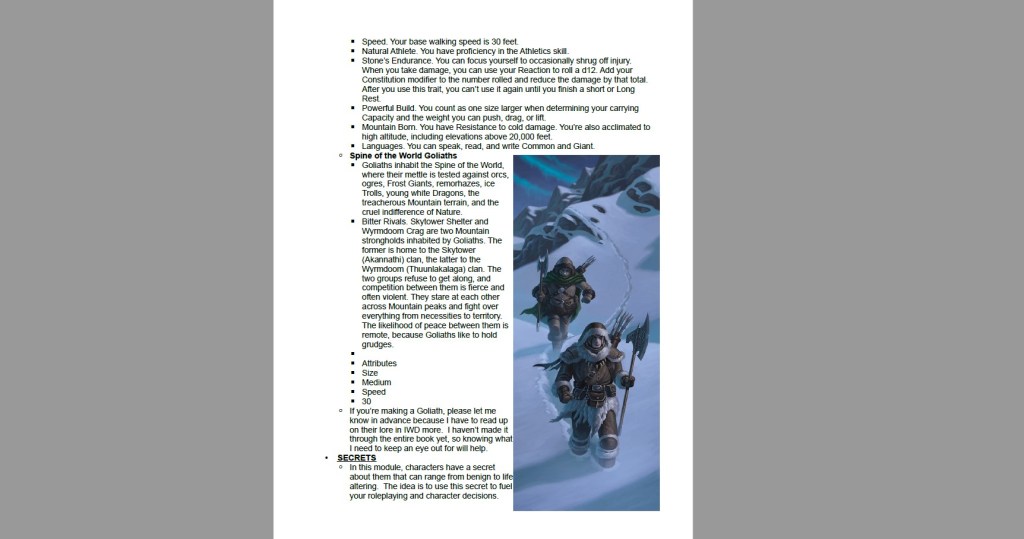
Page 2 of my Character Creation Syllabus

I even went as far as to make a 4-page syllabus of just about everything they need to know in order to create characters for this campaign. When I say that out loud it sounds truly insane, but they genuinely appreciated me doing that. When I’m head down on preparing for campaign, the thought that I might be more “into it” than my players always creeps into my mind, but their reaction to getting a literal syllabus was overwhelmingly encouraging.

All of the little seemingly superfluous things I’ve done in preparation I do because I know that it’s worth it. I can describe a battle in the middle of the frozen wasteland just fine, but having a generic snow-covered battle map I can toss up for them will help give them a sense of place and another opportunity to tangibly interact with their characters. Picking out hundreds of music tracks and categorizing them by their “emotional weight” seems ridiculous, but music is so damn important to setting the tone and atmosphere that I find it’s necessary to a successful campaign.

Maybe this article is just going to be met with other Dungeon Masters feeling like I’ve just described what they all do all the time, but to me I feel like I’m really putting in the extra effort to make this campaign a success. Like I said, this is my first time truly preparing for something this large and intricate, and I don’t want to mess it up. Luckily my players seem just as excited for this new campaign as I am, so I don’t think my efforts will go unnoticed.

The Master of Disaster: Combat Encounters – 15

People often talk about the three pillars of Dungeons & Dragons and how crucial they are when making a well rounded campaign. Of the three pillars, exploration, role-playing and combat, I usually tend to focus on the role-playing pillar the most while paying less attention to the others. I’ve always felt that exploration was the toughest one for me, but as I run more Dungeons & Dragons games with different groups, I find that combat ends up feeling the weakest and least interesting.

Combat always seemed like a layup to me, wherein I could just launch enough monsters at the players and call it a day. It wasn’t until I had to deal with a real slog of a combat encounter where everyone was rolling terribly, that I realized just how bad at these encounters I actually was. Simply pitting stronger enemies against a party doesn’t make for an inherently fun encounter, so I wanted to outline some things that I’ve started to fold into my combat scenarios to make them more interesting.


LOCATION

One of my biggest issues with a lot of Dungeons & Dragons adventure modules, particularly the lower level ones, is that they don’t provide much in the way of variety for the players. Take the 5e book of one-shots, Tales from the Yawning Portal (TYP) for example. In TYP there’s a level 1-3 scenario called The Sunless Citadel, in which a group of adventurers has to go to this mysterious citadel that exists at the bottom of a ravine. While I’ve enjoyed running my players through this scenario, I’ve found that the majority of the fights they’ve gotten into basically turn into slug-fests where it’s just about standing your ground and hoping you hit more than your enemy does.

Most of the battles in The Sunless Citadel go this way, where there isn’t enough space or location variety to do any of the crazy stuff that makes Dungeons & Dragons so special. No one is going to swing from a chandelier or knock a dude into a pit if that stuff just isn’t there, and that’s the problem. These locations tend to lack a lot of variety often just being some dusty old dungeon where something was worshiped in a time long forgotten.

Tales from the Yawning Portal – Wizards of the Coast

My solution to this is to invite people to flex their creative muscles by allowing them to basically manifest room features (within reason) if they succeed on a good enough investigation or other appropriate check. It can be something as simple as letting them scoop up dust to throw in an enemy’s eyes to blind them, or finding an empty bottle to hurl at a threat. I’m not gonna let them just find a rocket launcher or anything like that, but I think it’s important to allow players to get wacky and shake up the mundanity of just rolling dice to hit armor classes.

Most of the wildest stories you here when people describe their experiences with Dungeons & Dragons tend to come out of some wacky combat scenario, but planning for wackiness is an impossibility. Sure you can put some fun stuff in every room to entice the players, but they might not always take the bait. Instead, I tend to entertain just about every wild thing they want to search for in the midst of combat, and will make a decision then and there.

LEVEL DESIGN

Level design is incredibly important when making a combat scenario, and I often find that limiting the playing field both in width or height makes for a boring encounter. It’s easy to craft a battle in a single story room, but that doesn’t really afford the players or enemies any opportunities to do much besides just run at or away from each other. Things like pillars and furniture can help for sure, but I find that the best encounters are the ones where the enemies aren’t always in your line of sight.

I prefer battles that span larger areas as opposed to confined spaces, but that’s a broad sentiment that needs to be explained. You can make a combat encounter be on the first floor of a house and call it a day, but it would be far more engaging if the entire house and both front and backyard were in play as well. Sure a battle could just naturally spill out into those areas, but that might not happen which could lead to a bland encounter.

What really makes these encounters slow down to a crawl is when the party starts out all bunched together and there’s no incentive for any of them to move. That’s why you need a diverse location with plenty for the players to explore beforehand that could have them start the encounter off a little scattered. It isn’t a way for me as a DM to punish the party for splitting up, instead it’s a way to make combat encounters more than just a war of attrition. Are the wizard and rogue looking through an office on the second floor while the fighter and cleric explore the lower floors? Great, now the players have to really take into account their strengths and weaknesses and open their decisions up beyond just “what attack do I use?”

Descent into Avernus – Wizards of the Coast

If they’re determined to group up again, make that an exciting event that might involve them using a full dash or disengage action. The act of self-preservation shouldn’t feel laborious, it should feel like a triumph. As a DM, you have be able to paint these less flashy actions as a victory for whoever needs to utilize them. Players have so many non-combat oriented abilities they can utilize, but no one will ever do any of them if it’s just about making sure the tank can take all the hits while casters do their work from a distance. My method is to make sure that every player has the opportunity to shine in a given combat encounter, while also putting them in positions where their characters might not be primed to be in. Just don’t be malicious about it.

Make sure everyone has the chance to bail out and regroup if they need to, but give them a chance to be the focal point at all times in combat. Sure all the characters combined are a party that needs to work together, but being a party shouldn’t steal their individualism as characters. The line is quite thin, but making sure that a character both feels capable and under powered on their own is difficult, but I find that when it’s done right it makes for some very memorable moments.

LESS FREQUENT & MORE INTERESTING COMBAT SCENARIOS

This final point also builds on the previous one, but it’s important enough to be its own thing. There is nothing less interesting than opening a door to a small room, rolling initiative, beating the bad guys, then opening another door a few minutes later to do it all over again. It’s tedious and makes battle feel more like a chore than an opportunity for fun. I think combat scenarios should be bigger than just combat in general, which is confusing at first, but let me explain.

So you’ve got your big open mine where a bunch of goblins hang out. There are various natural ramps along the walls allowing for miners to reach new areas, there’s a mine cart track and a large molten lava pit in the center that’s used for smelting. We’ve got ourselves a big open combat scenario right there, but the party is bunched up together as they entered the room and don’t really have a reason to split up. That’s why you need to give them a reason.

Adding multiple objectives to combat scenarios beyond just killing everything is key. Have the players take a look around and find that there are half a dozen detonator plungers with wires leading off of them in various directions. If you visually track those wires, you can see a few of them are attached to explosive charges that are crammed into cracks in the walls. Also, this mine is right below a village of unsuspecting innocent people! Oh no! Now the party has to survive and accomplish a goal to truly be victorious.

Sword Coast Adventurer’s Guide – Wizards of the Coast

But you need to have a contingency plan for when your players just try mage hand the wires off the explosives or something. Maybe some goblins with fire arrows will show up to detonate the charges themselves, or some fire elemental gets summoned to do it. Maybe the goblins are protected by a massive troll who is going to run interference for the party, thus emboldening the slinkier and more nimble characters to go and deal with the charges while the tankier classes try to push the troll into the lava.

That combat encounter alone is way more interesting than just a flat room with 7 goblins running up to you with swords. I firmly believe that adding in objectives, having waves of enemies show up at different times, and having a big space with a lot of different tiny stories going on in them is key. Some goblins are on planting charges duty, some are running defense, that troll is protecting both of those parties. Having all of that going on at once will make for a longer and more memorable combat scenario than the firing squad of goblin archers standing opposite the party.


I’m not the ultimate authority on this stuff, but I’ve had plenty of experience in making boring combat encounters. Adding in some of these elements alone made for a more engaged party in my experience. It’s a shame that Dungeons & Dragons often paints combat encounters into these random occurrences like something out of a Final Fantasy game where you open a door and enemies pop out.

The beauty of Dungeons & Dragons is that it empowers your players to use their imagination to conquer any challenge in their way. Too often I find that new players will use the rules and their abilities as static things, like it’s all they can do. The rules are there to guide you and give you a way to navigate the crazy shit you want to do and not the other way around. Regardless of if you take my advice in this article or not, make sure you’re emboldening your players to be creative whether they’re in combat or not.

The Master of Disaster: The Descent – 14

I’ll never forget the first time I played Dungeons & Dragons. It was a few summers ago and one of our friends offered to run us through a single session campaign, otherwise known as a one-shot. It was a ton of fun and is the event I attribute to getting me hooked on the game. But there’s one thing that will always stand out to me most about that experience, and that was when we finished the game and our DM pulled me aside and said, “Ari, I play with a lot of people and I can tell when they’re hooked, and you’ve got it.”

That single phrase always stood out to me because of just how accurate it was. He saw something in myself that I never thought would be there, and even as he said it, I thought he was full of shit and just stroking my ego a bit. Maybe he was, maybe he wasn’t. Regardless of his intent, he was a thousand percent right.

In the past few weeks, I’ve heard his voice echo in my mind louder and more frequently than ever. That probably has a lot to do with the amount of Dungeons & Dragons related purchases I’ve made in that time, a trend that tragically shows no sign of slowing up.

I’ve bought so many fucking dice and I have no idea why. Even before the pandemic, all of the games I played were online, so why the hell did I buy a ton of plastic dice along with a fancy set of metallic ones? Why did I buy a dice rolling box? Why did I buy several digital rule books and modules, and then also buy their physical editions as well?

Because I need them.

Every time I hear my friend’s voice in my head, reminding me that “I’ve got it,” I can’t help but feel like he cursed me. Right there and then, in the middle of our mutual friend’s kitchen, my DM cursed me to an eternity of buying books filled with adventures I will never experience and dice that I’ll never roll.

One day in the future when we’re allowed to congregate once again, I’d like to believe I will actually make use of these physical items that now occupy my bookshelves. But the odds are these will just be items that I’ll be pissed about having to transport when I inevitably move away from here. I just hope that I don’t start buying miniatures next. Like, yeah they’re cool and you can paint them to look like your characters and stuff… Yeah, definitely don’t want to buy those little guys.

Send help…

The Master of Disaster: Finding Your Style – 13

Recently my friends and I shuffled our roles, affording me the opportunity to play in a campaign rather than run one. It’s been fantastic both from a gameplay standpoint along with freeing me up creatively to focus on other projects. Simultaneously another group of friends expressed interest in running a starter Dungeons & Dragons campaign, so being the masochist I am I obliged and started running them through The Lost Mines of Phandelver. And honestly, both games have been tremendous learning experiences that I desperately needed.

I don’t want to imply that I didn’t have fun running home-brew campaigns for my friends, but it did get pretty exhausting from a creative standpoint, which is ultimately why I needed to shift focus from running games to playing them. I agreed to run my other friends through The Lost Mines of Phandelver because I didn’t have to really prepare anything on a week to week basis. Everything is accounted for and fairly well explained, leaving little need for drastic improvisation.

Being a player again allowed me to experience how other people run their games, seeing what rules and mechanics they tend to enforce or cast aside. That’s given me a lot of perspective on just how much of my own campaigns I was glossing over in terms of rules and abilities, giving me more insight as to why they exist in the first place. Understanding the various resistances, spell components, move actions and so much more have made it really apparent as to how infuriating my DM style could be at times.

It was never something I did to intentionally upset or undermine my players, but I’m almost certain that my actions directly resulted in a lot of session to session disenfranchisement. Considering I’ve only been a player once or twice back in the very early stages of my relationship with Dungeons & Dragons, I didn’t really have any experience as a player and instead just became a DM when I had no business doing so. But everyone has to start somewhere right?

Being a player wasn’t the only thing that helped me gain some insight into proper Dungeons & Dragons gameplay, running the starter campaign has been infinitely more helpful than anything I was doing before on my own. Being able to see what a module accounts for and doesn’t has been instrumental in my better understanding of how to build worlds, maps and encounters. To see exactly what I should be accounting for when crafting my own adventures has been illuminating to say the least.

At this point I’ve been playing Dungeons & Dragons for about 3 years or so and only now can I say that I’ve really made progress as both a player and a DM. When I first started running games, I was trying to emulate what I’d seen and heard from popular videos and actual-play podcasts, not really understanding that real games don’t work like that. As of now I can safely say that my style of running games has evolved to the point where I am taking the rules of Dungeons & Dragons more seriously, and I am more conscious and aware of so many more facets of the game itself. I believe that this will only lead to a more positive experience for whatever group I end up running games for in the future. And for the first time in a while, I feel really confident about my abilities as both a player and a dungeon master.

For anyone out there that’s aspiring to be a DM, I genuinely and sincerely recommend starting with a preexisting module and really understanding why certain things interact with others and why. Knowing and enforcing effects on moves and spells heightens the tension and importance of every combat encounter because everyone is aware of what can and cannot happen. I look back at my previous blunders and wince at how I behaved and ruled on things, but genuinely hope that one day I can give my friends the satisfying and fun campaign that they deserve.

The Master of Disaster: Fatigue – 12

During my time running various campaigns for my friends, I’ve experienced a bevy of highs and lows that have both energized and exhausted me to different extents.  Today we’re going to be talking about the latter and how if left unchecked, can wear you out pretty easily.

A little under two years ago I took the plunge and started running a campaign for my friends in D&D that went off the rails a few times, which ultimately led to me rebooting the campaign and home-brewing a story of my own.  It was exciting, terrifying, and a ton of work that would be piled atop the rest of my responsibilities and projects.  It wasn’t a bad thing by any stretch though, because I was already working on other things like finishing out my degree and working on this website.  I was firing on all cylinders from a motivation aspect.

But recently I handed in my final assignment of my last class which was a massive weight off of my shoulders.  The unintended side-effect of that however, was that all the fatigue and exhaustion that I had managed during these busier times finally caught up with me.  Almost the second after I hit the ‘submit’ button on my final, I felt like a truck hit me, and all I wanted to do was just relax.

Shortly after that, we convened online to play the latest session I had prepared for our Monster of the Week campaign, and once it ended I was thoroughly spent both physically and mentally.  I wrestled with the idea of writing our next session and pushing this narrative forward for my players, something that had up until now, had been a labor of love.  But I crumbled and ultimately had to pull the plug on the campaign and take a step back from that level of creative output that I was used to.

It wasn’t so much an issue of just running a game that had gotten to me, but the amount of extra work I had to do in order to make it all work that eventually got me.  From creating the lore of this world, to fleshing out the characters, making a compelling plot, building on the players past decisions, making maps, making music and so on and so forth, the weight of all of that had just gotten to be too much to handle.

I explained the situation to my players who were all really supportive and understanding of my situation.  After all, I had been doing this level of work for them for nearly two years, and they got that.  I also made it clear to them that I still did want to play D&D with them, I just couldn’t be the one running the show for a while.

So there I was, with a clear head and a chance to finally unwind for the first time in a while.  That’s when a different friend of mine reached out to me suddenly and expressed that his friends and him wanted to play D&D for the first time.  Part of me instinctively rejected this idea outright, but then other, much stupider part of me chimed in and rationalized doing this whole song and dance again by suggesting just using the starter campaign on this group.  I looked into it and discovered that the module on Roll20, like all of their D&D modules, was incredibly straightforward and easy to use, eliminating most, if not all extra work I’d have to do to make it work.

I still haven’t made a decision about it one way or another, because like I said earlier, I’m an idiot.  But there’s something tempting about introducing these new players to D&D the way I was introduced to it, by using the campaign the creators themselves suggest using.  I feel bad for even considering doing it at all because I had just told my group that running a campaign wasn’t something I could do for a while.  I think the reality of the situation is that I needed to take a break from running these home-brewed games that required so much of me, at least for a while.

Ultimately, the treadmill of productivity that I was on up until now worked because I wasn’t thinking about how exhausting it all was, it was just part of my weekly routine.  But once that routine got disrupted by the quarantine, and once more by finishing up school, I was unable to keep up that mental pace.  A new DM has risen to take my place in our core group and I’m excited to just play D&D again for the first time in a while, but I’m also genuinely intrigued by the idea of introducing a new batch of people to role-playing games, as long as I don’t have to work too hard to do it.

If you’re looking for some sort of sage advice or piece of wisdom you can glean from all of this, I suppose I’d want to impart upon you the idea that it’s okay to step back and let those batteries recharge.  If you aren’t excited about the game you’re running your players through, they’ll feel that too, and I’d rather not disenfranchise them to the idea of playing a campaign of mine again, and instead just end it graciously.

The Master of Disaster: Maps – 11

Welcome to another installment of The Master of Disaster, a feature where I outline some of my preferences, tactics and stories that have come out of both playing, but mostly from running various tabletop role-playing games.  This time around I’d like to talk about something fairly obvious, but easily one of the more labor intensive parts of being a GM.  Of course I’m talking about maps.

To preface, considering all of my GM/DM experiences revolve around playing a game online, this article is going to exclusively be about online resources and tools I use to make maps.


MAP PURPOSES

First thing I want to touch on before we get into any specific tools is the mentality I have when I decide it’s time to make a map.  It’s an alluring prospect to have a map ready for every location your players might visit, but that’s a fool’s errand as well as the quickest way to lose your mind.

In my previous campaign where we ran a custom story in a custom world using the D&D rule-set, I wanted to create an entire continent with interesting topography, plenty of hidden areas with quests attached to them, and unique cities that all had a different feel.  While that sounds like a lot (and it was), I went ahead and pushed on, creating roughly 30 different maps that my players might stumble upon, not including bespoke dungeons.
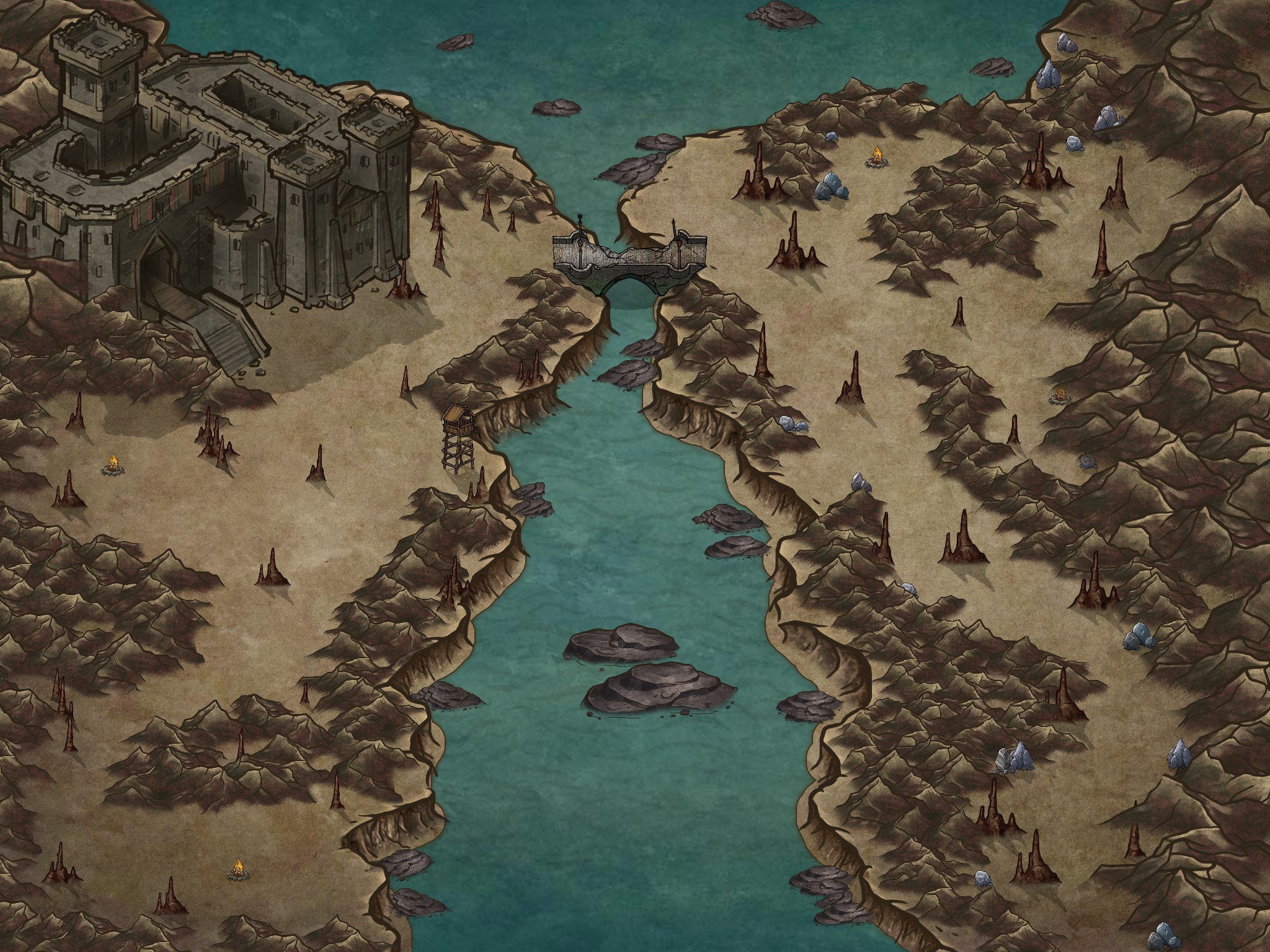
Cave 1.jpg

I essentially wanted them to approach my world like they would have if they were playing something like The Elder Scrolls V: Skyrim.  I had random encounters ready to go, caves and dungeons they could stumble upon and of course, cities for them to explore.  The problem was that I was approaching running a campaign along with map making, as if it were a video game.  Some video game concepts might translate better than others, but the way I went about crafting a world didn’t 100% work out.  Ultimately, I only ended up using a third of the maps I made before we ended the campaign.

Fast forward to the current campaign I run using the Monster of the Week rule-set, and instead of a massive world that’s been hand crafted, I went went with a city that had only a handful of notable landmarks.  Some of these landmarks do have maps associated with them, but for the most part I now rely on my players to tell me where it is they want to go, and flesh it out on the fly by painting a “word picture.”  This approach is easier on me, but far less visually appealing for the players.  So it’s good to brush up on your improvisation and narration skills before attempting this.
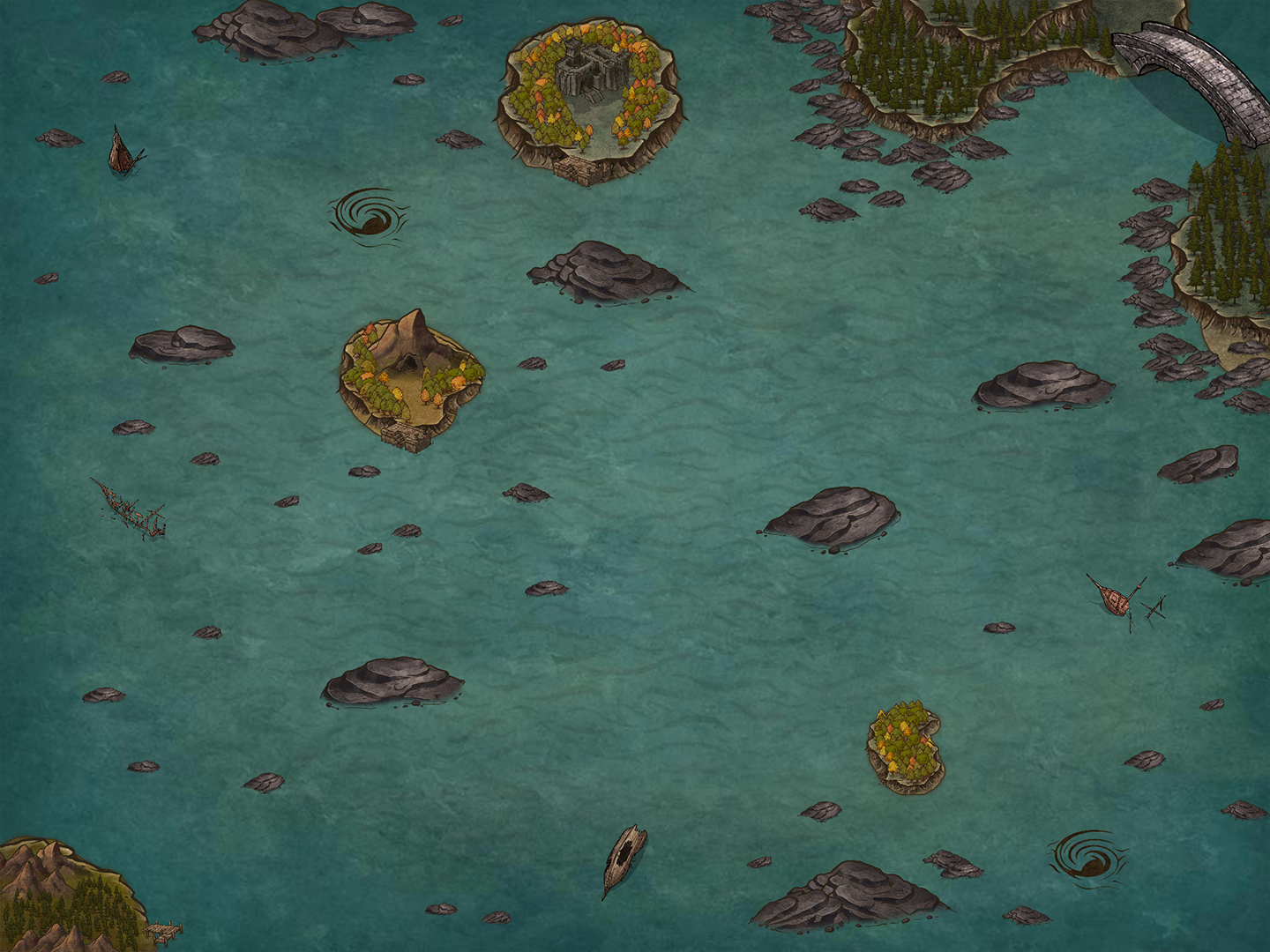
Sea of the Dead.jpg

The point I’m trying to make here is about over preparation.  I went insane and made 30+ maps, most of which that were never seen before, because I had these grand ideas about where my players would go, and what they’d do.  As we all know though, you can’t assume that your players will do anything you plan for.  My strategy now is to build each session, maps and all, based off of what happened in the previous one.  It lightens the workload a lot and let’s you get particularly detailed with descriptions if you know your players are going to be there for a while.


Being that all of my sessions are run through the Roll20 service, I rely exclusively on online tools and resources to aid me in my map making endeavors.  These tools range in quality and scope, but all of them are good for different facets of running a game.  So here are a few of my favorite tools and resources for you to use.

INKARNATE
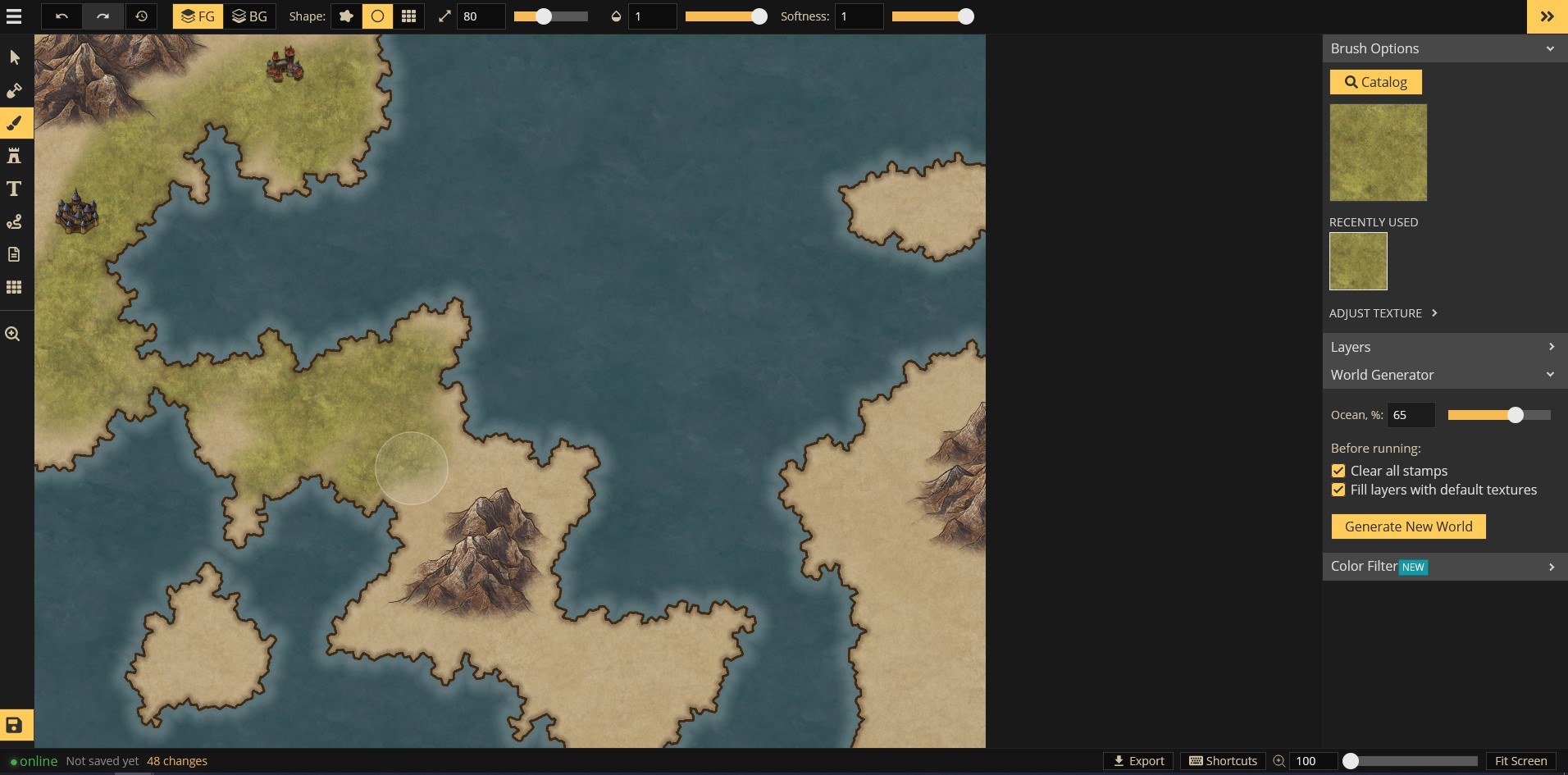
Inkarnate.jpg

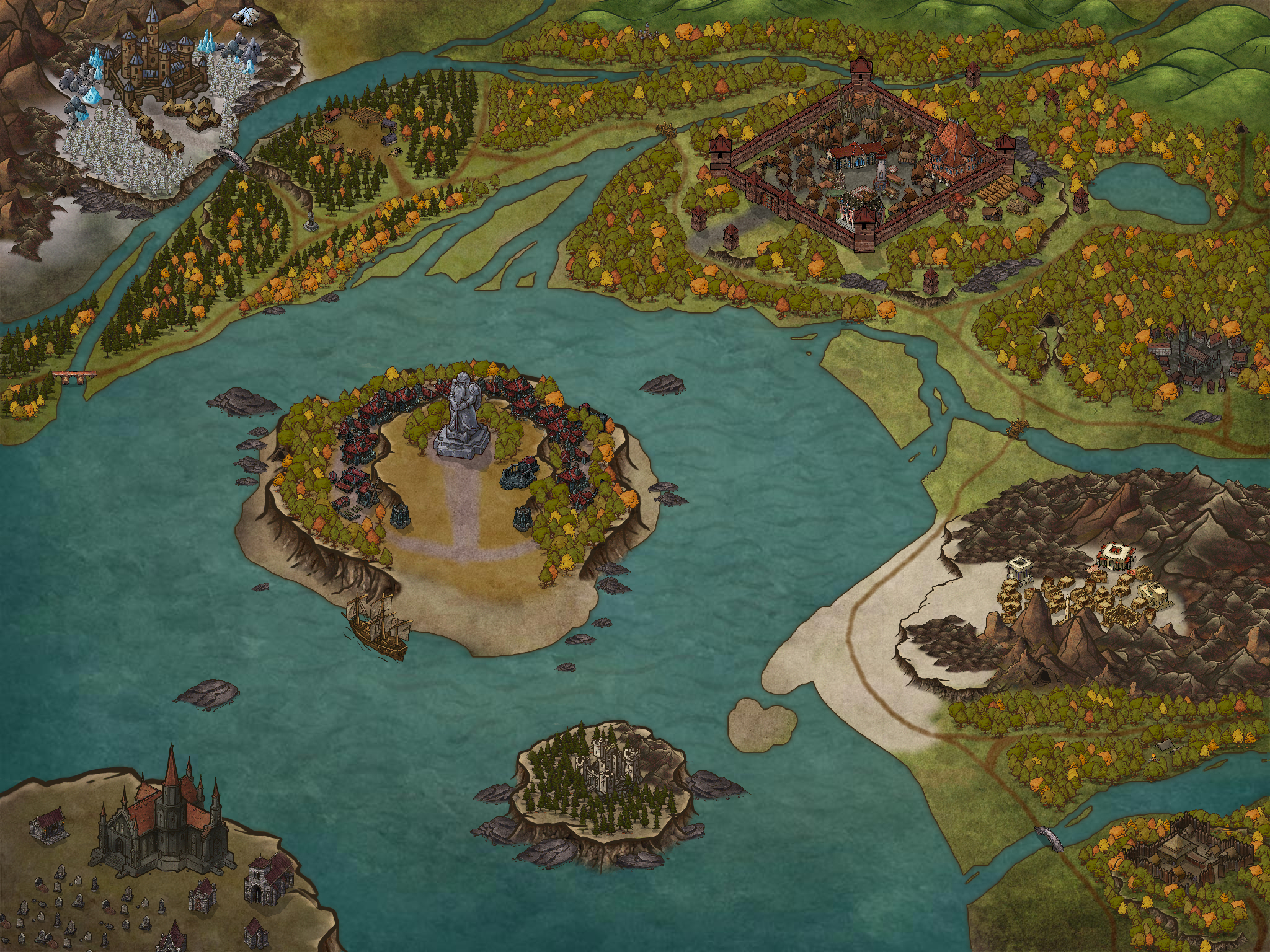
Inkarnate is a really accessible “free” tool that you can use to make all manner of visually striking maps.  It has a robust editing suite that has a lot of custom art for you to plop down and create with.  Within minutes you can generate a world, regional, or city map with various terrains, buildings and landscapes.  The tool is great whether you want to only spend 5 minutes in it, or an hour.

The only thing that could be a drawback is that the free version of Inkarnate, is severely limited in what you can actually use.  In the paid version, I have access to hundreds of different objects from different kinds of trees, mountains, buildings, walls, gates and so on and so forth.  The free version only had a fraction of that stuff to use, but still enough to pump out a couple of maps.
Alavor West.jpg

The free version also limits the export quality of your maps in some regards, although while I have the option to export my maps in 4K, I don’t know why I ever would.  The silver lining here is that if you did want to shell out cash for the full suite, it’s only 5 dollars a month or 25 for a year upfront.  I think it’s worth the price if you need good fantasy themed maps, but if you’re running anything other than fantasy, Inkarnate has basically nothing for you.

MEDIEVAL FANTASY CITY GENERATOR
Fantasy City Generator.jpg

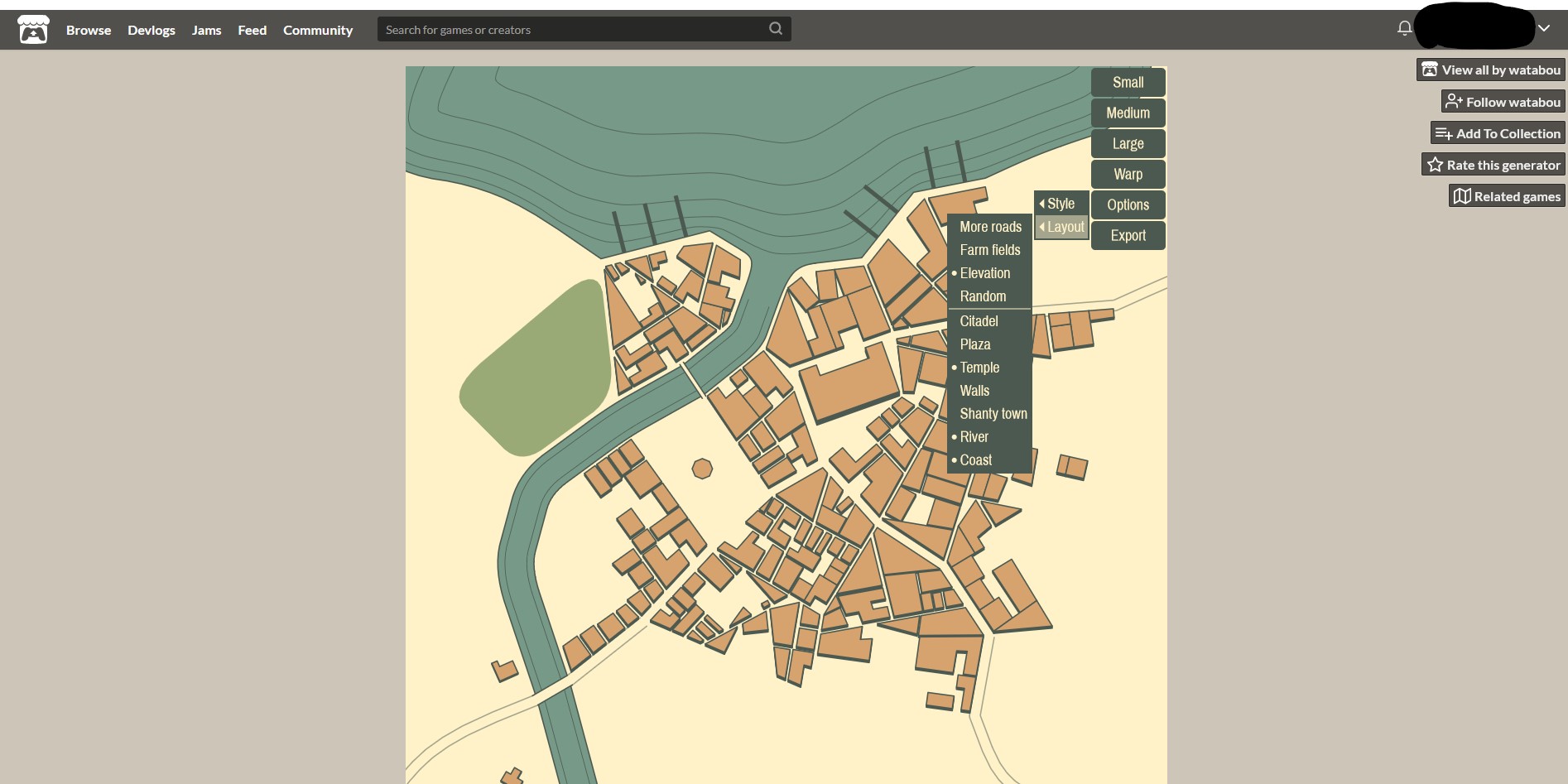
This one is kind of self explanatory, but it’s worth talking about briefly.  The Medieval Fantasy City Generator is super easy to use, but fairly limited as well.  With only a few clicks, you can generate a top-down view of a city and determine if there are farms, roads, coastlines, and other things like that.  It’s quick, it’s simple, and it’s free.

Arden.png

What this tool isn’t however, is super customizable.  You can choose different color and object options to toggle on and off, but you can’t really get granular with it.  You can edit the dimensions of certain objects in the city, but that’s about the extent of it.  I actually used this tool to make my modern day, Monster of the Week city, and it’s worked out pretty well.

DUNGEN

dungen.jpg

Want to generate a dungeon really quickly?  Well DunGen has got you covered, although not completely unless you back the maker’s Patreon, which you should consider if you like this tool.

With DunGen, you select a few options, size, theme and levels, and in seconds you’ll get a pretty awesome looking dungeon.  As I’m writing this in early April of 2020, the creator has unlocked some Patreon exclusive features for everyone to use during the pandemic, such as higher resolution downloads, and automatic dynamic lighting integration for Roll20 users.

Since the tool is using pre-generated assets which it stitches together, the maps can feel a little “samey” in spots.  But despite that, it’s one hell of a tool that I’ve used several times in conjunction with the art assets I have on Roll20.  Just drag a couple of boxes and torches or whatever on to one of these dungeons, and you’ve got something people will think took you hours.

DONJON
donjon.jpg

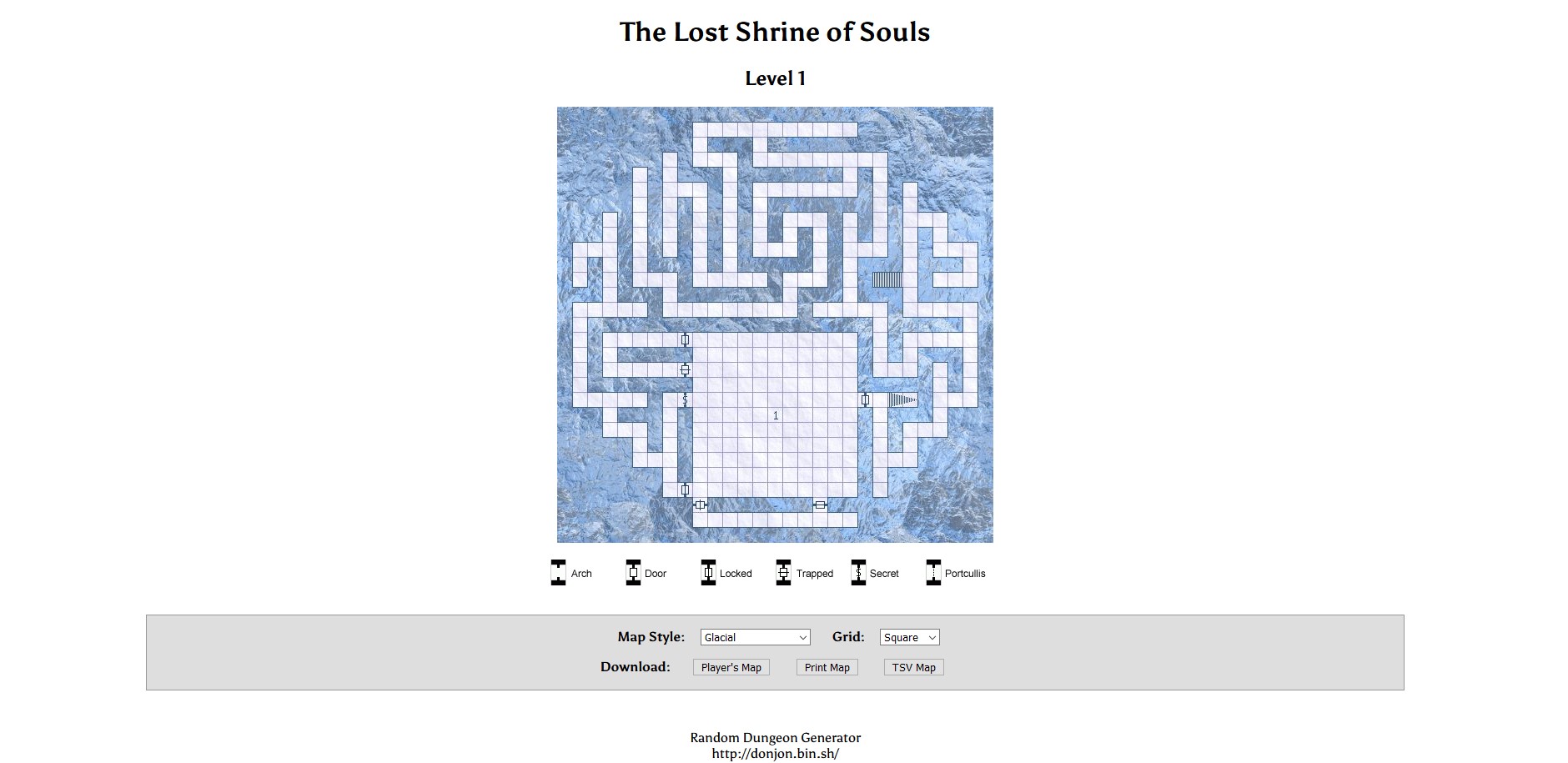
Finally, I’d like to highlight something that isn’t just a map making tool, but something all GMs should explore.  Donjon is a massive resource that includes, various map generators with annotations for doors, traps, and stairs, as well as a generator for just about anything you can think of.

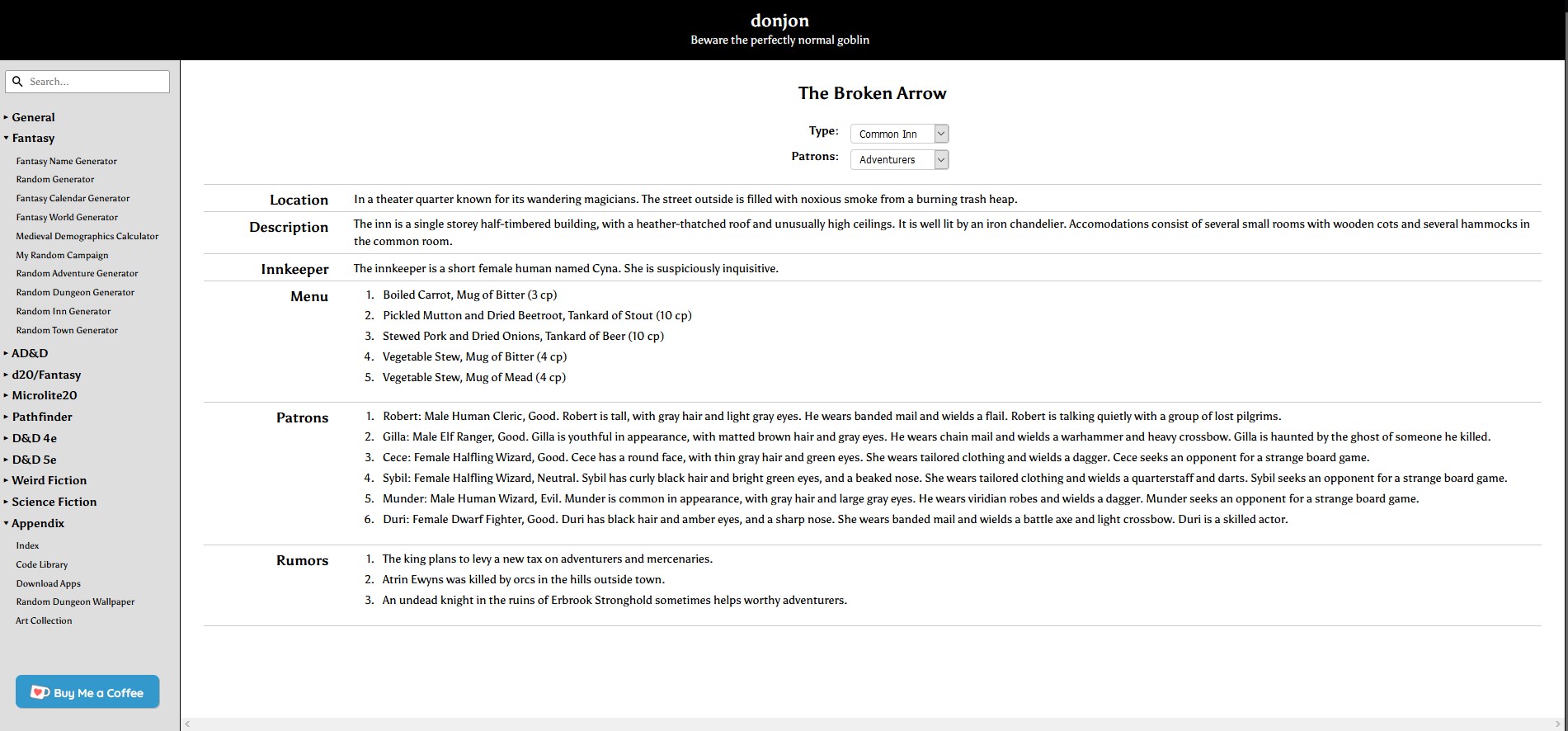
In a matter of clicks, not only can you make dungeons, but you can just generate full quests and locations.  For instance, the image below this paragraph was just the first thing that came up when I clicked on “inn generator.”  I now have this one page that not only gives me a quest to give my players, but menu items, NPCs, rumors and a description of the place itself.  In one click, I am able to describe a scene that might take me a while to write, and even longer to illustrate.
donjon 2.jpg

Donjon is an amazing set of tools that everyone should check out.  If you just need a dungeon, click here, but I strongly suggest you check out the entire suite of tools they have available.


This feature has already run pretty long, but I just have one or two more things to touch on really quickly.  Firstly, make sure your maps are clear and legible.  What is just a stack of useless boxes you plopped in the corner for flavor, might turn into a 20 minute conversation about looting the boxes because your players don’t know any better.  Not to say that those conversations aren’t useful or fun, but if you’re on a time crunch like we usually are, minimize the amount of confusing imagery on your maps.
Refuge.jpg

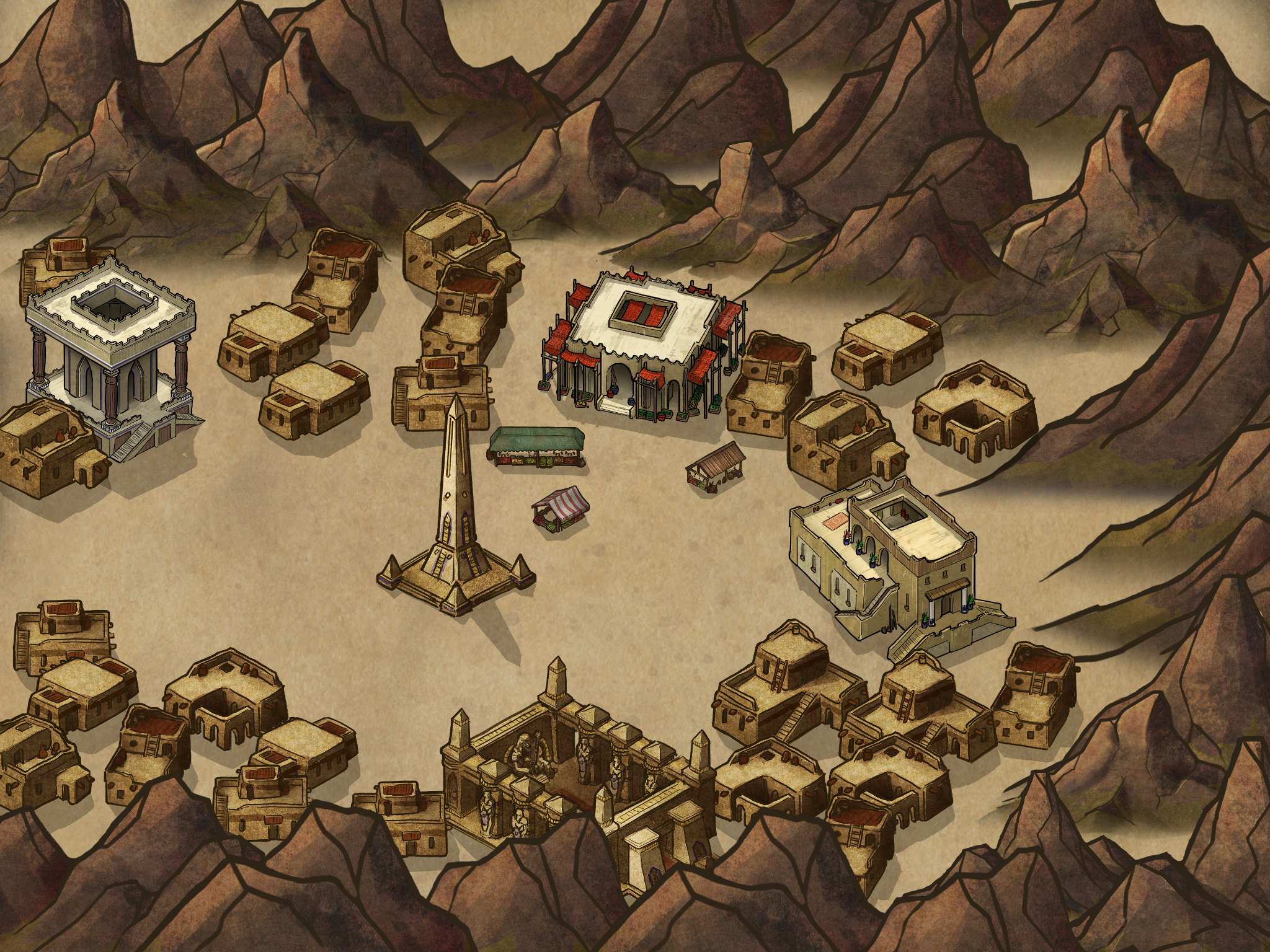
Finally, and this one is pretty obvious, but make sure each room has a purpose.  I know there’s only so many goblin sleeping quarters and dining halls you can stuff into one dungeon, but there is nothing more deflating to a player than the feeling that exploring is a futile effort.  These aren’t just maps, they’re supposed to be visual representations of “real” places.  Not many people just have an empty room in their homes that exists for no reason.


Anyway, thanks for sticking with this one for as long as you did.  I could go on and on about making maps and easily double the word count on this feature, but my fingers are starting to cramp.  So for all of you DMs out there who suddenly have to migrate to online sessions, I hope these tools helped a little.

The Master of Disaster: Music – 10

Pretty early on in the campaign I decided I wanted to add an auditory element to everything we were doing, without resorting to generic dungeon crawling ambient noises that you can find on YouTube.  How would one go about this then?  Maybe they would search for music that set the appropriate mood, cause that would actually be a smart idea.  But what if we added hours to my session prep and included unique music tracks for encounters and story beats?  That’s the position I’ve put myself in.

There were specific tones and moods I was trying to cultivate throughout our campaign in an effort to add some drama and weight to everything.  It started out with me making little stingers of violins swelling or big drums strikes that would act as the period on the important sentence I was relaying to the party.  It largely went unnoticed and didn’t really add much to the experience.

But instead of bowing out there, I decided to go further.  What if I made these long, loop-able songs that would properly portray the current encounter or location?  I should note, this was all inspired by listening to certain RPG podcasts, where the element of audio can add a lot for both the players and listeners.  On one of the podcasts, The Adventure Zone, they did an episode where they answered a lot of lingering questions by the listeners, where it was revealed that most of the music was made with Apple Loops that were built into Garage Band.

I didn’t have a Mac, but I did have an iPhone with Garage Band installed.  Using the phone version of Garage Band wasn’t the optimal experience, but it got the job done.  I mainly stuck to relying on the included loops and various midi instruments as well as occasionally actually recording a guitar track.  Luckily the loops all worked well with each other for the most part, which made the whole affair a lot more manageable and less laborious.  Once I had managed to make a handful of tracks, it was time to use them in the campaign.

It actually went really well and was received positively by my players.  It made things feel a little weightier and put them in the mental place they needed to be.  Would it have been easier to find a good facsimile of the music I was making on the internet?  Of course it would have been, but I like making things myself.  So not only did I get to make sure the mood was just right, but I got to stretch my creative muscles.

I suppose I never really appreciated how important music could be to a D&D campaign before, but I doubt I could ever go back to not having it.  Aside from making the campaign better, it’s just fun to create things in general.

Honestly, being a DM has been some of the most rewarding creative work I’ve ever had the pleasure of doing.  From writing, to map making, character creation, acting and of course, making music, it’s truly a creatively fulfilling experience.  And considering we’re about to start an entirely new campaign with new themes, you know I’m excited to get in there and make several albums worth of tracks for it.