Author Archives: thebonusworld

The Master of Disaster: Alternative Thinking – 19

One of the best things about tabletop role-playing games is just how much versatility a player has in any given situation. Any good GM should be able to accommodate any reasonable request from their players, but the real fun come in when a player completely sideswipes you with some genuine shenanigans. Having to adjust and improvise on-the-fly is an absolute thrill that really tests my abilities to honor the request of the player while adhering to the rules and story. It’s a tough thing to develop, but it’s a necessary skill to have when running a game.

During one of my first ever games I ran, the first thing that a player of mine did was just say they were doing something, which in this case was taking a pouch of gold off of an NPC. My first reaction was to prompt them for a sleight of hand check which seemed pretty reasonable in my mind, but then they clarified and said “no, I’m just taking it.” They made it clear that there was no intent for being sneaky or surreptitious at all, they just literally wanted to take a thing that belonged to another character without any resistance. Knowing what I know now, I shouldn’t have relented and instead made them roll a contested strength check or just tell them that wasn’t going to fly without a check, but when you’re starting out you just want to please everyone and let them run free.

Don’t do that. While it may seem counterintuitive to tell your players they can’t do something, sometimes you need to remind them that TTRPGs, while a great forum for wild improvisation, are by and large very rules-heavy games. It isn’t about just saying “no” to your players, rather you need to refocus their energy so they can work within the guard rails of whatever system you’re playing. Saying “no” repeatedly to a player might result in them just checking out entirely or feeling as if they’re being picked on, so usually I try to encourage my players to try a different tactic or work with them to accomplish whatever ridiculous thing they’re trying to do.

Because I play with my friends, there’s a built in level of respect between all of us. They know that I’m trying to give them as much flexibility as I can without completely throwing out the rule book, and I know that they’re going to respect me when I tell them that there’s going to be a couple of extra steps required in the insane shit they’re trying to pull off. I ultimately want their characters to succeed in whatever they’re doing, but that doesn’t mean I have to make it easy on them and let them dictate what rules are and aren’t enforced.

There are plenty of ways that you can help work with your players to accomplish their goals, but for my money I’ve found that just asking my players if they have any abilities that would aid them in their wild requests is something I’ve found not only reinforces the rules of the game, but makes sure they’re paying attention to their character’s unique abilities. But lets say you wanted to be fun for once in your life and just let the players have a good time, well that’s when luck checks, high dice checks and even some deus ex machina can help you loosen up.

Honestly, that’s kind of the secret. If the players want to do a near impossible thing, let them try it and set the DC at 30 and give them disadvantage if you have to. They’ll probably fail miserably if they actually try which could lead to even more hilarious situations. Or maybe they’ll succeed, which might ruin an encounter, but it’ll be a moment they talk about forever. In my experience, I’ve never been so happy to get fucked over by the dice thanks to a rogue natural 20, because the players eat that shit up.

Allowing your players to try something rather than just shutting them down is something that I truly believe you have to do in order to foster a positive gaming environment. If you don’t let your players have fun, they’ll eventually stop caring and stop playing, but if you let them get away with anything then you’ll probably want to stop playing. Having been on both sides of that divide I can attest to how difficult striking that balance can be, but I assure you that striving for that balance is well worth the effort.

Blog: Please Make This – 03/03/21

They say there’s a product for everything, right? If that’s the case, then where the hell is the asynchronous Dungeons & Dragons game that I’ve been imagining in my head for the past few years? Surely I can’t be expected to go out and develop a video game on my own, so I’ll do the only thing I know how to do decently and write an article complaining about it. So let’s talk about the D&D game that should exist by now, but miraculously doesn’t.

Without any real understanding as to how video games are made or what market trends look like, I feel like there’s a massive gap in the market for a video game to capitalize on the ever expanding tabletop role playing game market that’s desperately looking to be filled. I guess this all stems from my frustration with virtual tabletop (VTT) programs like Roll20 and Fantasy Grounds. Don’t get me wrong, I’m extremely thankful that these services exist, but some of them can be an absolute hassle to use reliably. Sometimes everything works without any issue, but other times you’re plagued with connectivity issues, or some compendium sharing option is acting weirdly because there are 4 ways to enable the same setting but you didn’t choose the right one. Hell, certain VTTs can’t even be bothered to put a fucking pause button on their music players. Add in the player frustration of having character sheets not updating properly, or certain spells just not working within the confines of the VTT itself, and you’ve got a situation where every session feels like a roll of the dice.

What if there was something else that actually worked consistently, was accessible, easily available and didn’t require too much heavy lifting from either GM or player? There are a lot of books, software and services that all claim to cut down on the prep time for a session or streamline the experience in some way, but they don’t necessarily scratch my particular itch. The two main angles of approach for this concept revolve around using phones and tablets for the players and GM respectively, or something involving a console and smartphones to achieve something similar.

I know there are ways to accomplish this right now, but in my mind I just picture my friends gathered around the TV while I flip through maps, distribute art handouts, and engage in combat with them from the comfort and privacy of my tablet without any additional software or hardware. The GM could have an app that streams to a Roku or Chromecast that only displays what the GM wants the players to see while simultaneously giving them a fully feature VTT to use on their tablet or phone. You could even accomplish a similar thing with a console and some smart phones too.

An existing alternative to this currently exists in the form of games that have campaign creator modes in them, but as a GM, I haven’t really found one that worked for me. Also, if a game like Baldur’s Gate III implements this kind of mode at some point in the future, it’s still a $60 buy in from all of my players which seems like a really hard sell especially when the VTT that we use is free for them. The way to combat that would be for a game like Divinity: Original Sin II to offer a free demo download that’s only used for playing custom campaigns that someone who owns the full product is running, but I guess the mentality is that if someone like D&D enough to play a custom campaign created inside of a video game, they probably want to buy the game anyway. That logic makes sense, but as someone who enjoys D&D way more than playing CRPGs, I can say that people like us do exist.

I would love to see a game or piece of software to come out and genuinely offer the D&D experience, not just in terms of the rules but the communal aspect of it. We’ve seen the popularity of D&D and TTRPGs in general explode over the past few years, and I can’t believe that there isn’t a more accessible option for people to get a game going that doesn’t involve one person doing an endless amount of prep. I’m sure there are like 40 different projects on Kickstarter that are trying to make good on this vision in some fashion, so hopefully one of them gets funded and actually does the damn thing. I guess what I really want is an easy way to set up a D&D session without a lot of hassle for people who have a passing interest in TTRPGs in general. Sure I’d love for my dream application to also be the optimal platform for running a long term campaign, but I’ll take what I can get at this point.

Imagine if once we all get the chance to see people in person and interact with each other again, that I could just have a bunch of people come and sit in front of my TV where they can manage their characters on screen via their cellphone while I throw goblins at them on my iPad. That seems like a no-brainer of an idea to me, but once again, I don’t know what it takes to make a game. But I bet the Jackbox folks could totally make this thing and make it well and now it’s all that I can think about.

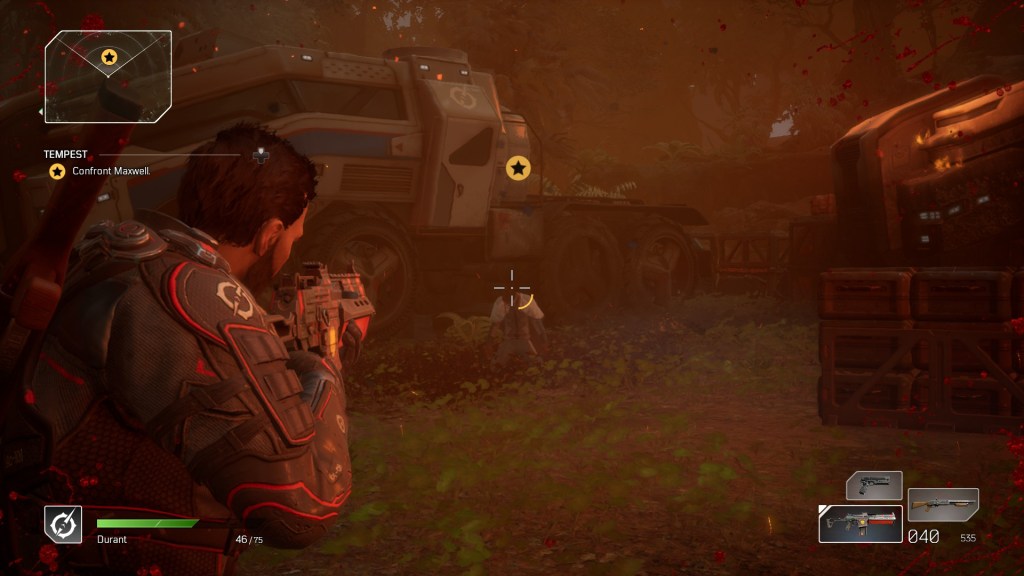
Gut Check: Outriders Demo

Recently a demo for the upcoming Square Enix game, Outriders, was released to the public in what I can only assume was to get people like myself to finally stop asking, “what the hell is Outriders?” Seriously, I had no idea what this game was or when it was announced or who was making it, but ads for started cropping up everywhere so I figured I’d just try the demo and seek out the answer for myself.

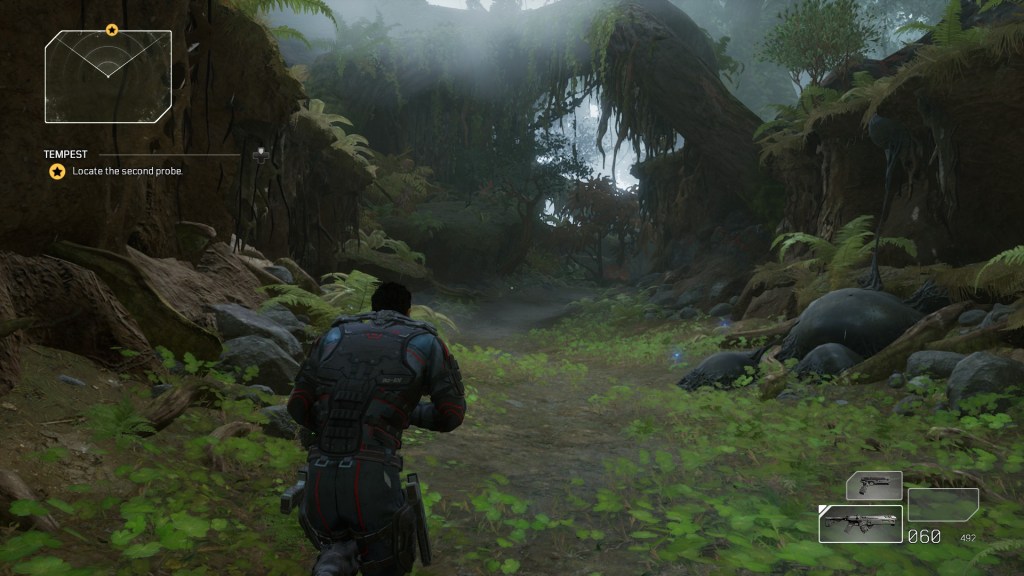
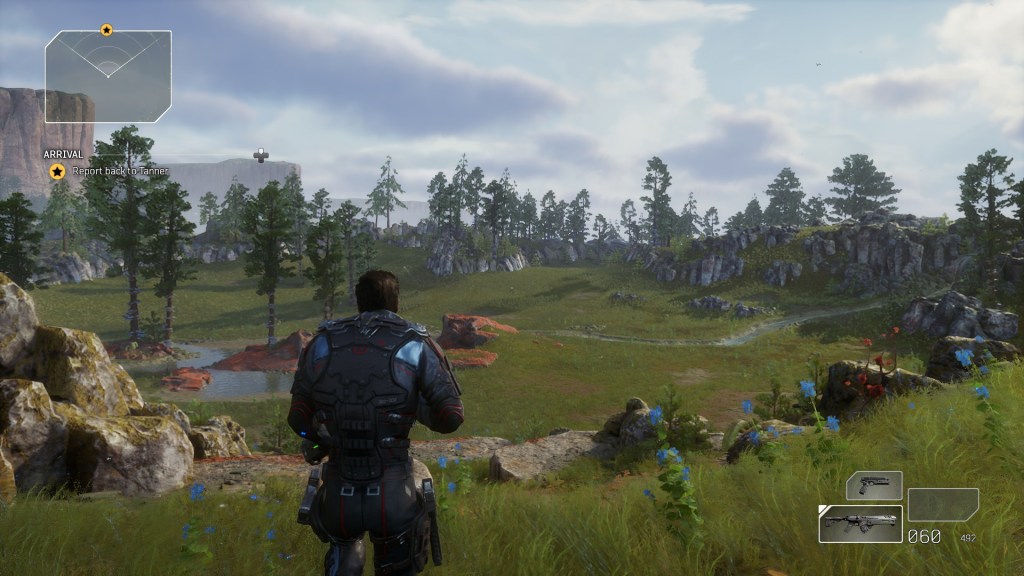
Outriders is a cooperative third person shooter with different classes, skill trees and a heavy focus on getting loot. The immediate comparison one could draw from that description would be to liken it to Destiny, but that would be unfair to Destiny. Sure they’re both loot focused shooters that have big skill trees within various classes, and yes, Outriders also uses that stupid cursor-based menu system that’s infuriating for anyone using a controller, but a lot of games share at least some of those elements these days. My understanding as someone who doesn’t play it is that people enjoy Destiny for a multitude of reasons, chief among them being that it feels really good to shoot stuff in that game. Outriders however, isn’t particularly fun to play. It isn’t bad, but mechanically it’s completely unremarkable.

The biggest issue with the Outriders demo is that its intro and tutorial sequence are so abysmal that it’s quite honestly amazing that I managed to get through it at all. The demo starts off with an incredibly generic and tired story that’s repelling in almost every way. Earth is dead so they launched a bunch of military types and scientists into space in order to colonize what they initially believe to be a vacant planet, but in a shocking twist, it isn’t.

You get down there and are forced to interact with the blandest and most uninteresting characters in existence, like no nonsense space cowboy guy who is a father figure to your character, or the science lady who is so smart she doesn’t get obvious (yet bad) jokes, and you’ve even got an evil British (I think?) guy who is at odds with the mission for some reason. And you have to talk to each of them for way too long in order to progress to the next bad story beat, with the game even having the guts to offer you additional dialogue options so you can get to know more about them, something I wholeheartedly suggest you do not engage with.

In my eyes, Outriders commits the cardinal sin of making you watch an extended cut-scene, then dumping you into a “gameplay” section where you walk to another point where another cut-scene will start, over and over again. It’s like 30 straight minutes of you walking from cut-scene to cut-scene and it’s absolutely miserable.

But then the game tries to be interesting by changing everything up on you.

Within that first 30 minutes of tutorial hell, the game basically plays out an entire bad video game story from start to finish. Spoliers for a demo, I guess? Basically the British guy is in charge of making sure colonists can land on the planet safely, something your character and their team are there to confirm. Some wild magic murder storm comes through and starts icing everyone on your team, something which space cowboy uses as a justifiable reason for these colonists to not land here. British guy says no and that it’s too late to halt the landing procedure, the two of them get into a shouting match which ends with space cowboy dad getting shot by the British guy. A firefight ensues in which you end up getting mortally wounded, something which science lady responds to by putting you back into the cryogenic sleep pod you initially emerged from to buy time for the medics to come and help you. That never happens, but you’re apparently cured anyway when you emerge from the pod 31 years later.
That’s right, Outriders does a big fucking time skip that honestly turned me around on the game a little bit. You’re then introduced to the world as it is now where the colonists landed and had to carve out a meager existence similar to what they had on Earth. Now it’s all this dystopian, post-apocalyptic looking world with different factions all vying for control of the little resources that are available. You get immediately captured by a bad group of nasty boys and are sentenced to death in “No Man’s Land.” Oh by the way, all this time, I’ve maybe played the game for about 5 of the 30 minutes of intro that led up to this point. This all ends with your character dying out in “No Man’s Land.” The lights start to fade and your character drops to their knees, desperately trying to grasp at another life-sustaining breath that will never come.

And then a menu pops up and asks you which class you want to choose.

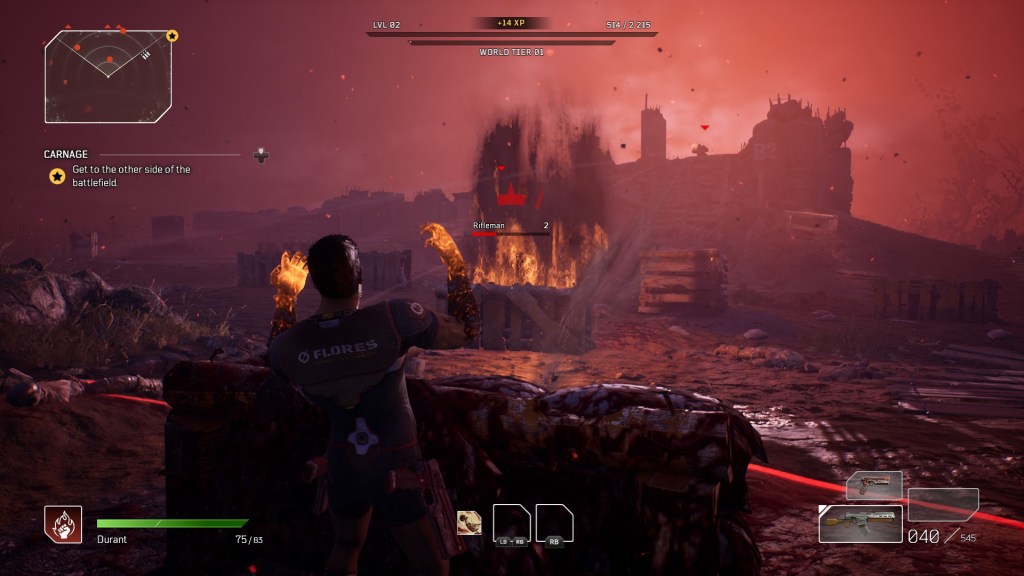
That’s right, nearly 40 minutes since starting this demo I finally got the option to pick a class. Classes seem fairly basic with you basically choosing between a sniper class, a balanced class, a shotgun class, and I guess some sort of glass cannon styled close up class that’s all about getting in and out quickly, all of which have magic powers associated with them. I went with the balanced class and the fire magic that came with it. That particular magic power allowed me to cast a wall of fire emanating from me in a line igniting enemies, with the added bonus of regaining some health for killing any enemy that was actively impacted by my magic.

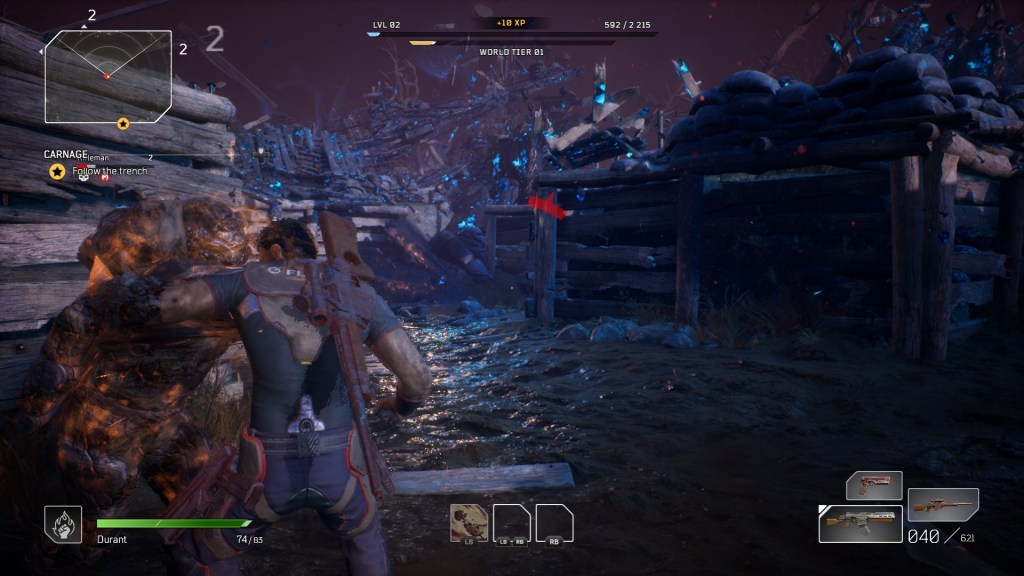
I played through a lengthy shooter sequence where I learned that the cover mechanics both aren’t necessary for success, nor do they work reliably at all. Sometimes I would be mashing the “get into cover” button only for me to just stand in front of a stack of boxes while getting lit up by gunfire like an idiot. That sequence ended with me arriving at what I’m assuming is the first hub area where I’m sure vendors and stuff will all be hanging out eventually, and that’s where I called it.

It took so damn long for anything remotely interesting to happen in Outriders that I’m certain this demo is ultimately going to do a disservice to what might be a decent game. Something I learned later on through reading and watching some coverage about Outriders, was that it isn’t a live service game like Destiny or The Division. Apparently Outriders has a full story that eventually ends, which considering I don’t really want a live service game in my life right now, actually sounds appealing. It’s also a cooperative game that ostensibly, if I enjoyed Outriders a little more, I might trick my friends into buying and suffering through it with me.

Just from the little bit of this demo that I’ve played, I really don’t think I enjoy what Outriders is doing. I might put some more time into the demo just to see what the game is like after the bloated tutorial nightmare, but I don’t know if that’ll actually happen. All I can say for certain is that if you are going to play the demo, you can skip cut-scenes and dialogue pretty easily which will save you a lot of grief.

Blog: Lemon Days – 02/24/21

Sometimes you can just buy and thing, rip it out of the box, plug it in and just go without any problems, whereas other times you might buy a thing, turn it on once, later learning that it would be the last time it would ever turn on again. That plug and play appeal has been a big selling point for a lot of products like gaming consoles and at one point, Apple devices just to name a few. But no product is immune to defects, something we all have to learn at some point in our lives. For some of us, we learn this lesson every few months thanks to our superhuman-like powers of bad luck.

Let’s backup a bit though. A few weeks ago my partner and I agreed that I should have a workspace at their apartment so we could spend more time together, which also meant that I was going to be able to justify buying a new computer. I get the hobbyist appeal of building a computer from scratch, but I’ve done that song and dance before and I’ve had my fill of it, which is why I specifically decided to buy a pre-built computer to avoid all of that. Now how do you think that went?

Poorly, is the answer. My lovely little pre-built came with everything I needed including components that rivaled and surpassed my build at home and an obnoxious amount of LEDs on every inch of the case. Upon arrival, I set the thing up at my place, transferred some files and did some big downloads so I could hit the ground running at my partner’s place and not have to worry about configuring everything to my liking. It worked flawlessly and I loved it.

I moved it to my partner’s apartment without any issue, where I proceeded to set it up and give it a test boot to see if it was okay, which it was. Oh joyous day, now I had my workstation almost ready, only needing to buy a new chair to complete the ensemble. Well, yesterday I stopped in and planned to just hang out all day while acquainting myself with my new toy, except yesterday it decided that turning on was an unachievable goal. Yeah, for some reason the computer just decided to crap out on me.

All of the gaudy LEDs would turn on and the fans would spin, but nothing would actually work. The monitor, the keyboard, the mouse, they all knew they were connected, but didn’t function whatsoever. So after a lot of troubleshooting and a trip to the computer repair store, I discovered that the motherboard just up and croaked, which is apparently something that can just happen. So now I’ve got this cool lemon of a glowing monolith just taunting me.

Luckily I was under factory warranty and was able to request a replacement without issue, but the whole situation has just been deflating as all hell. Not only was I excited to play with my new toy, I was excited to be able to spend more time with my partner. Sure they’d be working all day, but I figure being around someone who is actually being productive would inspire me to do the same, but now that has to wait. I don’t know what will come of the replacement process, but I hope it all happens smoothly and quickly. If there is a silver lining, I guess it’s that now I have time to do some chair shopping.

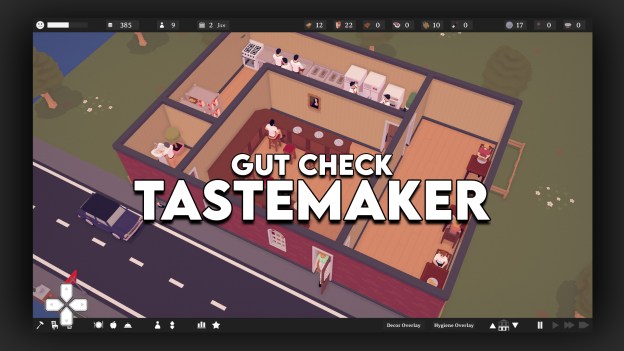
Gut Check: Tastemaker

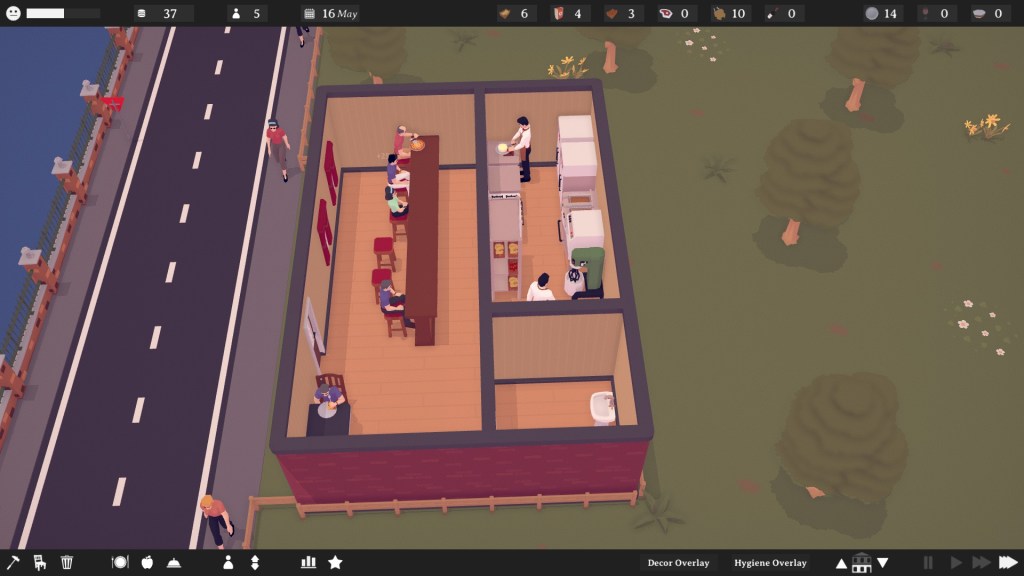
I recently spent some time playing a little restaurant management game that I found thanks to a post on Reddit by the creator themselves. Normally I don’t take game recommendations from the infinite void that is Reddit, but it was interesting and cheap enough for me to take the chance on this early access title. It’s called Tastemaker and it needs a lot of work, but there’s definitely something there that’s got me hopeful enough to keep an eye on its progress.

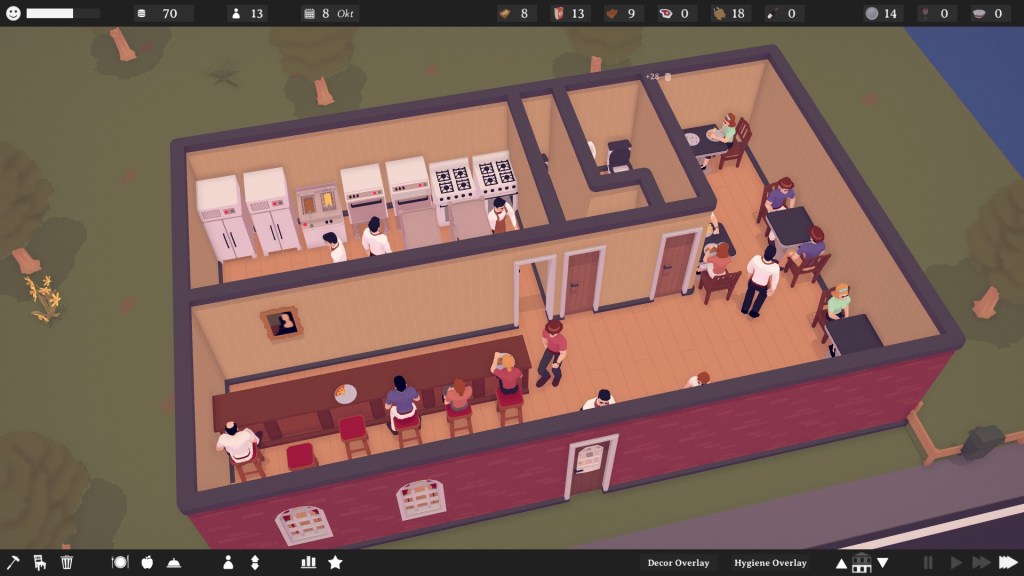
Tastemaker is this low-poly, very simplistic looking management simulation game that has you trying to build out your restaurant. The basic loop involves ordering ingredients and buying equipment that allows your employees to prepare different meals for customers. You have a couple of options for menu items that all have ingredient or equipment prerequisites that need to be fulfilled before you can actually serve more interesting meals. People come in, your employees serve them autonomously, and with your profits you continue to expand your restaurant, both in terms of menu offerings and actual geography. There is a clicker-like quality to Tastemaker that I really enjoy, specifically when you strike the perfect balance of customers, ingredients, prices and employees, ultimately letting you just kick back and relax while some cash rolls in. Unsurprisingly, you’ll need a lot of cash in order to address the concerns of your customers and staff while growing your little restaurant.

A big part of Tastemaker revolves around outgrowing your current capacity. Employees might complain about their heavy workload or customers might complain about slow service, both of which are issues that hiring another employee can easily fix. There might not be enough plates, ingredients or seats in the restaurant, all of which are easily fixed by spending more money just like in real life. At the moment, Tastemaker is very much a game about making the biggest and most efficient restaurant you can rather than being able to make niche restaurants that have certain specialties, meaning that every restaurant you make will eventually serve the same things because there’s no reason not to fill out your menu with all of the options available.

There were a ton of minor grievances that kept popping up throughout my play time with Tastemaker, but none of them were able to completely dissuade me from wanting to play more. Little things like not having a camera option that removes the walls or not being able to designate employees to certain jobs, to even the monotonous sound of cars passing by outside of your restaurant are just a couple of examples of these minor issues, but Tastemaker has some serious issues that need to be resolved before a complete release that I’m sure are going to be worked on as more people play during this early access period.

One thing that really bugged me was the inability to actually close my restaurant, which really became an issue whenever I wanted to redesign the whole store. You might think that isn’t that big of a deal, but every so often you’ll decide to expand your building to offer more seating or build some bathrooms or even just to expand the kitchen, but you have to do it one piece at a time because you have to wait until a chair is uninhabited before you can move it. Closing the store would make it so much easier for me to redesign my restaurant, instead of having to do it one piece at a time between customers.

There also isn’t an easy way to expand your store even when you do get the opportunity to do so. You have to destroy walls and move furniture piece by piece, which becomes extremely tedious considering how often you’ll be doing it. But even when you do build out your restaurant, there really isn’t too much you can do with the place. Now, I want to preface once again that this is an early access title, but there isn’t a ton of decorative flair for you to play with to customize your restaurant. I’m sure that will be expanded on as development progresses though.

Yet for as much bellyaching as I’ve done, there’s still something about Tastemaker that I’m still very much onboard with. It’s simplistic, maybe to a fault, but it has a lot of potential. I really do enjoy how it isn’t overly complex, opting for something way more approachable, but I’m sure that more systems will be layered on in due time. I really would like to see some more variance from Tastemaker, specifically I’d like to be able to make a burger joint where customers don’t complain about how we don’t serve pizza, or make a steakhouse where people don’t whine about the lack of chicken nuggets, but time will tell if I’ll ever have that ability. Tastemaker is a neat little experience that isn’t doing anything special at the moment, but I feel like it has the potential to be something great, and I look forward to tracking its progress.

Blog: A Mini Mario – 02/17/21

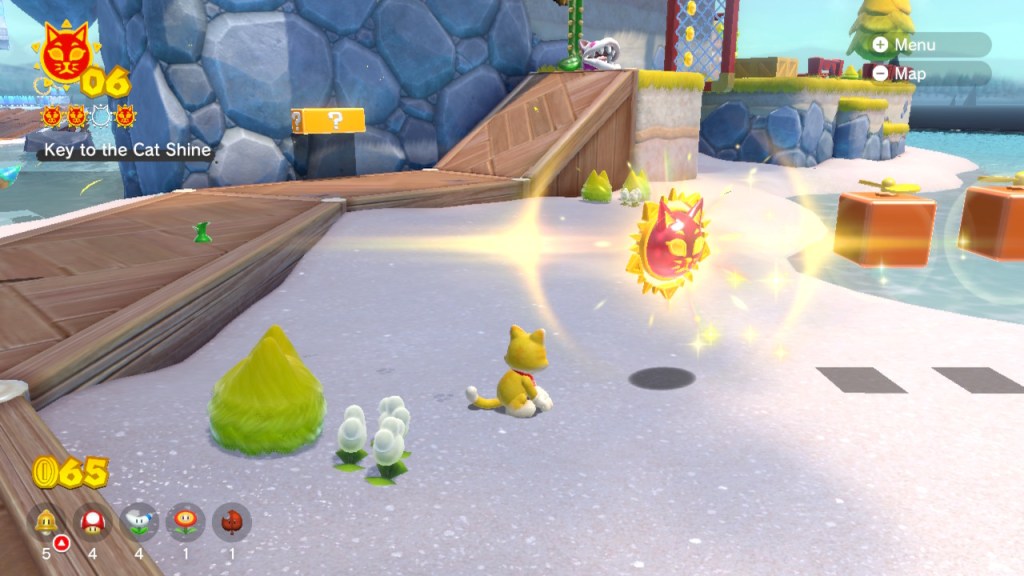
Last week the incredible yet nearly forgotten Super Mario 3D World, formerly a Wii U exclusive, was re-released on the Nintendo Switch. That game alone is very good and you should certainly check it out if you’re one of the many people who missed it when it was initially released back in 2013. That’s all well and good, but what I really want to talk about is the bundled game that comes alongside this new port of Super Mario 3D World, a little game called Bowser’s Fury.

For context, Super Mario 3D World + Bowser’s Fury (a bad title for a great package) is a full-priced game that contains the entirety of Super Mario 3D World, alongside an open-world 3D Mario game called Bowser’s Fury. While I’m sure I’ll end up writing a review or something for Bowser’s Fury later on, for today I want to highlight how cool of an idea this game is and why Nintendo won’t fully capitalize on it. Nintendo will certainly make a fully open-world 3D Mario game, that’s not in contention here. But Bowser’s Fury is a bite-sized example of what that might look like, and honestly, I’m way more into the idea of a smaller and more focused Mario experience than having to wait 5-7 years for a new Mario game.
Bowser’s Fury is only about 5-10 hours long depending on how thorough you want to get, which is honestly the perfect amount of game for me at the moment. But like I said, Nintendo won’t ever capitalize on this idea in a way that doesn’t come off as them “devaluing their IP.” Ideally, I would love to see a game in the vein of Bowser’s Fury release for like $20-$30 or something. Just like a nice aperitif of that Mario flavor we all enjoy so much, coming out once every two years or something to that effect.

It’s a shame too, because these little experiences could serve as table-setting for whatever big 3D Mario game is coming out. Imagine for a moment that Super Mario Odyssey 2 is coming out, that’s a good feeling isn’t it? Now in the run up to that game, people are gonna be asking the same questions about if any of the supporting Mario cast will make an appearance in the game. People could finally get the Waluigi game they some desperately have been asking for, but that won’t happen because he’s a terrible character. But you could give us a Luigi game that explains why he won’t be in this hypothetical sequel while also giving the player a soft introduction to the mechanics and flow of Super Mario Odyssey 2.

Bowser’s Fury proves that you can make a compelling and engaging platformer without releasing a full blown 3D Mario game, but I don’t think Nintendo will ever make good on that concept. Maybe you’ll see more of these kinds of experiences bundled into bigger products and re-releases, but I sincerely doubt we’ll ever see small standalone titles that are priced accordingly. But I guess at the end of the day it really doesn’t matter for Nintendo, because people are gonna buy a Mario game no matter the scope or price. But man, it would sure be cool if we got that Waluigi side story game where you watch him get hurled into a black hole.

Valentine’s Play

Even though our 2020 Game of the Year coverage is dead and buried with the rest of 2020, there’s still one list that I felt needed to be published in regards to the games I played last year. See, my partner and I started dating towards the end of 2019 and like most people, were put into a really challenging position when it came to maintaining our relationship while we were both quarantined. Luckily we both had Nintendo Switches and were able to have “date nights” where we’d just play games and talk for hours, something we still do only now in person thanks to them moving closer to my place. So in celebration of Valentine’s Day, here are some of the games we played and continue to play together that they have specifically called out as their most memorable games that we’ve played together in no particular order.

Trine 1&2

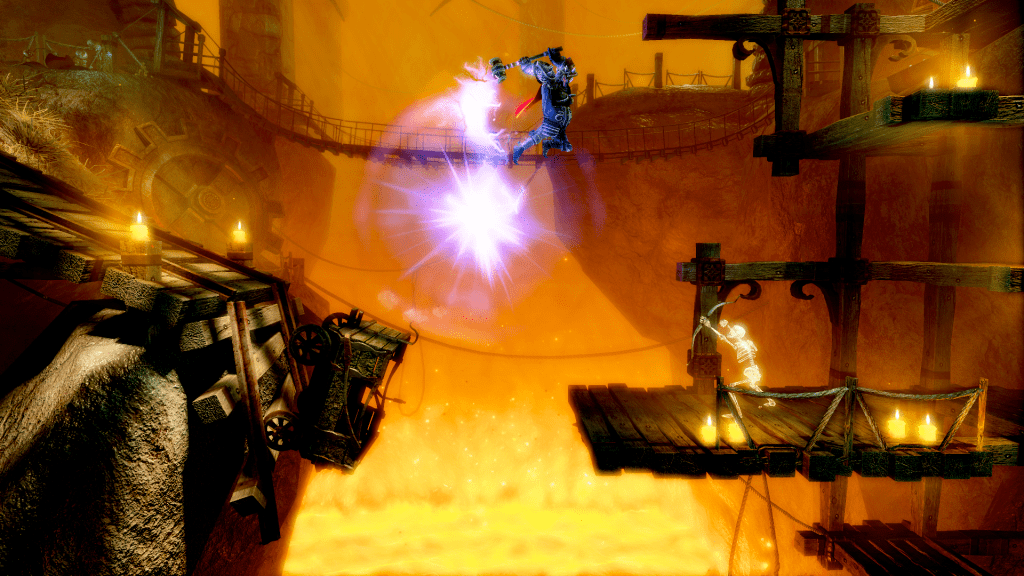
I don’t recall exactly when it happened, but at some point there was a really good deal on all 4 of the Trine games that were bundled into one package that we took advantage of. Both Trine 1 and 2 were big hits around these parts as we’d both been craving some sort of cooperative game with some light progression elements (my words, not theirs). I’d dabbled in the Trine games before, but never really dove into one like we did last year.

The amount of laughter and joy that would come out of our Trine gaming sessions is something that I’ll always treasure. Despite the game being overtly cooperative, my partner found a way to make it competitive by having to be the first one across any gaps or even just the first one to collect the various pickups and collectibles scattered around the levels. It was a really fun pair of games that we were quite simply hooked on for a few months last year.

While we both had a chaotically good time with the wacky physics-based mayhem and puzzle solving of the first two games, we only made it a few levels into the third entry of the series before we hit a wall. Trine 3 ditches the solely side-scrolling nature of the first two games in the series in favor of this 2.5D kind of approach where characters have to travel along the Z-axis to progress through the levels. While I was used to games that either dabbled in or lived completely in the third dimension, they weren’t as comfortable with it and bounced off of the game pretty quickly. It also didn’t help that Trine 3 is buggy as hell and that third dimension makes a lot of the mechanics they had come to know and understand be a lot more fiddly and unresponsive. But none of that can take away from the fact that the first two titles were great fun for the both of us.

Overcooked!

I have this terrible habit of accidentally introducing my partner to games that I kind of like, only to have them turn around and demand they be the only games we end up playing. Overcooked might just be the epitome of this unwelcome trend, but it’s something my partner truly enjoys to the point where it’s the only thing they want to play lately. I wasn’t exactly sure what specific things they enjoy about the game itself, so I just went ahead and asked them.

“I like that we have to work as a team for a common goal. And it is fast paced so we really have to focus on communicating (well) and figuring out a strategy to complete the objective.” While they enjoy the fast-paced, communication heavy gameplay loop that Overcooked is all about, I just find myself unable to work that fast while focusing on several different objectives at once. Luckily, their brain seems to be significantly more capable of keeping track of multiple concurrent objectives without entering a fugue state, which is basically what happens to me whenever we play.

But the point is that Overcooked is a game that’s been wildly popular among the two of us, and while it might not be my favorite game, they sure do enjoy the hell out of it. One thing we can both agree on however, is that the game itself is overwhelmingly charming, from the character designs to the music, Overcooked is a delightful game to experience with another person.

Dr. Mario

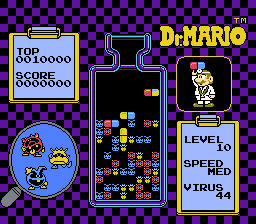
I did not anticipate launching the NES or SNES virtual console thing that’s on the Switch as often as I had last year, but we both did because that’s where Dr. Mario lives. The classic puzzle game not only boasts two of the best music tracks in video games ever, but it was fun enough to become a long time favorite for my partner and I. Now, I really liked Dr. Mario as a kid, but I don’t know that I’d consider it one of my absolute favorite games of all time. But my partner, well they were and still are pretty obsessed with the good doctor’s particular brand of hurling pills at their patients until a cure happens.

It was seriously the only game that we’d play for a while, offering a good distraction as we made conversation. However, there’s only so much Dr. Mario I can personally endure before the siren song of the “Fever” track becomes an unwelcome ear-worm that won’t leave no matter what I do. Like I said, I enjoy Dr. Mario, but my partner fucking loves it.

Heave Ho

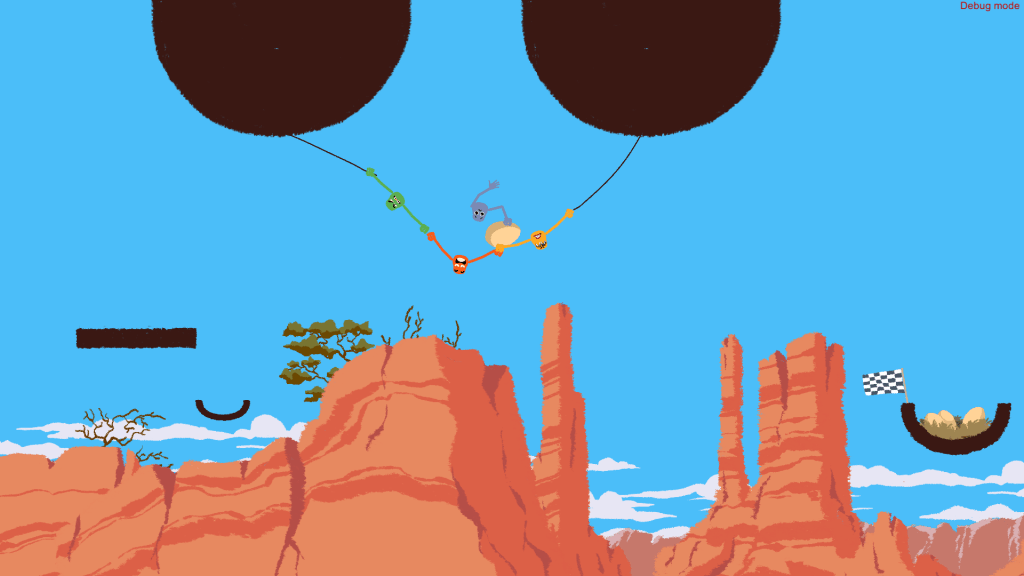
Heave Ho is the kind of game that is so absolutely hilarious to play that a person might have to sprint to the bathroom mid-game in order to avoid pissing their pants. That to me is the surest sign of a game being great fun. Both my partner and I absolutely loved Heave Ho so much that even now we still boot it up and bash our heads against some of the super challenging levels that you unlock after beating the game. There’s just something so delightfully stupid about what you’re doing at any given moment in the game, whether it’s locking arms with one another and trying to swing across the level or just plummeting to our death and watching the blood splatter fly up and coat the other person.

If you haven’t played Heave Ho with at least one other person, you’re truly missing out. It’s easily been one of our favorite games to play together and is probably my favorite game on this entire list.

Nidhogg II

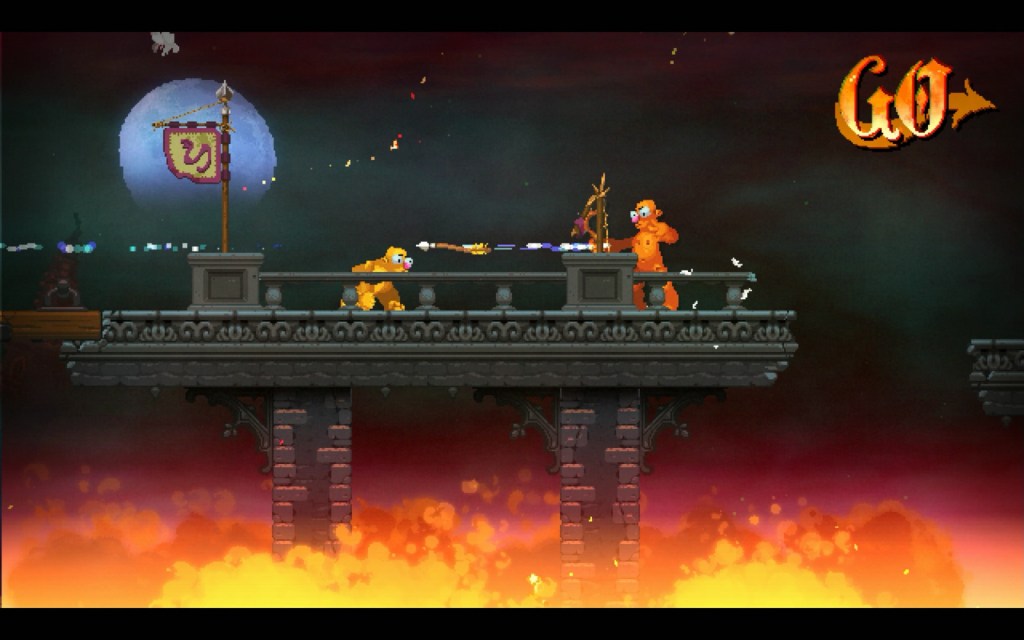
Nidhogg II is a lot like Overcooked for me in the sense that I like it well enough, but not nearly in the same way that my partner does. I don’t know what it is about Nidhogg II that they enjoy so much, but whatever it is has led to me playing way more Nidhogg II than I ever intended to. They’re crazy about this game in a way that I personally didn’t expect, although it’s pretty hilarious to both of us whenever I unsuccessfully try to outrun a sword that’s spiraling through the air in my direction. Or maybe it’s when I accidentally roll off the side of the stage like a goober. Or maybe it’s when I slam my head into a doorway. Or maybe it’s when I hit the jump button too many times and just bounce around waiting for something pointy to pierce my flesh.

When asked, my partner said, “I like how competitive it gets, and that it is just us against each other. One slip up an you can gain a lot of ground, so you have to be focused and make sure you keep pushing in your direction.” While I agree with that sentiment, I think my ever growing ambivalence towards competitive games keeps me from enjoying it as much as they do. But hey, it’s still a good time when we do end up playing Nidhogg II.

NES Pro Wrestling

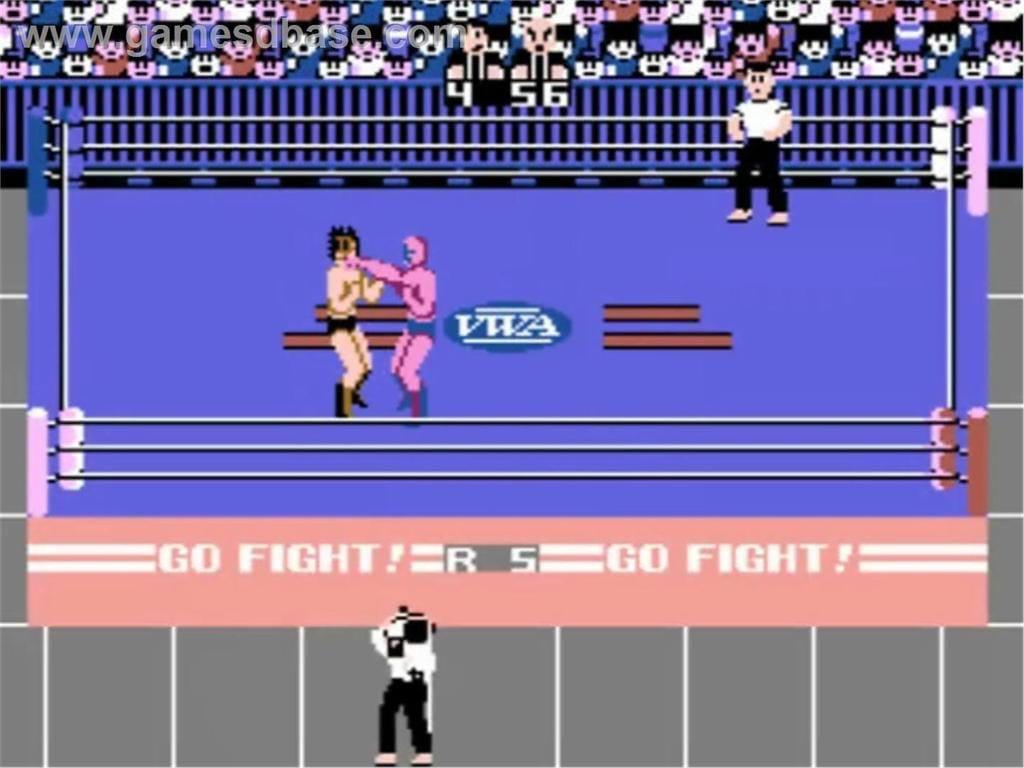
Image credit: u/mastablasta26 on reddit

Let me be clear when I say that neither of us have any sort of affinity for wrestling at all, but something about this game makes us lose our minds and breakdown into fits of laughter. I personally love the ridiculous characters like Star Man and King Corn Karn, but I’m pretty sure my partner is more into how their button-mashing ability out performs my haphazard attempts at learning the controls. I think I’ve only managed to land one spinning back kick on my partner, whereas they’ll transform their character into a whirling dervish of limbs that has a natural ability to connect with my face.

Whatever it might be, all I know is that against all odds we found great joy in a game that neither of us would have gone out of our way to try had we not been bored during our distanced quarantine. There’s also one on the SNES virtual console analog that’s also very good, but nothing beats the classics I suppose.


There were plenty of other games that we played together that I really enjoyed that I wanted to call out specifically. Things like Animal Crossing: New Horizons and Castle Crashers jump out to me as games that defined our time in quarantine. But this is just a slice of the games that we’ve tried together. I’m still trying to get them to try out Scott Pilgrim vs. The World: The Game with me, as it’s easily one of my favorite beat-em-ups of all time with a crazy good soundtrack to boot, but we’ll see how that goes.

But just today, February 12th, the Nintendo Switch port of one of the greatest Mario games of all time is being released. Of course I’m talking about the incredible and easily overlooked Super Mario 3D World + Bowser’s Fury, a title that just rolls off the tongue. That ranks incredibly high up on my list of Mario games and I can’t wait to share with my partner how delightfully chaotic that game can be in multiplayer. I predict many instances of getting hurled off of the side of a level that will be immediately followed by a barely stifled giggle on their end and a sigh of resignation on mine, a constant theme that exists throughout most of the games we play together.

And that’s kind of it really. Video games are a big part of our relationship, and I’m always on the lookout for new and interesting experiences for us to try out. I’m still trying to figure out what games will be a hit and which ones won’t, but I’ll get there. One day I’m going to get them into something more dense and complex, but I have no idea when or what that will be. Anyway, enjoy your Valentine’s Day if you’re celebrating it, and for the love of God, don’t go out to eat at a restaurant. Just stay home, hang out with your partner, and play some dang video games.
Blog: Blog? – 02/10/21

Look, I’ll be honest, there isn’t really a ton to talk about this week. I’ve been struggling with what the hell I would actually write for this blog, and I’m just kind of flying by the seat of my pants here. I’ve been playing some stuff here and there, including the excellent Hitman III and the less excellent but still good Super Mario 3D All-Stars collection. It’s just been a pretty uneventful week honestly. So yeah, no blog today. Thanks for checking in though. There will be an article going up on Friday that I’m really excited for. Oh, and Super Mario 3D World + Bowser’s Fury comes out on Friday as well, and that’s one of the best 3D Mario games out there, so that should be fun. Anyway, enjoy the rest of your day, and we’ll be back with an actual blog next week.
Review: Cyber Shadow

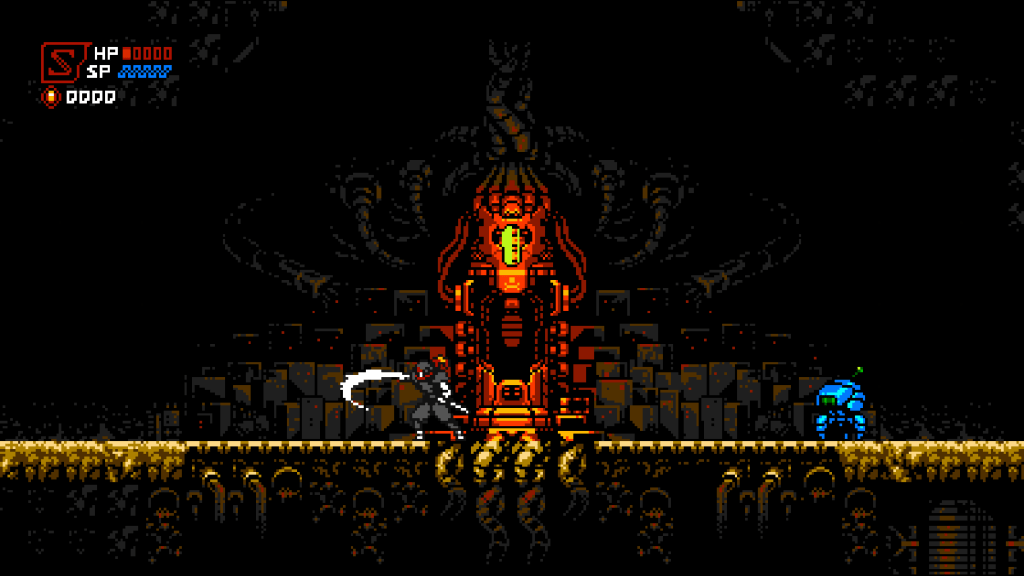
There’s a moment when playing an action game where you fall into a rhythm and everything just clicks, making your deft dodging and precision platforming feel less like conscious choices and more like you’re just acting off of pure instinct. When a game manages to get you into that zone, it can be the difference between enjoying said game and loving it. Cyber Shadow is a game that’s filled with these moments of pure 2D action and platforming bliss, but it’s also filled with a lot of bullshit that can rip you right out of that rhythm. Yet none of the lows of Cyber Shadow are enough to outweigh its highs.

Cyber Shadow is a very good video game that hearkens back to the “tough as nails” platformers of my youth like Ninja Gaiden and Mega Man, but it’s never nearly as punishing as those games solely because there isn’t really a way to lose. When you die, the worst thing that happens is your robot-ninja protagonist is sent back to a previous checkpoint which admittedly are spaced out pretty poorly, especially in later levels. It becomes pretty annoying when you have to trudge through these previously cleared sections just to attempt to decode what new enemy or level mechanic is going to kick your ass on the next screen. To be fair though, it is very satisfying when you finally do manage to make your way through these nightmarish gauntlets and onto the next checkpoint, I just wish that these sections weren’t as punishing as some of them are. But that’s certainly a “me” complaint, whereas I’m sure other people though Cyber Shadow was fairly easy and just breezed through every section that gave me trouble.
Yet despite these spikes in difficulty and the several times where I had to quit the game out of pure frustration, I always ended up coming back the next day to tackle a challenge with a clear head. Eventually I’d find myself in that fugue state where I wasn’t even thinking about my next moves because I was just leaping and slashing my way through the levels like some sort of murderous, sword-wielding gazelle. Those are the moments where Cyber Shadow stops feeling like a good game and truly feels like a great one, and there’s plenty more of these moments than the ones that make you want to uninstall it all together.

What I really enjoyed about Cyber Shadow is how it doles out abilities and new items as you progress. At the end of each level or so, a boss you defeat will drop some sort of new ability for you, whether it’s throwing shurikens or shooting fireballs into the air, each ability isn’t only viable for combat but also helps you traverse levels. For instance, you unlock a ground pound early on that allows you to smash through certain floors and boxes, but it also allows you to bounce on the heads of enemies and avoid falling into death-pits. All of these abilities can utilize your energy meter, which you can refill by breaking stuff in levels or just slicing up some robots. But even without energy, these abilities are still usable albeit without the extra damage boost or special effect.

One of the more interesting mechanics in Cyber Shadow however, is how they handle checkpoints. Aside from them being scarce and in some cases, poorly spaced apart, they have this interesting mechanic where you have to activate the unique properties of a checkpoint by buying it with in-game currency. This currency is also found by breaking shit in the environment and dispatching enemies, and is expressly for usage at the checkpoints. Every checkpoint has at least one of three purchasable upgrades that can either refill health, refill energy, or spawn an item. Most checkpoints have the health regeneration ability unlocked already, allowing you to just step onto the checkpoint and refill your health, but some will charge you for that feature. These purchases don’t carry from checkpoint to checkpoint, making you have to choose if it’s worth it to unlock that cool item at this checkpoint.

As someone who has beaten the game already though, I can say that you shouldn’t spend your money on refilling your energy because those things drop like crazy throughout the levels. Instead, you should buy the item at the checkpoint if you can afford it. The items are all pretty great with the exception of the first one which just makes your sword slashes a little bit longer, while the cooler ones are like auto-firing guns that hover around you, a shield that you can propel forward, and a saw blade on a chain that you can swing around and hit to gain more murderous momentum. I don’t think the items are randomized, meaning that if the game is giving the opportunity to buy the gun, it’s probably because it’ll make the next section a lot more manageable. My only real issue with the items is that you never really get to spend too much time with any of them, as early level items are nowhere to be found in later levels. I would love to use that dope saw blade again, but I never had the opportunity to buy it.

There’s also a story in Cyber Shadow that you can pay attention to if you want. I however didn’t find it that interesting or engaging, as it mostly served as a way to stop the action so I could see a cut-scene of some people being very dramatic and talking about robots. I think there’s a Dr. Wily figure that’s making all the robots do bad stuff, but once again, I kind of checked out of the story pretty early on. Your mileage may vary, but I didn’t play Cyber Shadow for it’s narrative and don’t feel like I missed out on much. However, if you find yourself uninterested by the story, Cyber Shadow has one hell of a good soundtrack that you should most certainly pay attention to.

The things I like about Cyber Shadow far outweigh the things I dislike about it, but I do feel like I should mention that there are a few levels that are real momentum killers. Whether it’s checkpoints making these levels more laborious than they actually are or the level itself is just filled with nonsense garbage that can only be tackled through trial and error, Cyber Shadow isn’t without flaws. Yet despite those rage inducing moments, I still made my through the entirety of Cyber Shadow because the action is that good. There are also some later levels that break from the structure of what you’ve been doing for most of the game that are really enjoyable. Cyber Shadow isn’t my favorite action-platformer by a long shot, but it’s still a very good one that’s deserving of your time if you find that there’s a robot-ninja sized hole in your heart.

Demos of the Steam Game Festival 2021

It’s times like these that I’m really grateful that my internet provider hasn’t saddled me with data caps, because I’ve downloaded a ton of demos from the ongoing Steam Game Festival that would certainly have resulted in some sort of additional charge on my bill. But the point is that as of February 3rd, 2021, you can open up Steam and download a bunch of demos for upcoming games. While I could never play all of them, nor would I ever want to be in a position where I had to, I did play some of the titles and have a few thoughts about what you should try and what you should avoid.


LUNARK

Lunark was the first demo I jumped into once all of my downloads from the festival completed, and while that might sound like some appraisal of its value, it was just the first one I clicked on. Looking back on it, I’m kind of glad I got it out of the way first because I really didn’t enjoy my time with this particular demo.

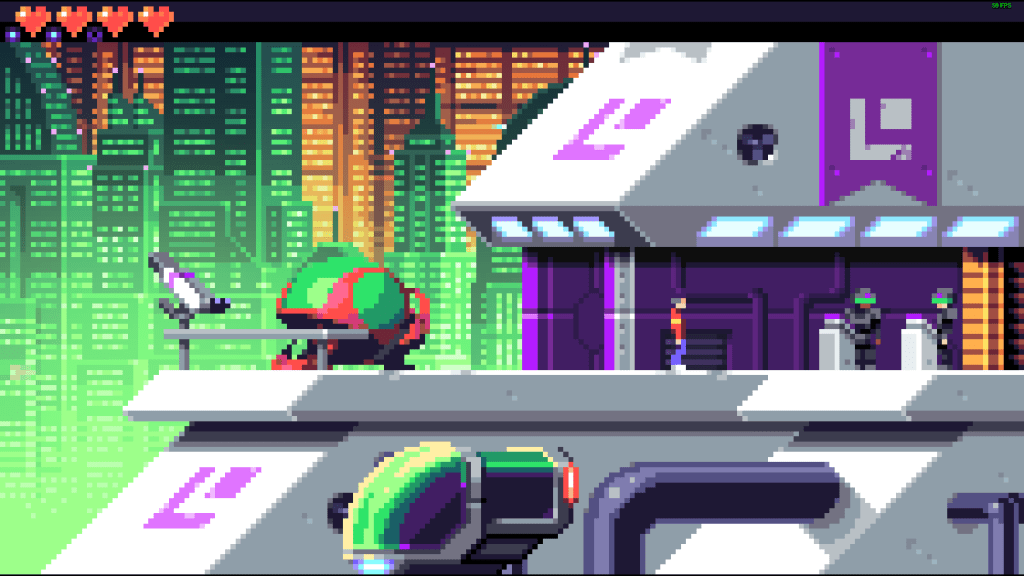
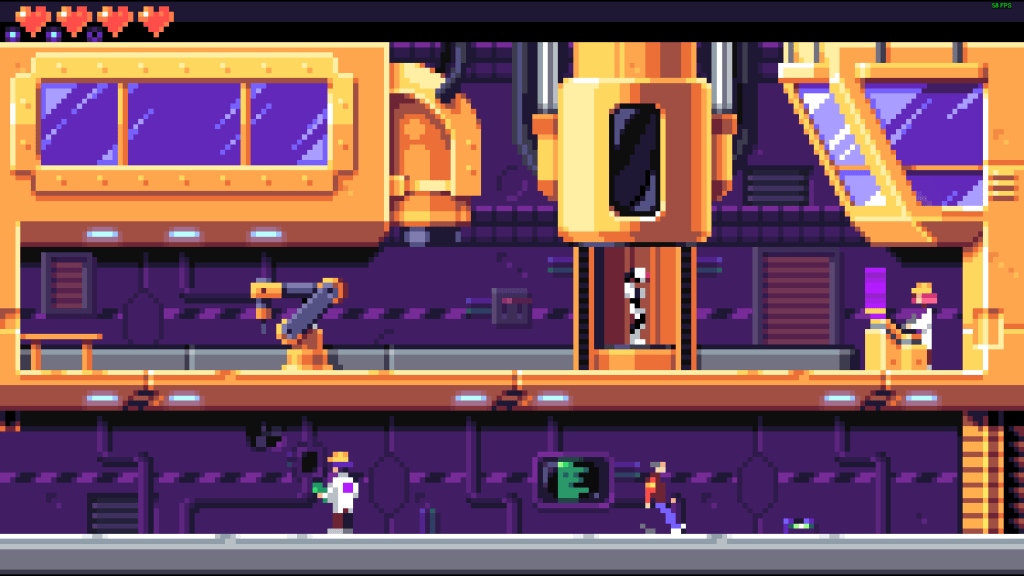
Lunark is a 2D side scrolling action and puzzle game that boasts a chunky-pixel aesthetic and plays kind of like the original Prince of Persia or Out of this World. If those references go over your head, it’s a very deliberate game that prioritizes the animation of what you’re doing over responsive controls and easy to use controls. Everything from running to climbing feels like there’s a giant lag between your button press and what happens on screen. It’s clear that Lunark is trying to illicit the same feelings of those other games, but it ends up feeling more convoluted and tedious than anything else.

Aside from mechanical issues, the game looks pretty cool with those big and beefy pixels even if it isn’t necessarily my aesthetic. The soundtrack also seemed pretty decent as well, but neither of those things seemed good enough to make me want to play the full version of this game. I don’t know about Lunark, but maybe it just isn’t for me.

CHICORY

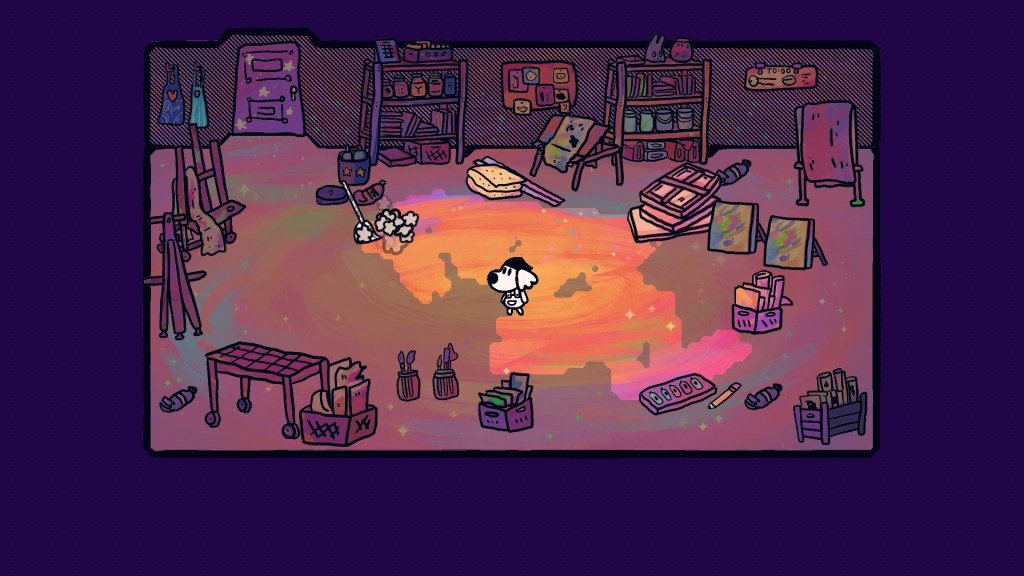
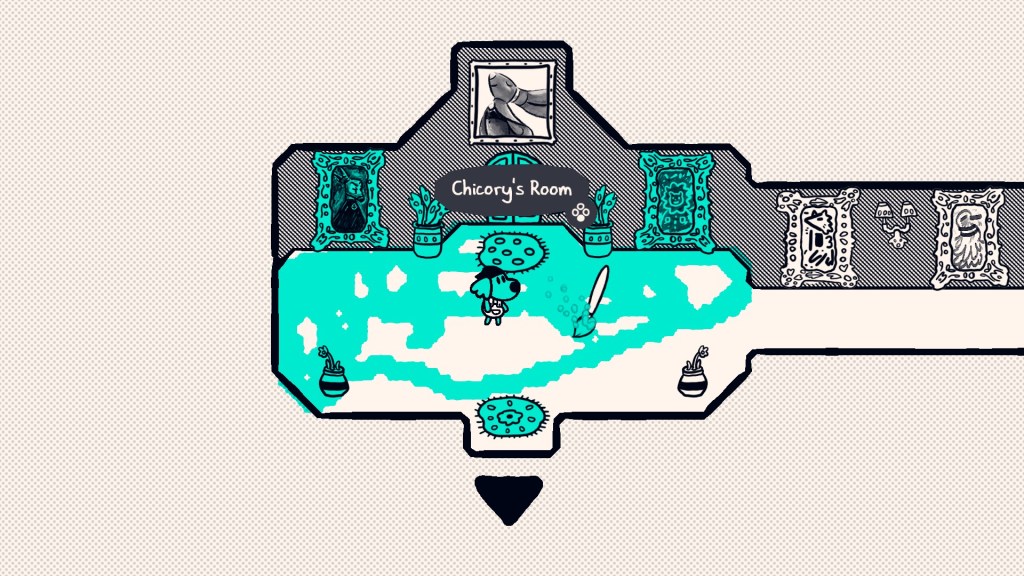
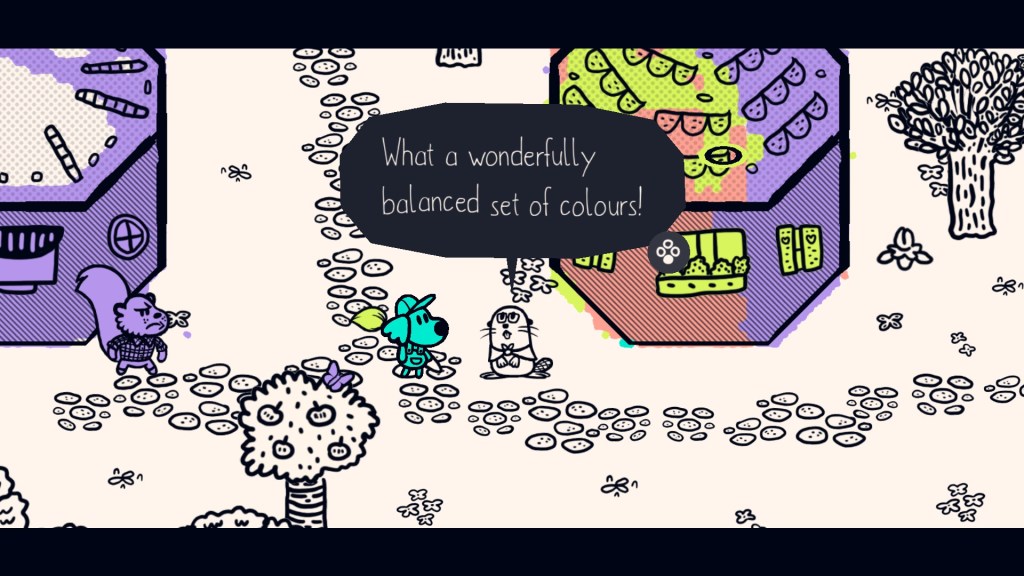
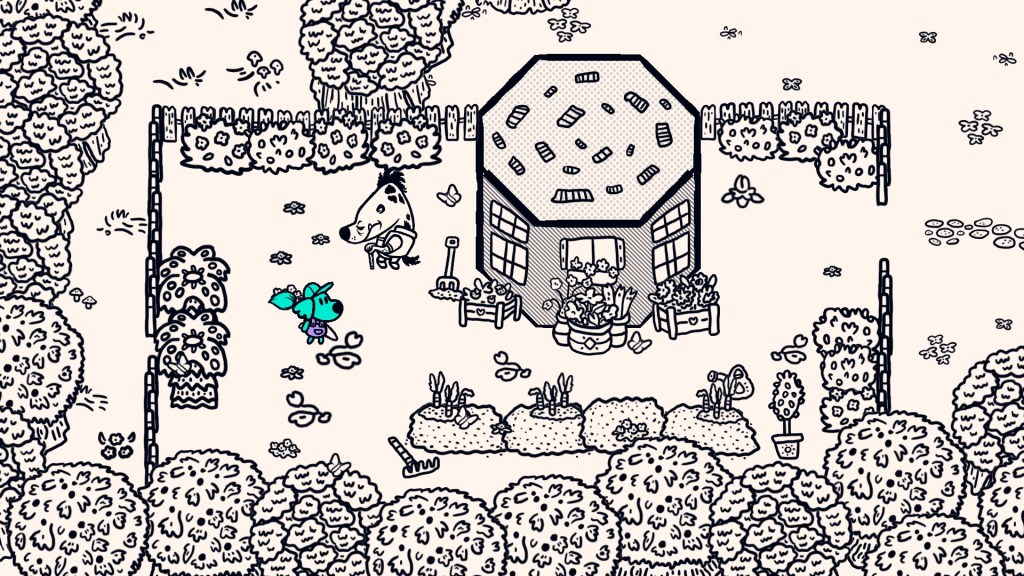
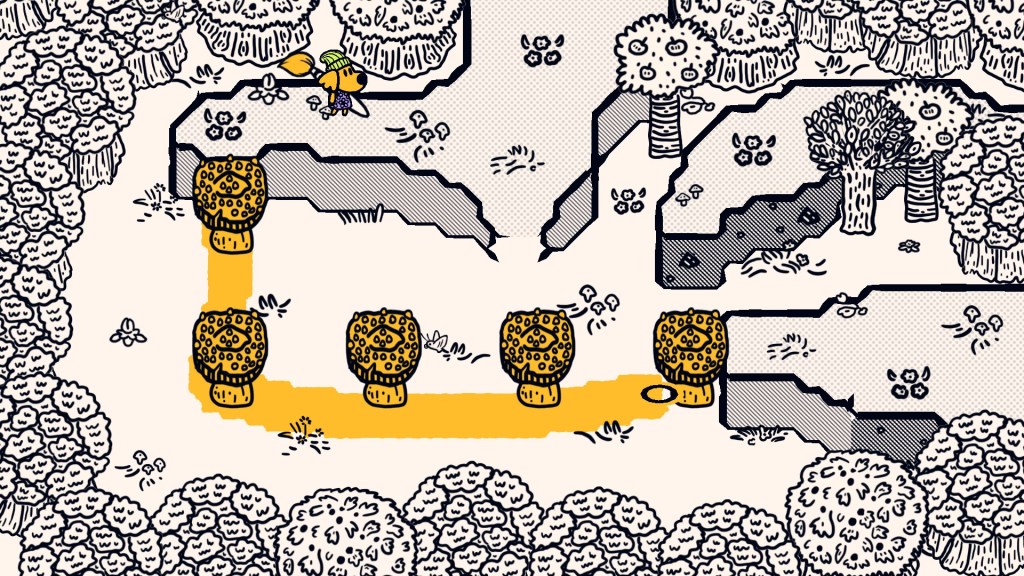
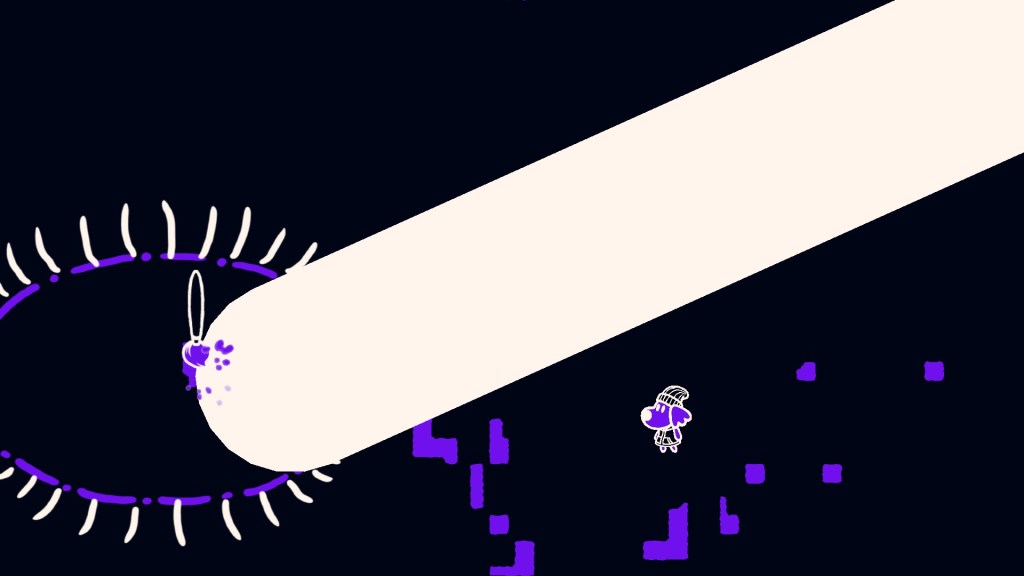
Now here’s a game that I could really see myself spending a lot of time with. Chicory is a delightful little game about being a cute little dog person who has the ability to paint in the world around them. There’s context as to why they’re able to perform these artistic feats of magic that tie into the central plot of the game that (obviously) wasn’t fully explored in the demo, but it left me eager to see where the story goes.

Your quest to find out what happened to all the color in the world isn’t just a fun story hook, but it has mechanical repercussions as well. Your magic painting powers will allow you to navigate the environment, solve puzzles, help random citizens and oddly enough, fight enemies. I’m really curious to see how the mechanics evolve over time as you progress through the story.

For as delightful and joyous as Chicory appears on the surface, the end of the demo really takes a turn that I didn’t expect and basically transforms it into something of a bullet-hell. The controls work without issue for most of the demo, requiring you to use the right stick to move your brush around and the right trigger to actually paint, but it gets a bit dicier when you have to manage your paintbrush and move around at the same time. I’m sure it’s one of those things you get better at as time goes on, but even with that slight hesitance, I really think Chicory could be something special.

RETRO MACHINA

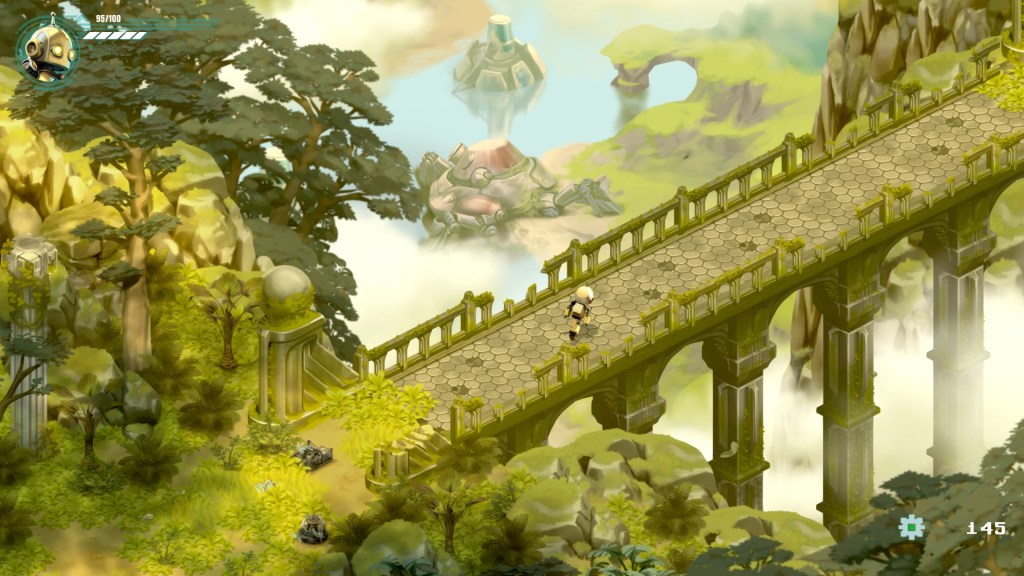
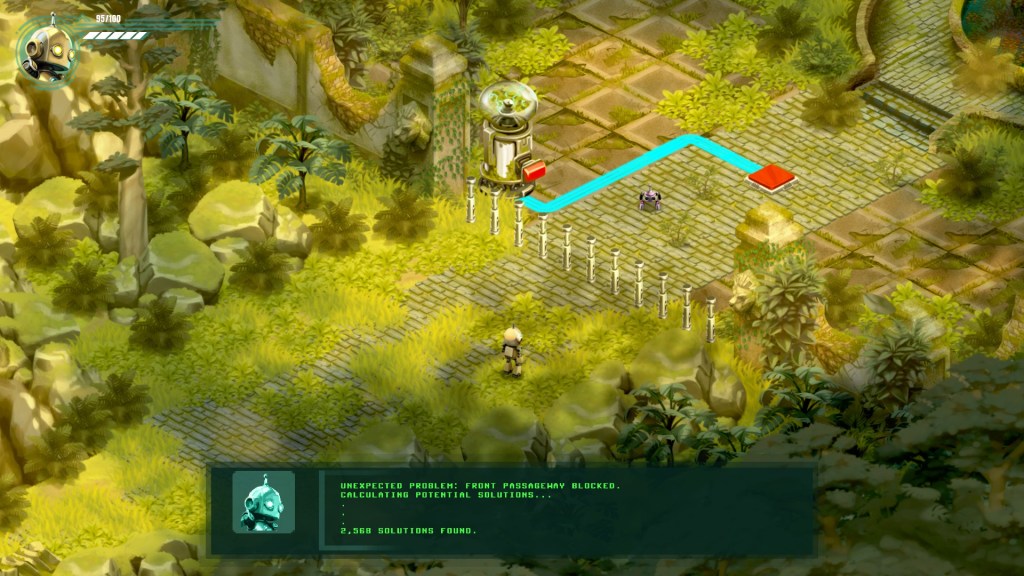
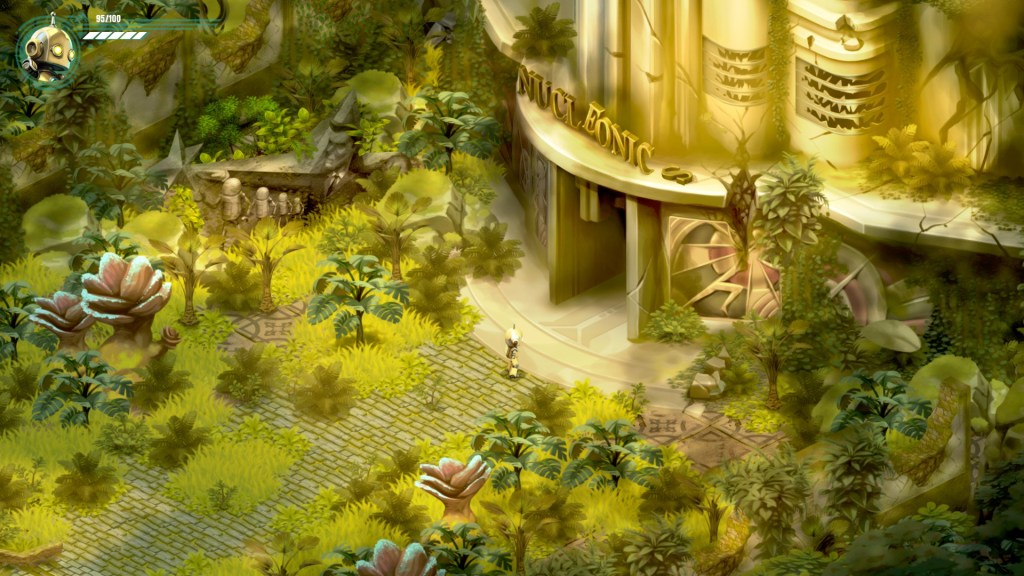
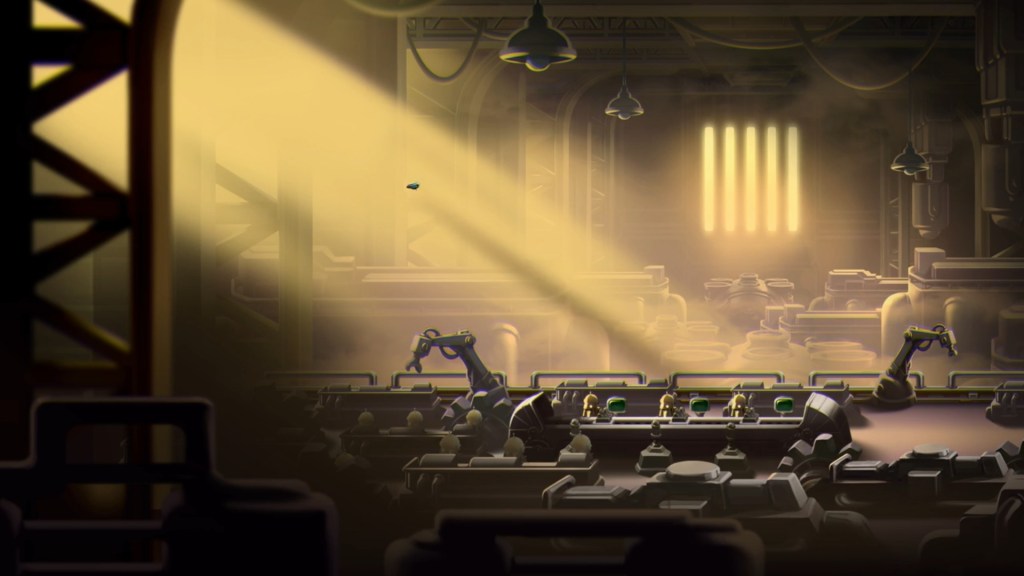
It feels mean to say that Retro Machina is squarely in the camp of “style over substance,” but I really felt that it was a game I’d rather look at than play myself. In Retro Machina, you play as a robot who was working at a nondescript factory alongside of their other identical robot buddies, who suddenly decides to not follow their orders because they saw a butterfly. I’m sure there’s more of a story there, but that’s all I gathered from the demo.

You escape the robot police and somehow get launched into the wilderness where you begin your search for a robot mechanic or upgrade station or something? Whatever the motivation, you end up in this different factory/office building where you have to solve puzzles and fight other robots to continue on. From a perspective that’s purely based on presentation, Retro Machina is great, but when you find yourself engaging in combat is where the experience kind of fell apart for me.

It isn’t that the combat is aggressively bad or anything, it just lacks any feeling of momentum or impact. The biggest thing that bugged me about the combat was the way that enemies can destroy you incredibly quickly, but not because they’re super powerful or anything, but because the game isn’t great about letting you know you’re taking damage. That led to a lot of moments where I’d exit a combat encounter with a fraction of the starting HP despite only having to fight like one robot. What I’m saying is that there isn’t great feedback for when you’re taking damage.

Aside from the combat issues however, the puzzle-solving aspect of Retro Machina seems promising. Despite needing or wanting an upgrade, your robot is extremely capable, boasting the ability to possess other robots to make them flip switches or navigate through otherwise inaccessible areas for you. There wasn’t a ton of innovative stuff I saw in the demo in regards to the puzzle mechanics, but it seems like that’s all primed to get insanely complex later in the full game. Overall the game seems neat, but I don’t think it’s something that I’d end up putting much of any time into.

SHERWOOD EXTREME

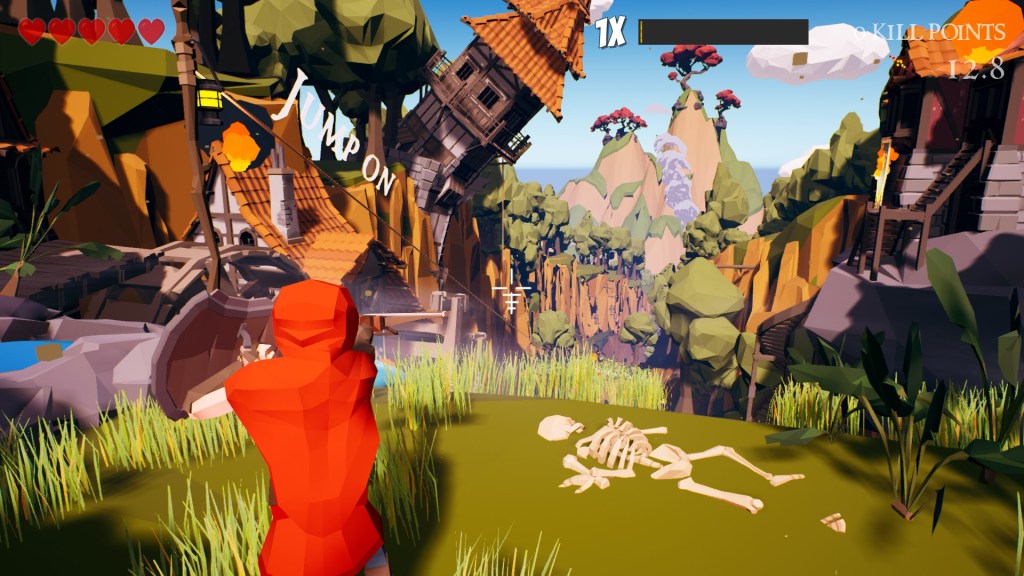
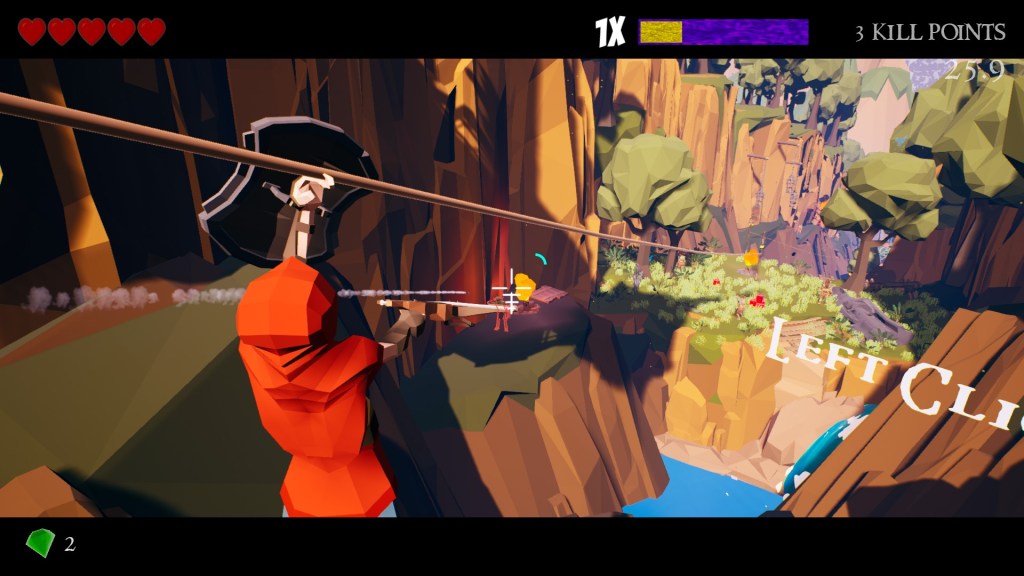
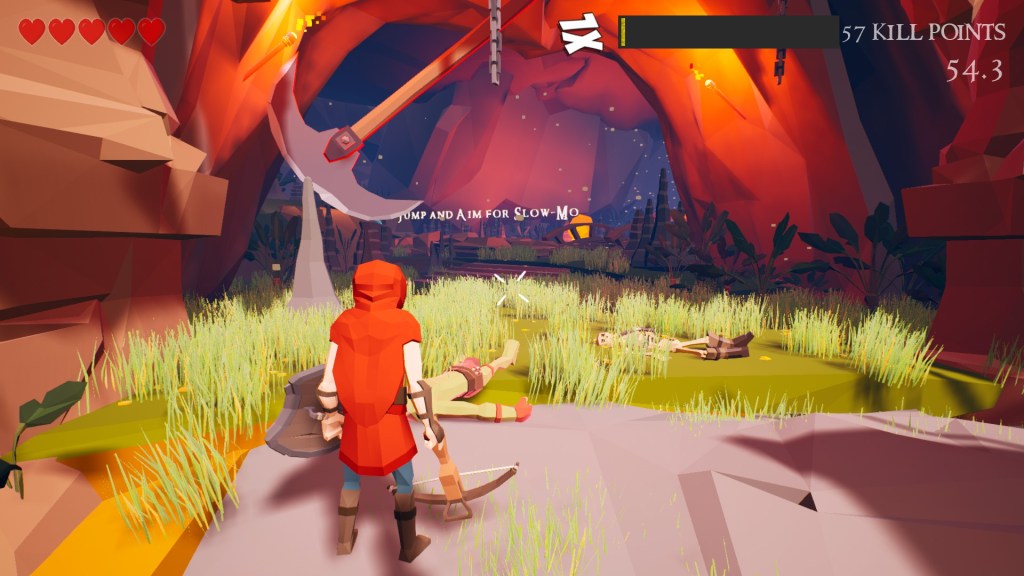
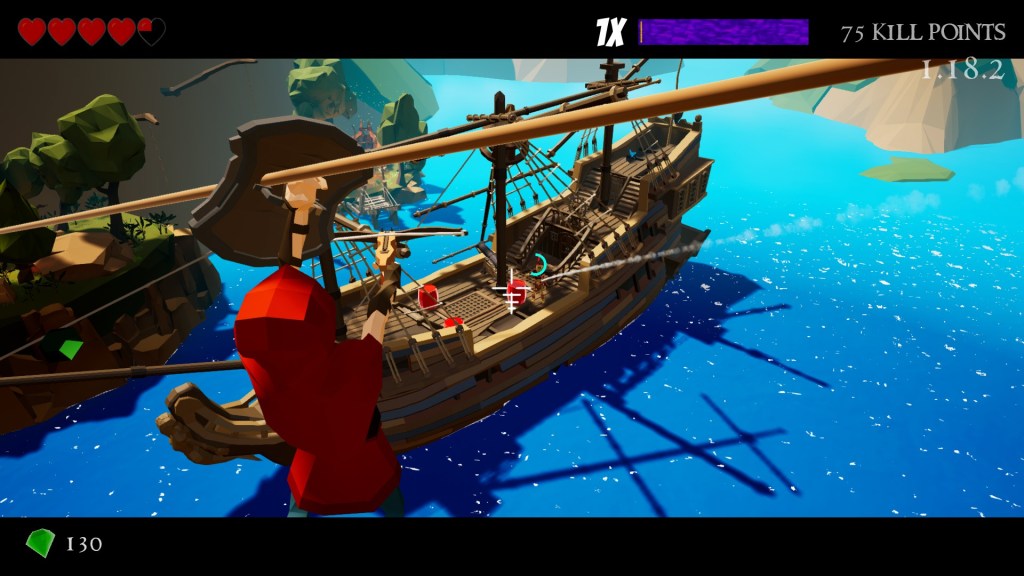
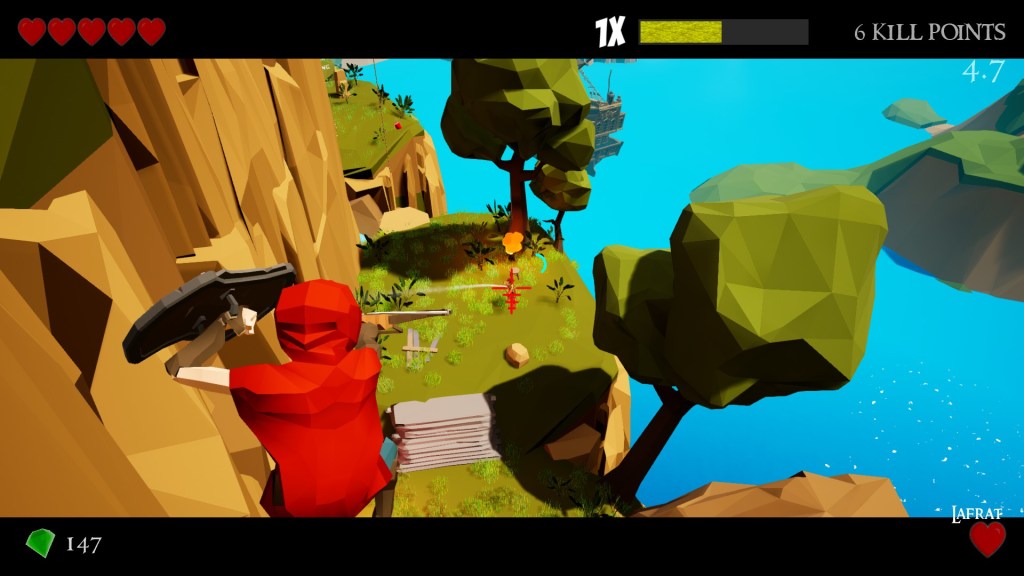
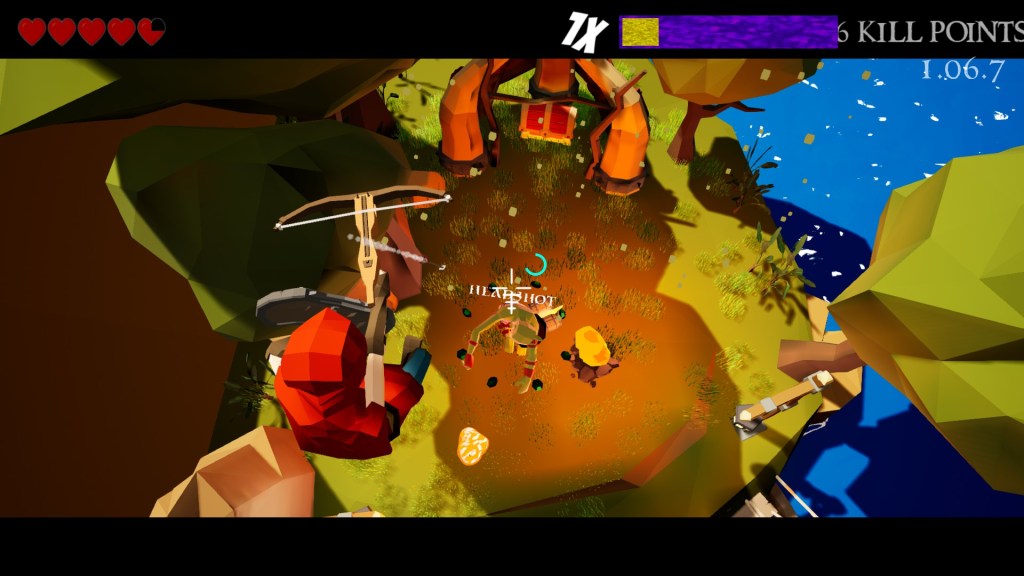
While it isn’t necessarily a bad thing, Sherwood Extreme sure seems like it’s trying to do the whole Bulletstorm thing in a low-polygon art style, replacing space marines with a Robin Hood-looking character who’s killing orcs. Sherwood Extreme is a level-based arcade-styled action game, where you’re trying to rack up the highest score you can by chaining together kills and acrobatics throughout a level in order to keep your combo meter up.

You run around with a crossbow and shield and shoot orcs while flipping in the air in slow motion like you’re in some medieval version of The Matrix. The shooting and score chasing aspect of Sherwood Extreme seem pretty solid, I just hope you unlock some more abilities or something because after only two or three levels, I was looking for some more variation. However, the game moves a lot slower than I initially thought it would because there isn’t a good feeling of momentum to running around or flipping, and it all just feels a bit janky. But hey, it’s a demo of an unreleased project.

Obviously I can’t speak to how Sherwood Extreme is as you get further into it, but there’s something there that’s worth paying attention to, I just wish it controlled and flowed a little bit better than it currently does. Hopefully that gets ironed out as the game develops, but even if it does, it’s one of those weird circumstances where I don’t dislike the game, but something just isn’t clicking with me. I wanted to enjoy Sherwood Extreme more than I actually did, but I don’t know if that’ll happen.

NARITA BOY

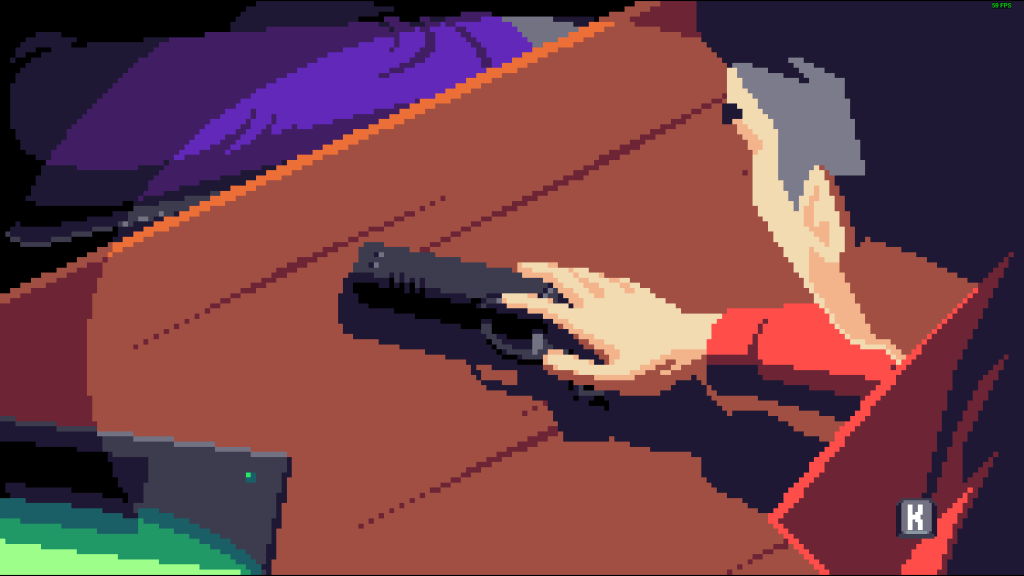
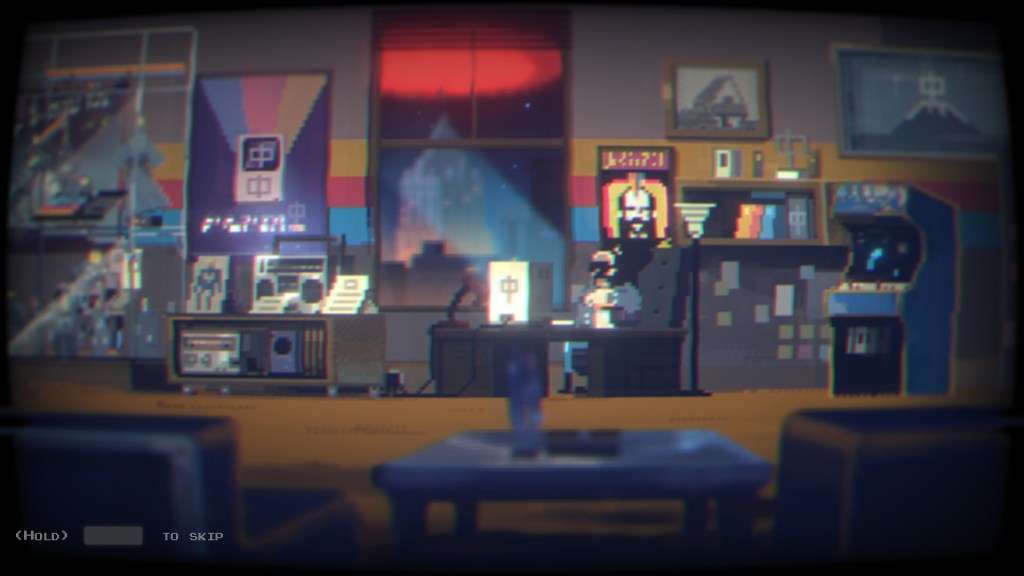
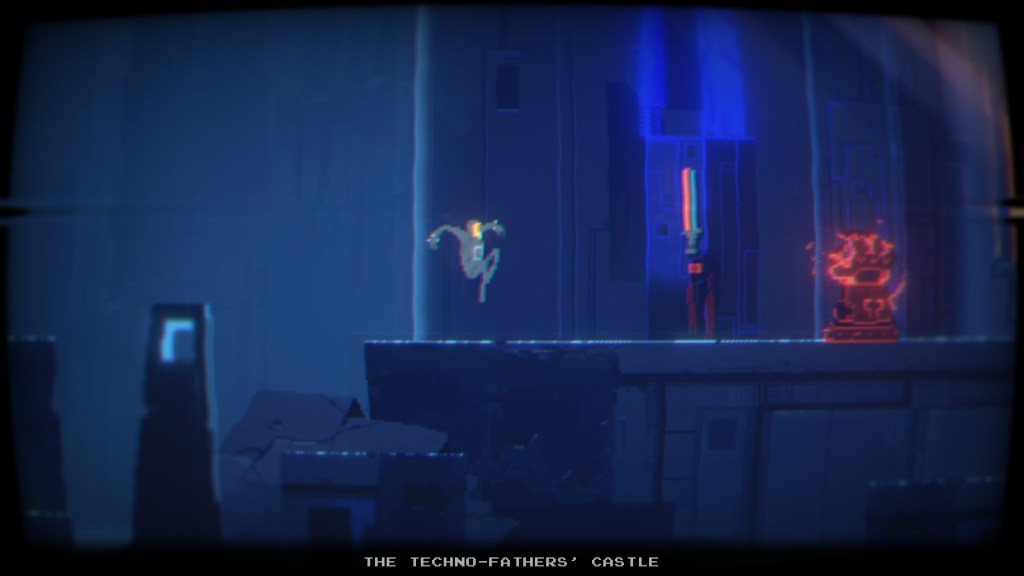
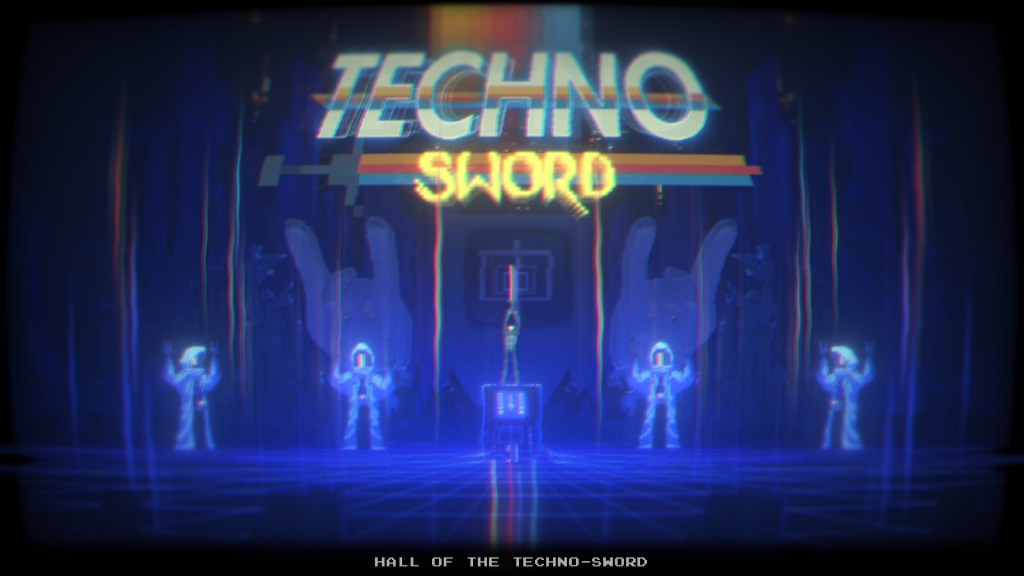
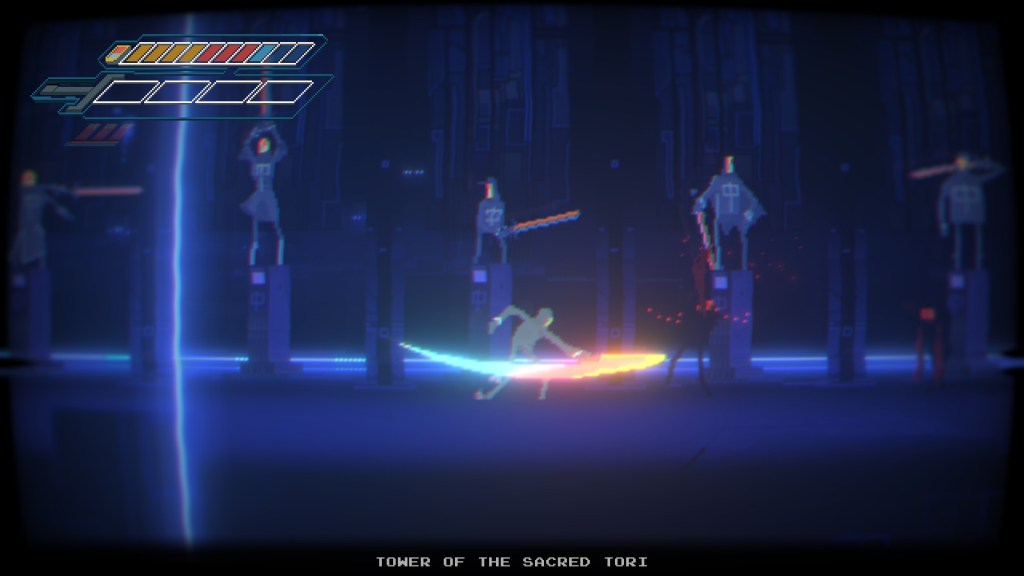
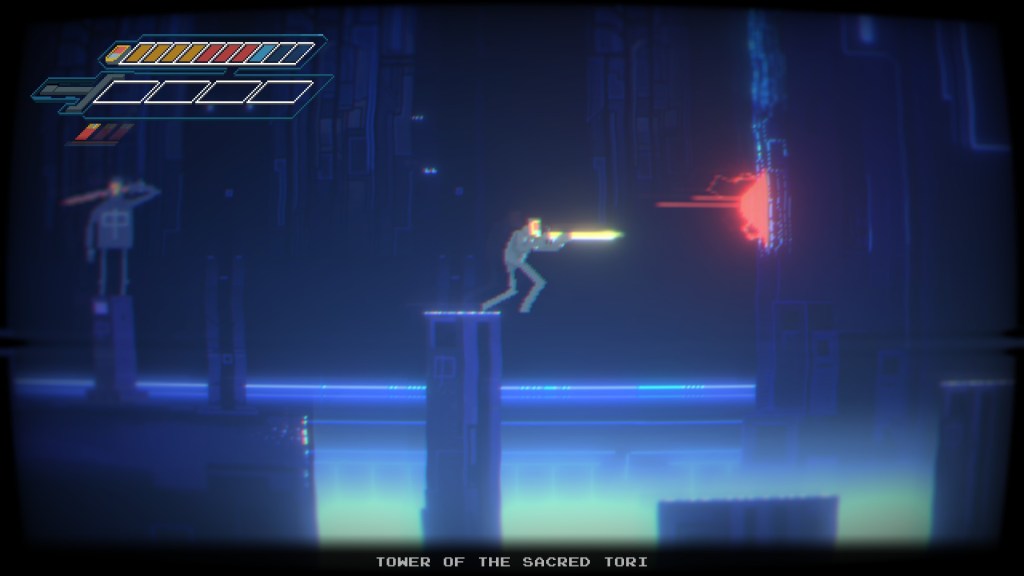
Speaking of games I wanted to like more than I actually did, let’s talk about Narita Boy. Stop me if you’ve heard this one before, but Narita Boy is a 2D pixelated action-platformer with Metroidvania elements. Right off the bat I will say that Narita Boy presents itself very well, both in terms of the art style and the soundtrack. And when you eventually do get to fight things, that feels pretty dang good too. You get this very cool sword that feels great to swing around and slash up monsters with, but you can also turn it around and use it as a shotgun which is objectively rad as hell.

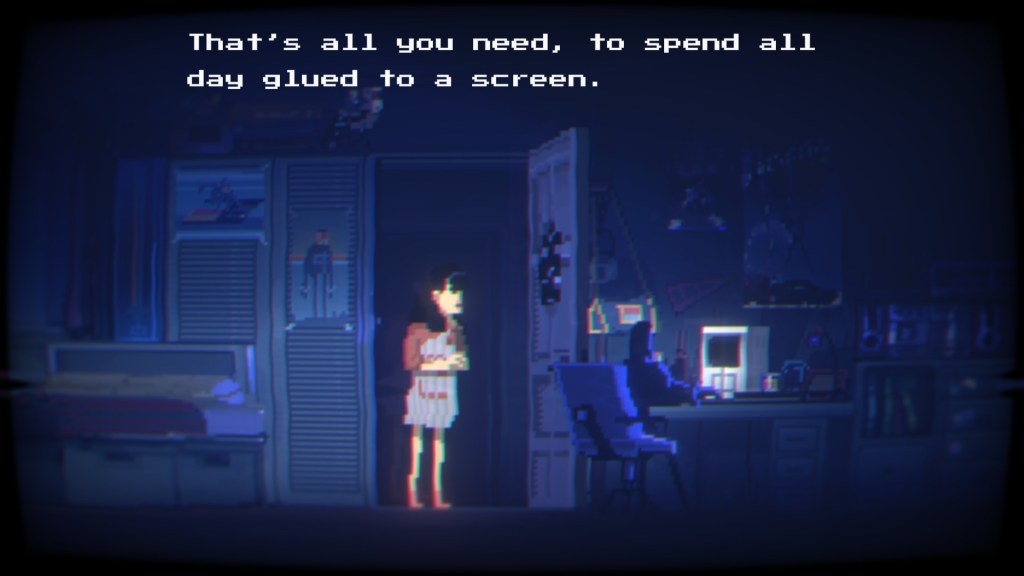
While I think Narita Boy looks cool and has some neat combat mechanics, I don’t think this demo does the full product any justice. Like a lot of these demos, it starts with a world-setting cut-scene, but then it dumps you into a portion of the game that would probably be way more tolerable if it wasn’t the first and longest thing you do in the demo. You have to suffer through endless dialogues about the world and your place in it before you actually get to do anything cool. Even when your task is to go find the cool sword you have to trudge through more dialogue and an obscene amount of screens where you literally walk in a direction until you can press a button to open a door, just to do that again in a different room.

I’m sure the story is interesting, but they front load so much of it in the form of people just talking at you in dialogue boxes that I began to lose interest almost immediately. And it isn’t like a few sentences, these are full on paragraphs that talk about how cool it’s gonna be when you get that sword but first they have to describe the sword’s power in excruciating detail. Needless to say, I buttoned through a lot of dialogue because I just wanted to play the damn game. I think Narita Boy is really cool, but if that demo is indicative of what playing the full product is like, I don’t know that I can handle the pace of it.

STEEL ASSAULT

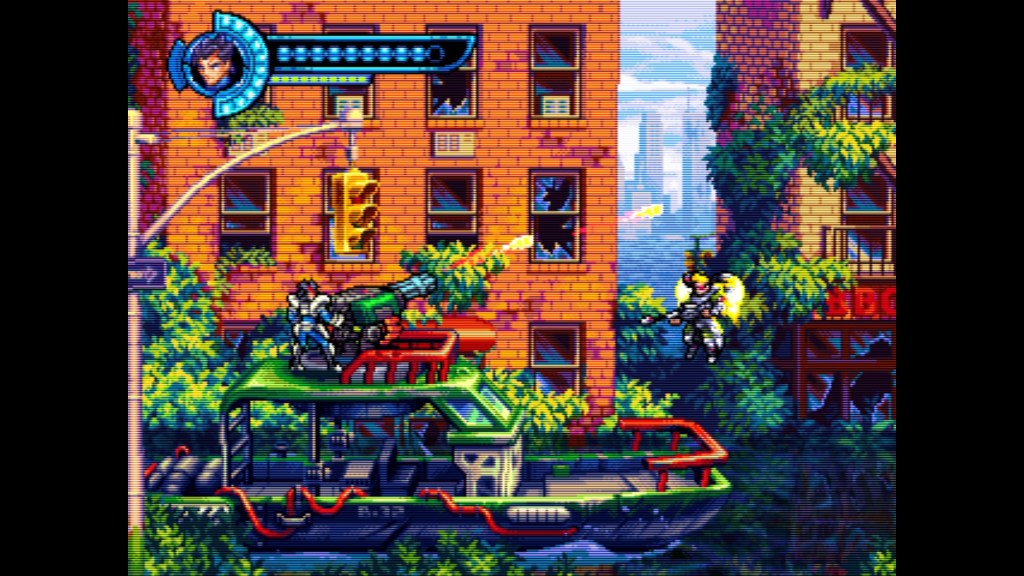
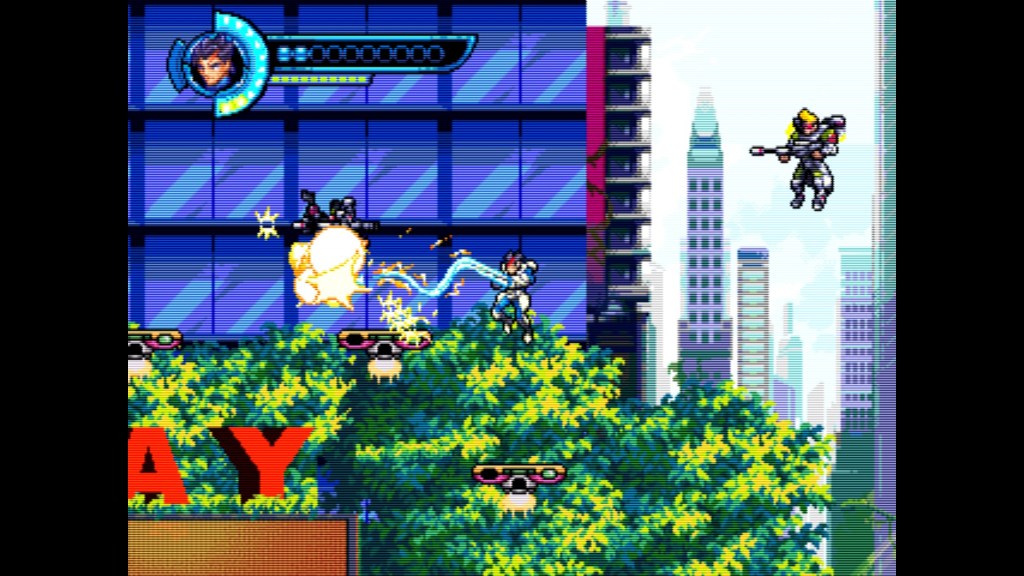
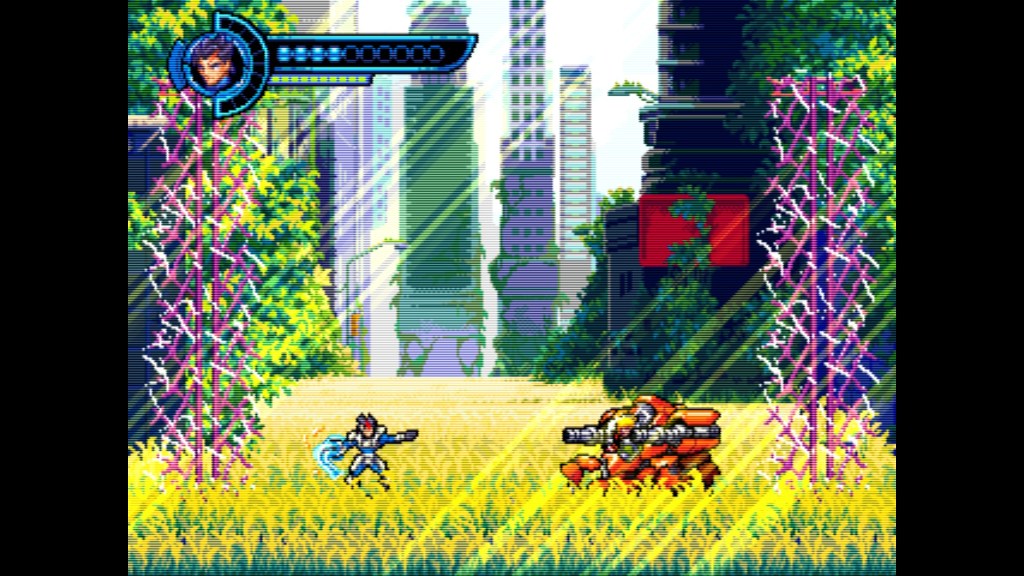
Yes, okay, Steel Assault is a pixelated 2D action game. I feel like I’ve written that so much today, but that’s not the point. Steel Assault reminds me of Bionic Commando, Contra and even the Metal Slug games a bit. It’s very much a “shoot everything” kind of game, but it has this interesting tether mechanic that I unfortunately was never able to wrap my head around, but was still very cool when I did manage to use it correctly.

The basic rundown is that you have a cool laser whip that you can kill bad guys with as well as the ability to fire a tether in two directions at once to make a zip-line or tight rope that you can use to traverse distant platforms. For instance, if I’m on a platform and fire the tether up, one end connects to my current platform and the other tethers to the one above me. From there I can climb up the rope and also whip guys while hanging from the rope which looks very cool.

Yet despite how cool it looks, I found Steel Assault to be difficult in kind of bullshit ways. First and foremost, the enemies constantly spawn, leaving you no respite whatsoever. Now I’m sure that’s not an issue a lot of folks out there, but when I was trying to get a handle on what was going on it became incredibly frustrating. But that alone wouldn’t sour me on a nostalgia-driven action game, however what did get me was the readability of everything that was going on. I rarely have this issue in games, but I had a really hard time clocking enemy projectiles. The first sequence of the demo is you fighting a flying robot while you’re on a boat that’s speeding through the canals of a city. That robot fires bullets at you that basically vanish into the colors of the boat as well as the background, which might be more of an issue with the heavy retro-styled filter they put over the screen. I died a lot because of that.

Steel Assault was the only demo that I wasn’t able to get through just because of how difficult of a time I had with it. I don’t think it’s a bad game, I just couldn’t get into a groove with it. You’re mileage may vary, but if you think you’re a bad enough dude to play Steel Assault, you should go for it.


And that’s really it for now. I have a couple of other demos I want to try out before the Steam Game Festival wraps up on the 9th, so maybe I’ll gin up a “part 2” before that happens. I haven’t even scratched the surface of what demos are currently available, so I recommend you check out the offerings for yourself because there’s definitely stuff that’s exceptional that I didn’t or probably won’t end up covering here.