Category Archives: archived articles

Demos of the Steam Game Festival 2021

It’s times like these that I’m really grateful that my internet provider hasn’t saddled me with data caps, because I’ve downloaded a ton of demos from the ongoing Steam Game Festival that would certainly have resulted in some sort of additional charge on my bill. But the point is that as of February 3rd, 2021, you can open up Steam and download a bunch of demos for upcoming games. While I could never play all of them, nor would I ever want to be in a position where I had to, I did play some of the titles and have a few thoughts about what you should try and what you should avoid.


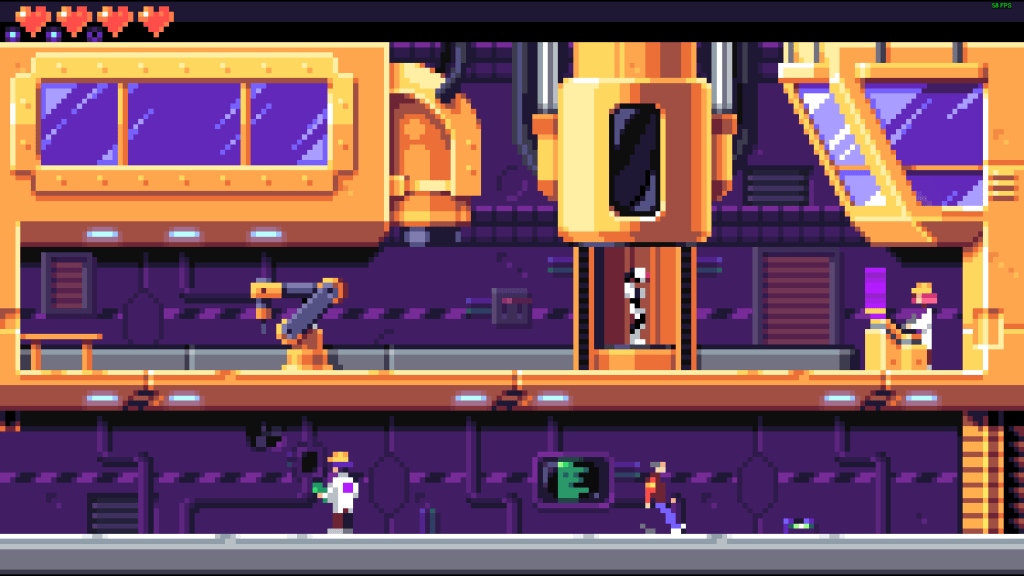
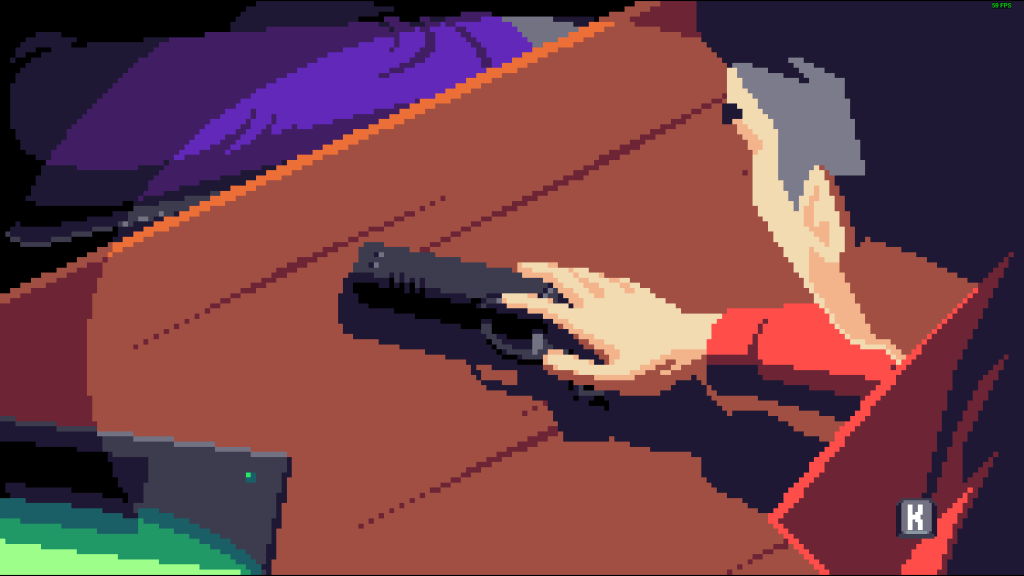
LUNARK
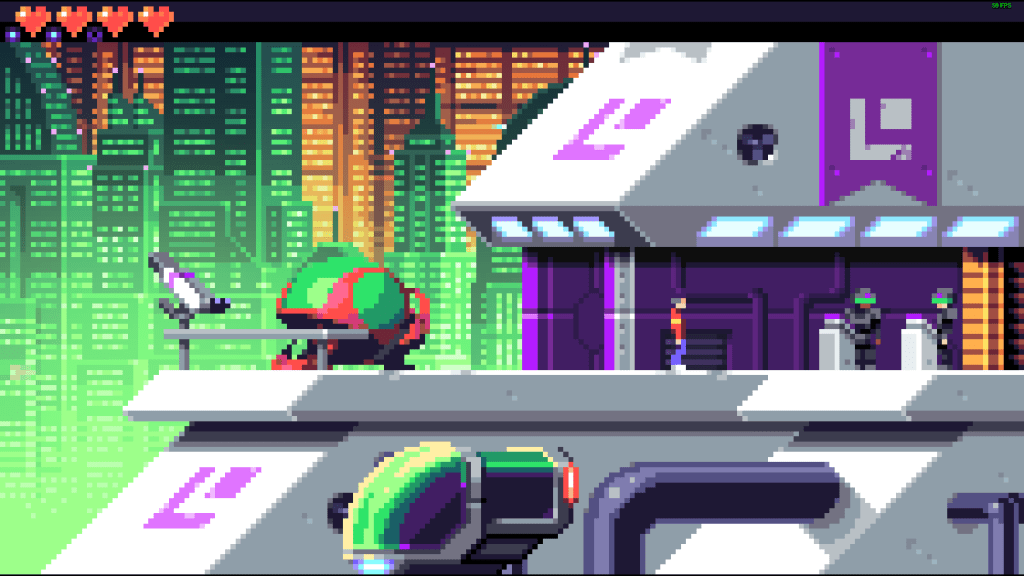
Lunark was the first demo I jumped into once all of my downloads from the festival completed, and while that might sound like some appraisal of its value, it was just the first one I clicked on. Looking back on it, I’m kind of glad I got it out of the way first because I really didn’t enjoy my time with this particular demo.

Lunark is a 2D side scrolling action and puzzle game that boasts a chunky-pixel aesthetic and plays kind of like the original Prince of Persia or Out of this World. If those references go over your head, it’s a very deliberate game that prioritizes the animation of what you’re doing over responsive controls and easy to use controls. Everything from running to climbing feels like there’s a giant lag between your button press and what happens on screen. It’s clear that Lunark is trying to illicit the same feelings of those other games, but it ends up feeling more convoluted and tedious than anything else.

Aside from mechanical issues, the game looks pretty cool with those big and beefy pixels even if it isn’t necessarily my aesthetic. The soundtrack also seemed pretty decent as well, but neither of those things seemed good enough to make me want to play the full version of this game. I don’t know about Lunark, but maybe it just isn’t for me.

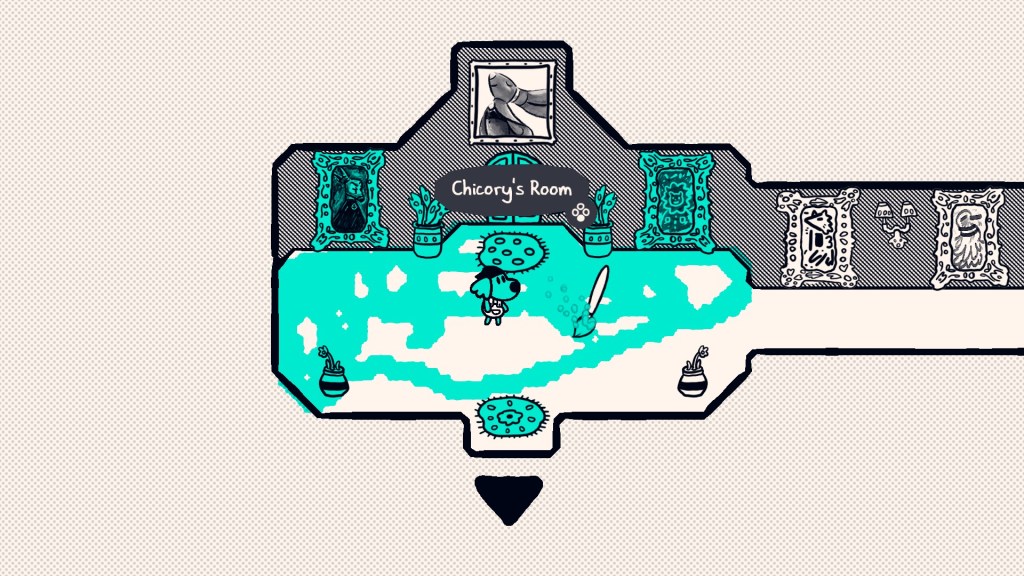
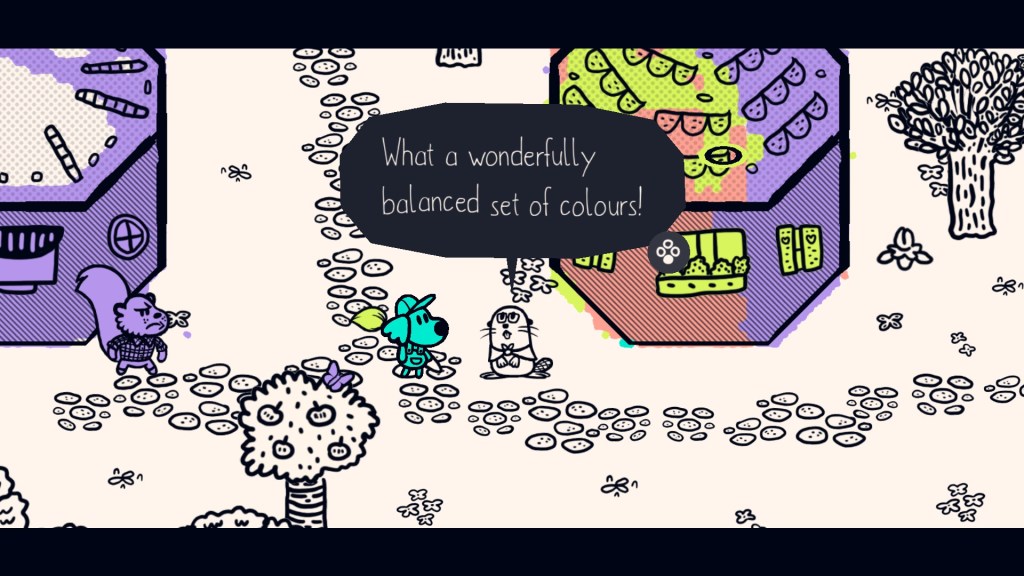
CHICORY
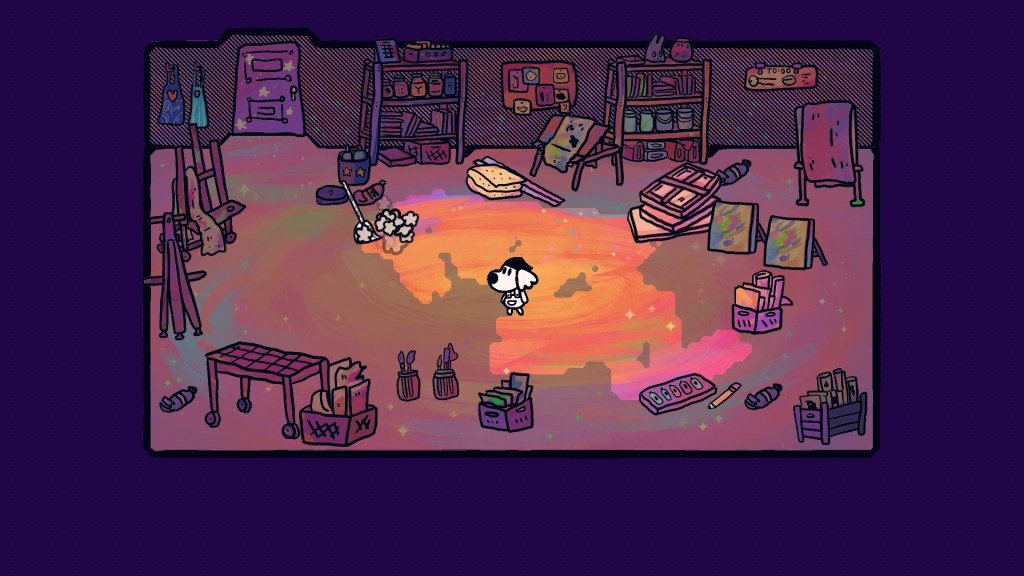
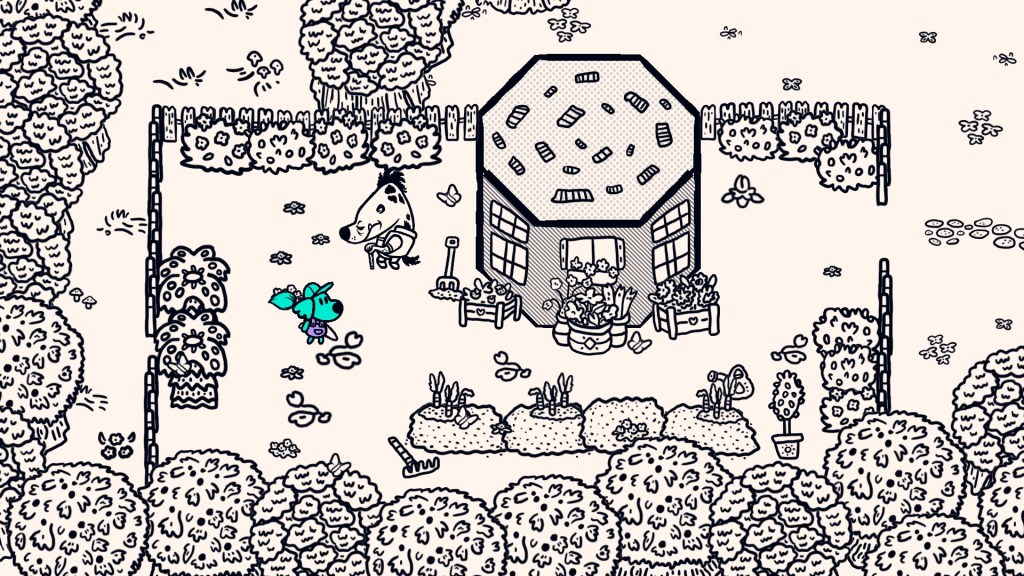
Now here’s a game that I could really see myself spending a lot of time with. Chicory is a delightful little game about being a cute little dog person who has the ability to paint in the world around them. There’s context as to why they’re able to perform these artistic feats of magic that tie into the central plot of the game that (obviously) wasn’t fully explored in the demo, but it left me eager to see where the story goes.

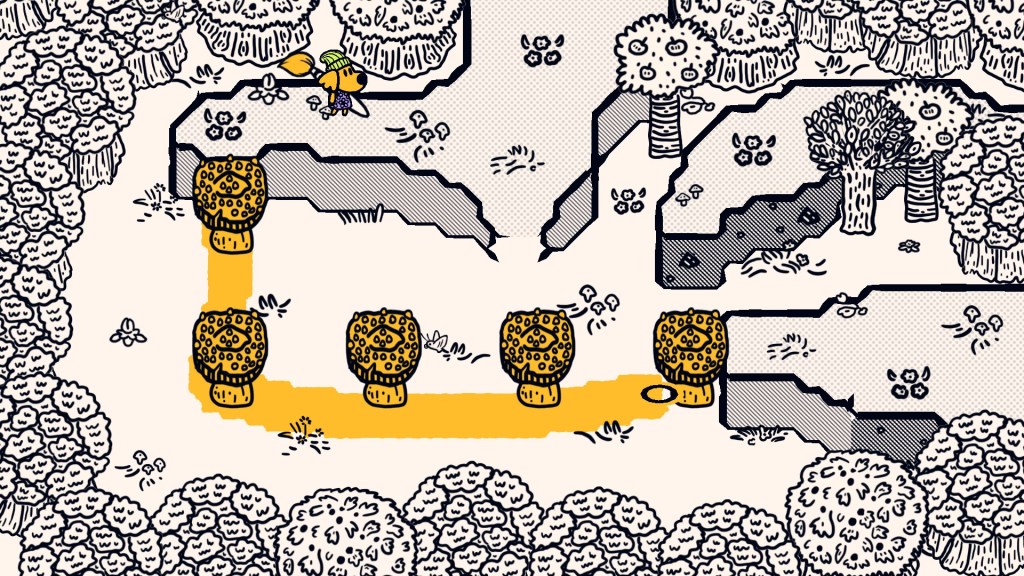
Your quest to find out what happened to all the color in the world isn’t just a fun story hook, but it has mechanical repercussions as well. Your magic painting powers will allow you to navigate the environment, solve puzzles, help random citizens and oddly enough, fight enemies. I’m really curious to see how the mechanics evolve over time as you progress through the story.

For as delightful and joyous as Chicory appears on the surface, the end of the demo really takes a turn that I didn’t expect and basically transforms it into something of a bullet-hell. The controls work without issue for most of the demo, requiring you to use the right stick to move your brush around and the right trigger to actually paint, but it gets a bit dicier when you have to manage your paintbrush and move around at the same time. I’m sure it’s one of those things you get better at as time goes on, but even with that slight hesitance, I really think Chicory could be something special.

RETRO MACHINA
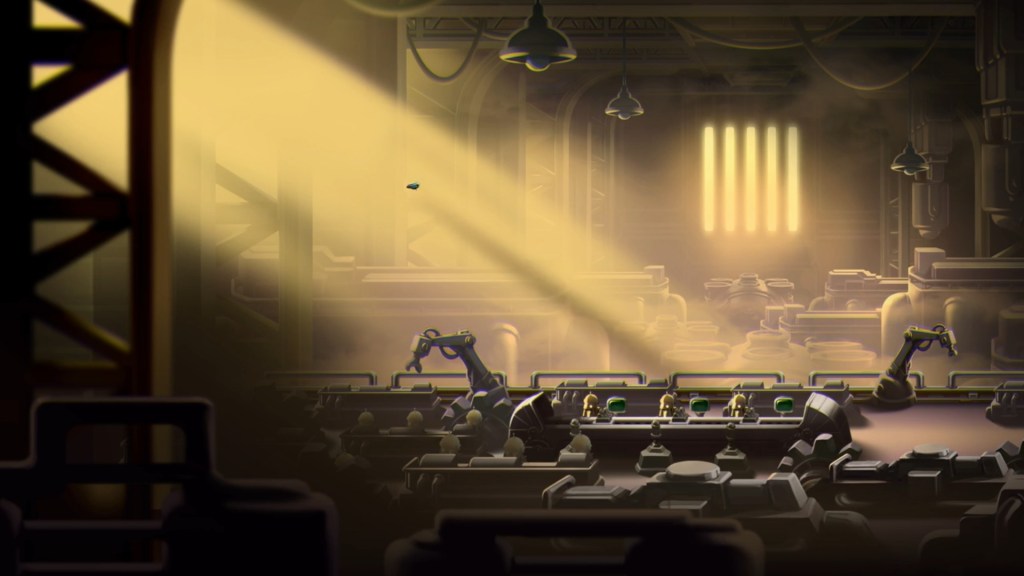
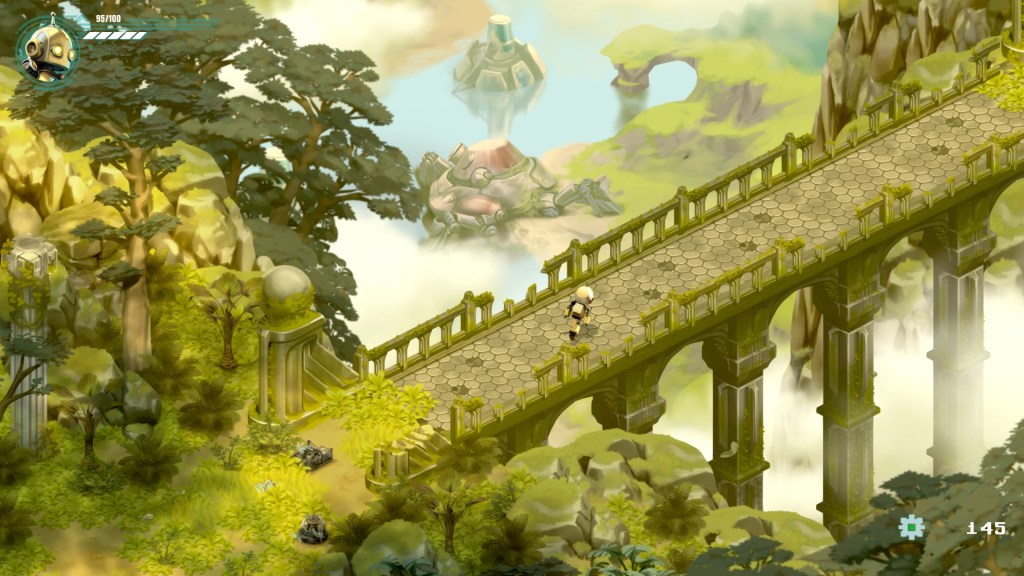
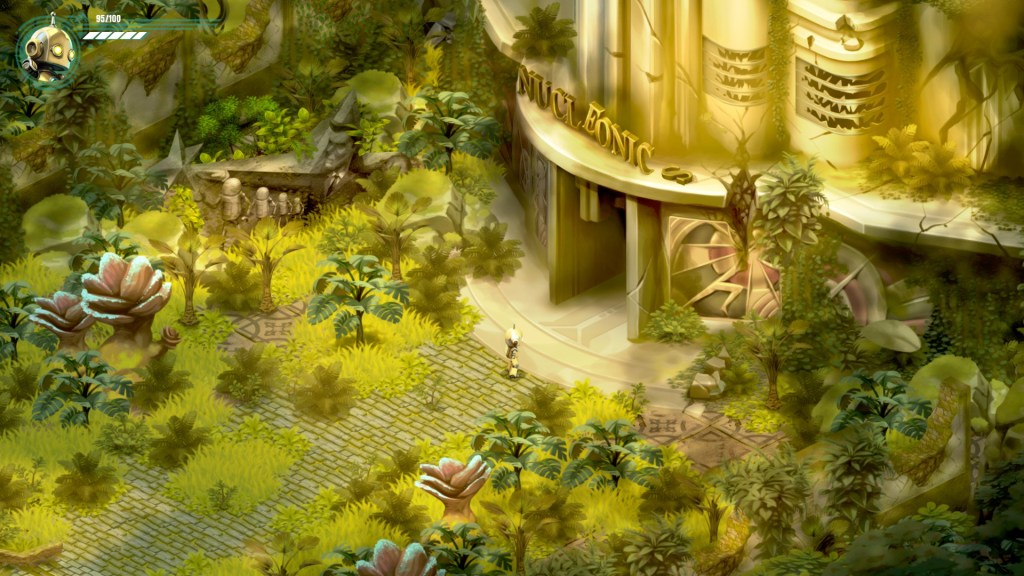
It feels mean to say that Retro Machina is squarely in the camp of “style over substance,” but I really felt that it was a game I’d rather look at than play myself. In Retro Machina, you play as a robot who was working at a nondescript factory alongside of their other identical robot buddies, who suddenly decides to not follow their orders because they saw a butterfly. I’m sure there’s more of a story there, but that’s all I gathered from the demo.

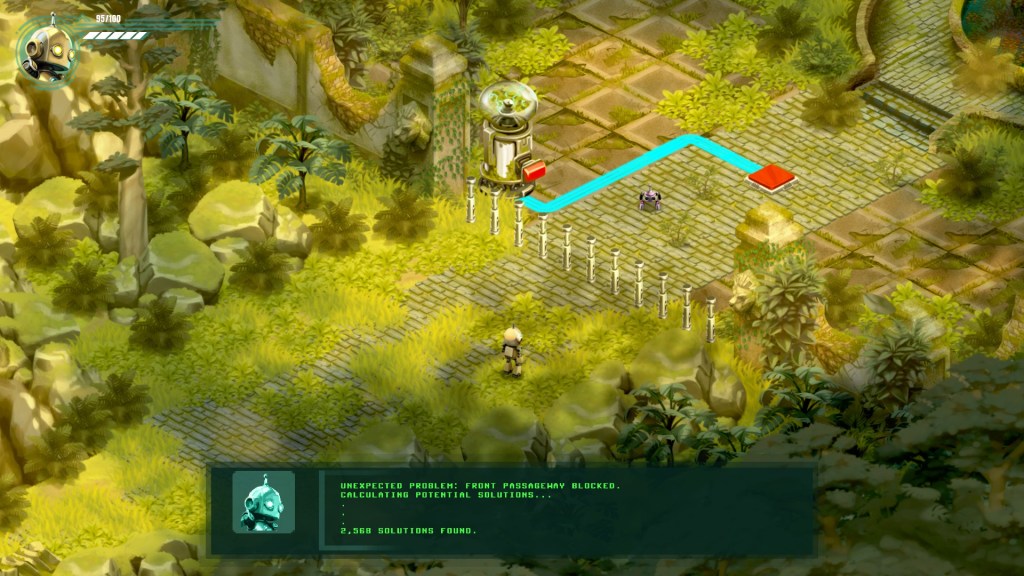
You escape the robot police and somehow get launched into the wilderness where you begin your search for a robot mechanic or upgrade station or something? Whatever the motivation, you end up in this different factory/office building where you have to solve puzzles and fight other robots to continue on. From a perspective that’s purely based on presentation, Retro Machina is great, but when you find yourself engaging in combat is where the experience kind of fell apart for me.

It isn’t that the combat is aggressively bad or anything, it just lacks any feeling of momentum or impact. The biggest thing that bugged me about the combat was the way that enemies can destroy you incredibly quickly, but not because they’re super powerful or anything, but because the game isn’t great about letting you know you’re taking damage. That led to a lot of moments where I’d exit a combat encounter with a fraction of the starting HP despite only having to fight like one robot. What I’m saying is that there isn’t great feedback for when you’re taking damage.

Aside from the combat issues however, the puzzle-solving aspect of Retro Machina seems promising. Despite needing or wanting an upgrade, your robot is extremely capable, boasting the ability to possess other robots to make them flip switches or navigate through otherwise inaccessible areas for you. There wasn’t a ton of innovative stuff I saw in the demo in regards to the puzzle mechanics, but it seems like that’s all primed to get insanely complex later in the full game. Overall the game seems neat, but I don’t think it’s something that I’d end up putting much of any time into.

SHERWOOD EXTREME
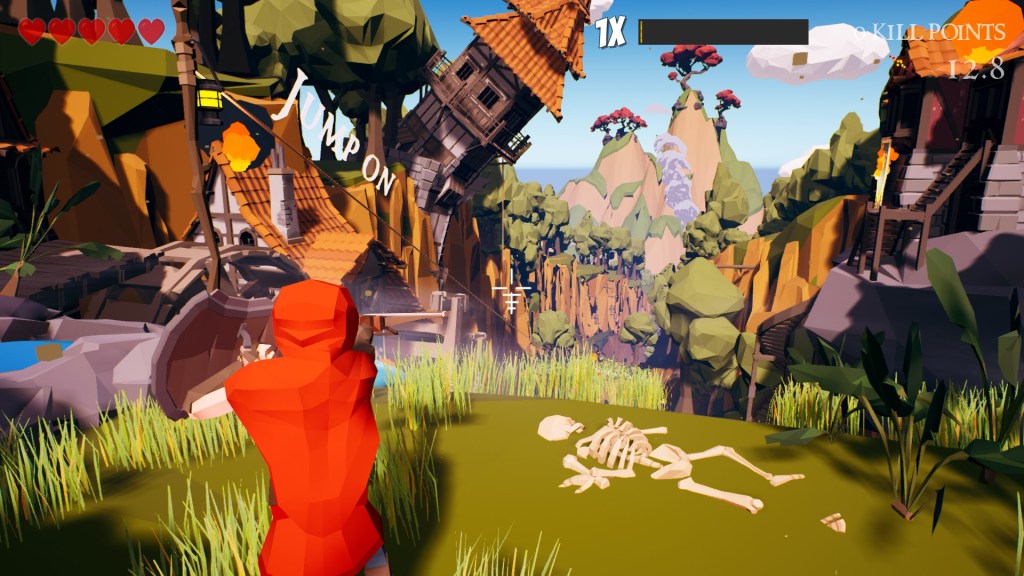
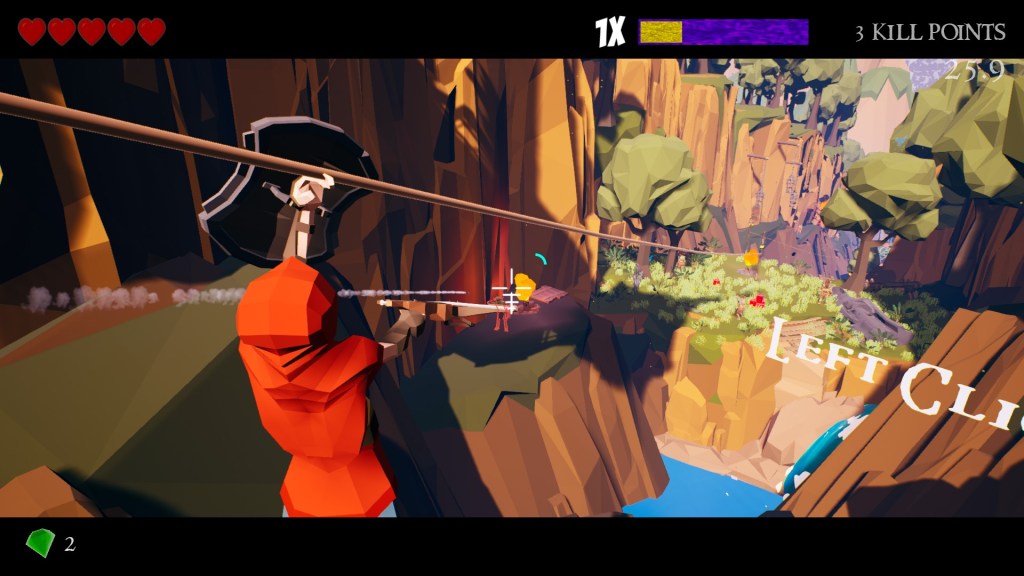
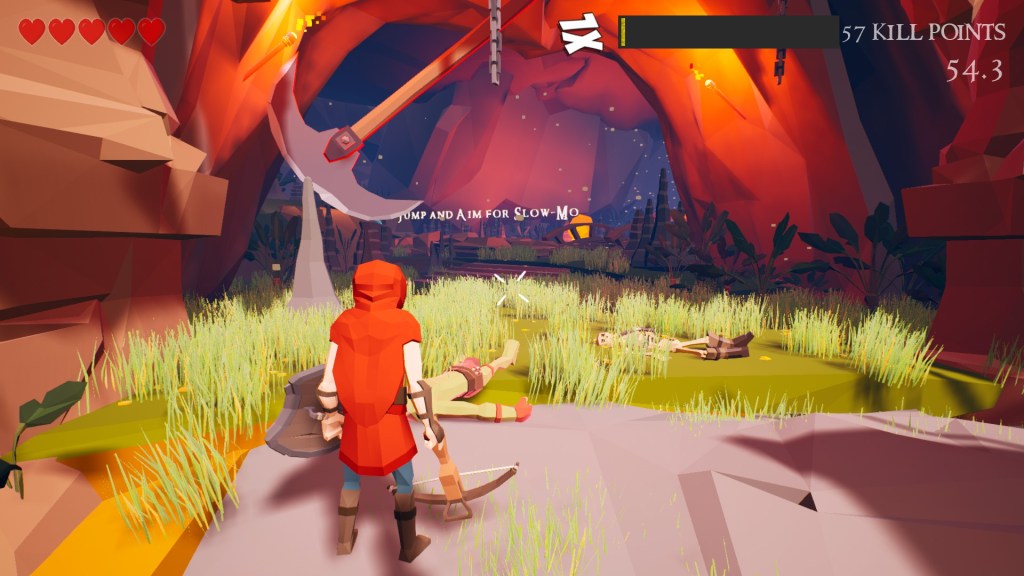
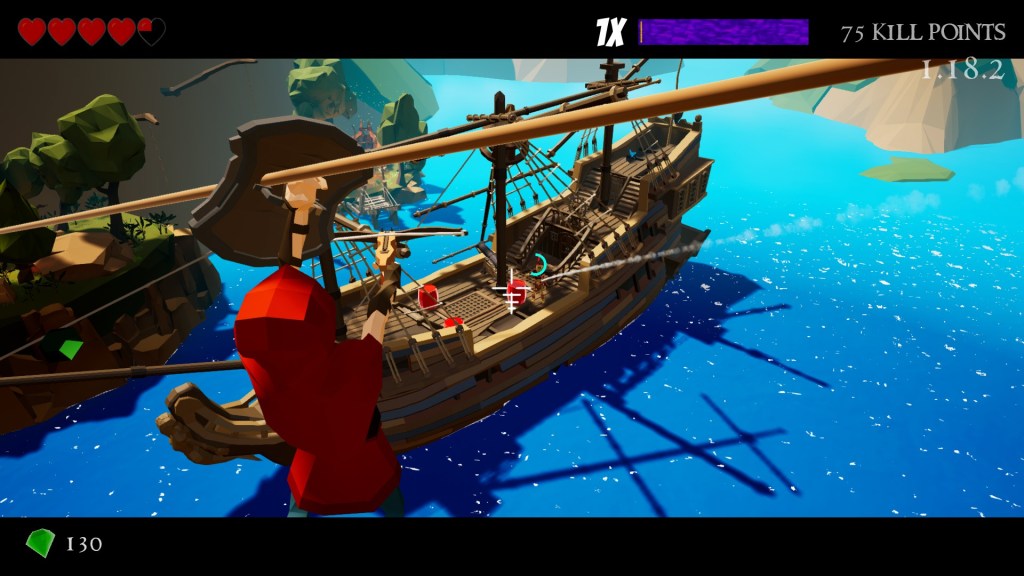
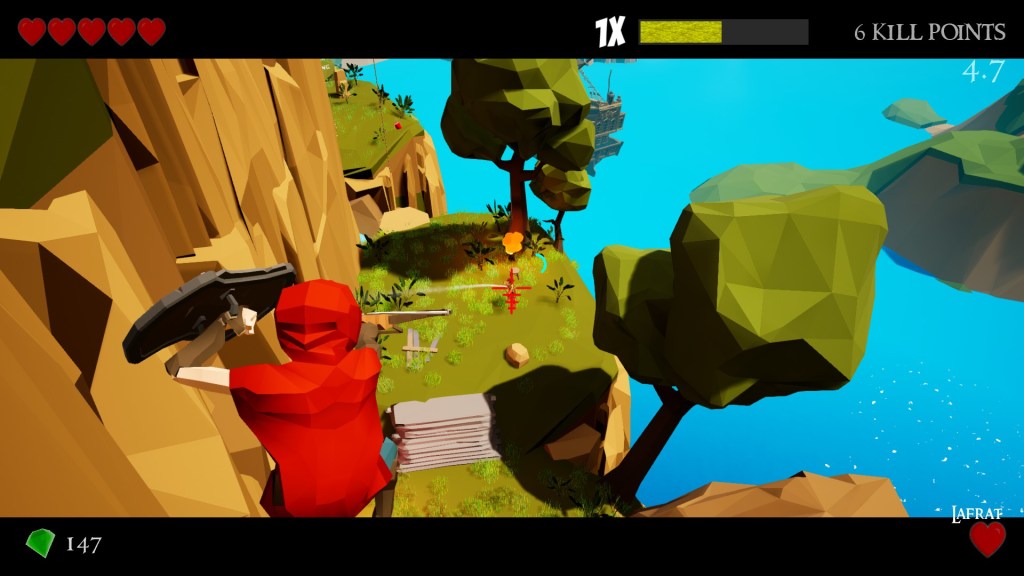
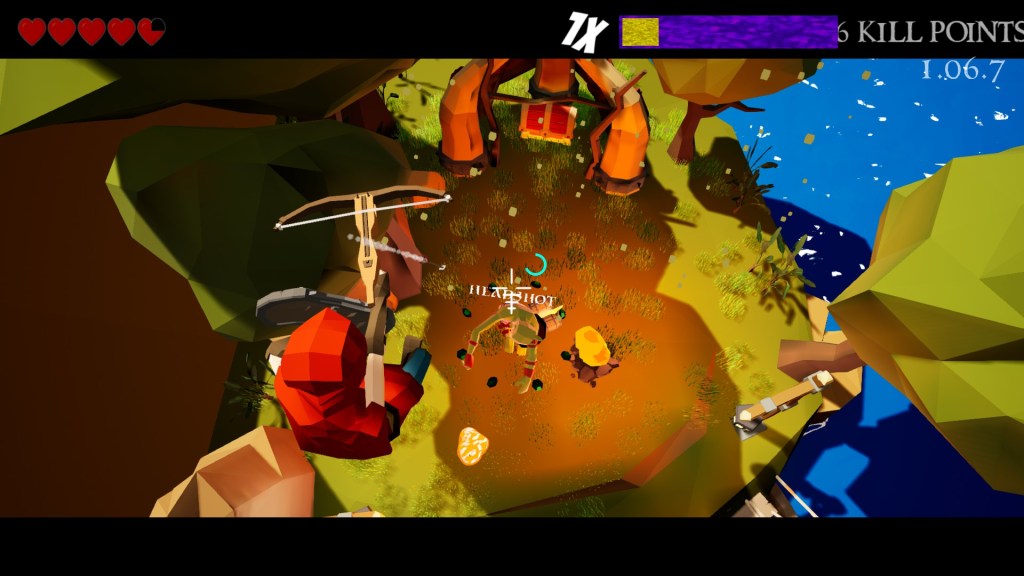
While it isn’t necessarily a bad thing, Sherwood Extreme sure seems like it’s trying to do the whole Bulletstorm thing in a low-polygon art style, replacing space marines with a Robin Hood-looking character who’s killing orcs. Sherwood Extreme is a level-based arcade-styled action game, where you’re trying to rack up the highest score you can by chaining together kills and acrobatics throughout a level in order to keep your combo meter up.

You run around with a crossbow and shield and shoot orcs while flipping in the air in slow motion like you’re in some medieval version of The Matrix. The shooting and score chasing aspect of Sherwood Extreme seem pretty solid, I just hope you unlock some more abilities or something because after only two or three levels, I was looking for some more variation. However, the game moves a lot slower than I initially thought it would because there isn’t a good feeling of momentum to running around or flipping, and it all just feels a bit janky. But hey, it’s a demo of an unreleased project.

Obviously I can’t speak to how Sherwood Extreme is as you get further into it, but there’s something there that’s worth paying attention to, I just wish it controlled and flowed a little bit better than it currently does. Hopefully that gets ironed out as the game develops, but even if it does, it’s one of those weird circumstances where I don’t dislike the game, but something just isn’t clicking with me. I wanted to enjoy Sherwood Extreme more than I actually did, but I don’t know if that’ll happen.

NARITA BOY
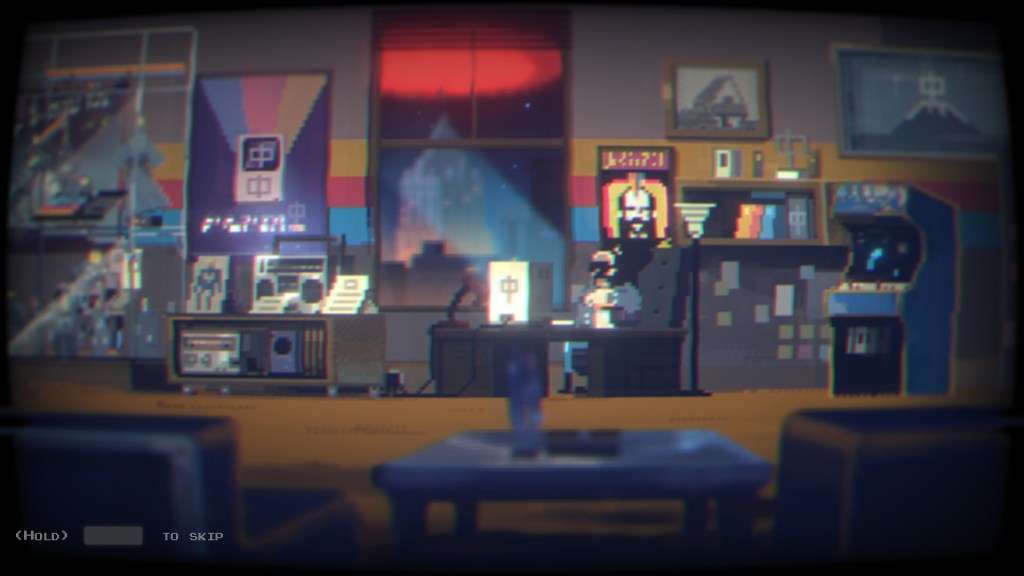
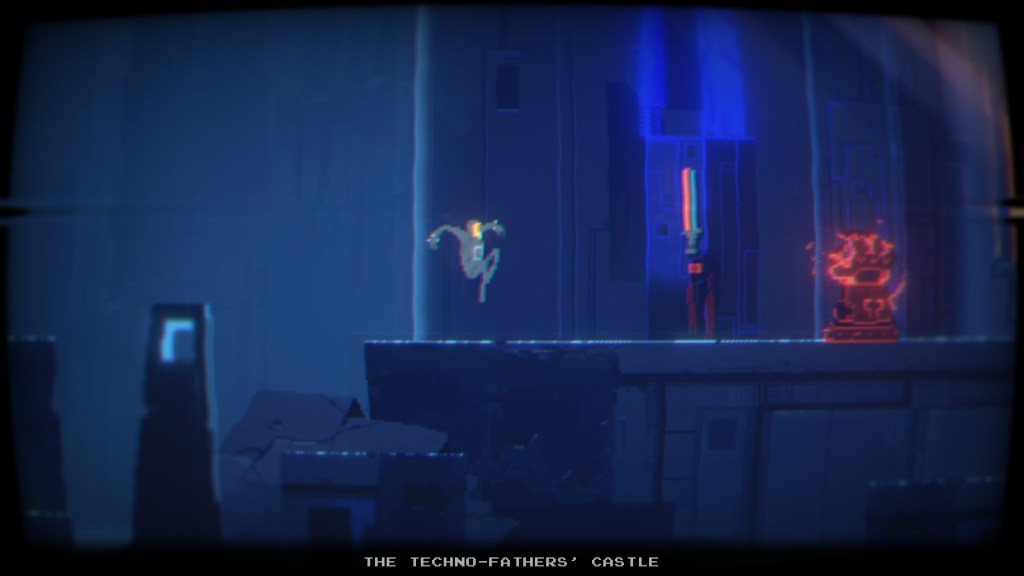
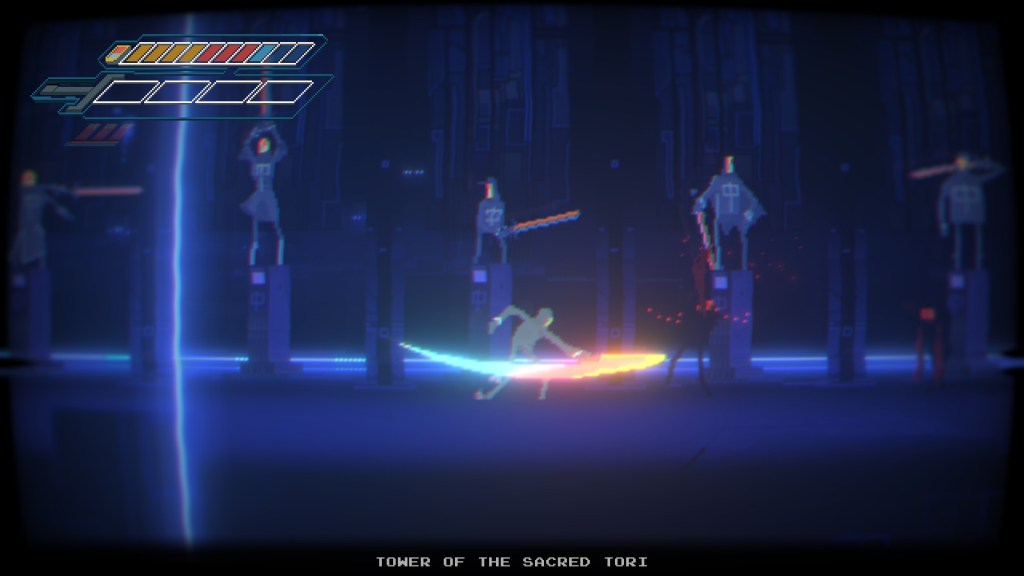
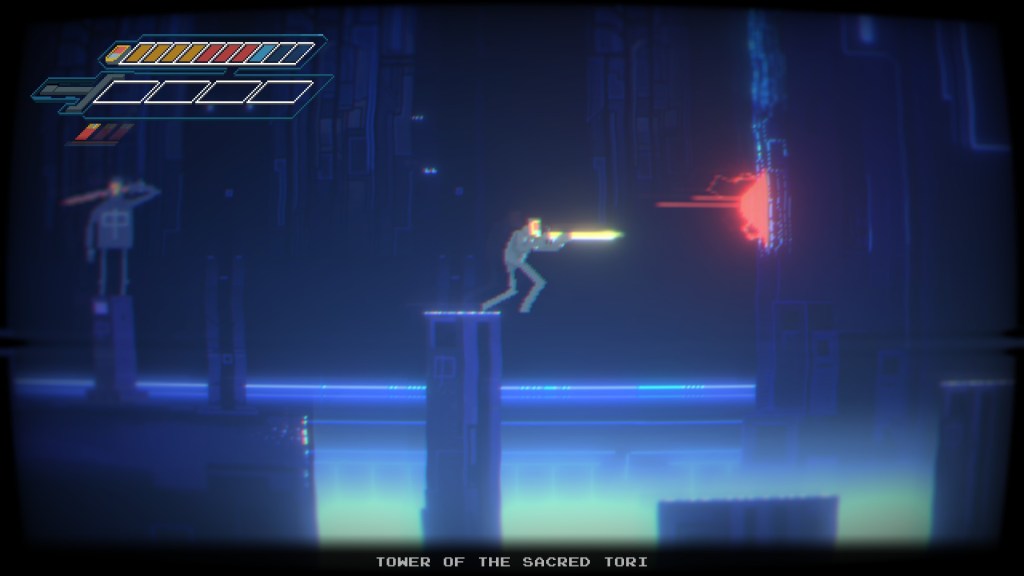
Speaking of games I wanted to like more than I actually did, let’s talk about Narita Boy. Stop me if you’ve heard this one before, but Narita Boy is a 2D pixelated action-platformer with Metroidvania elements. Right off the bat I will say that Narita Boy presents itself very well, both in terms of the art style and the soundtrack. And when you eventually do get to fight things, that feels pretty dang good too. You get this very cool sword that feels great to swing around and slash up monsters with, but you can also turn it around and use it as a shotgun which is objectively rad as hell.

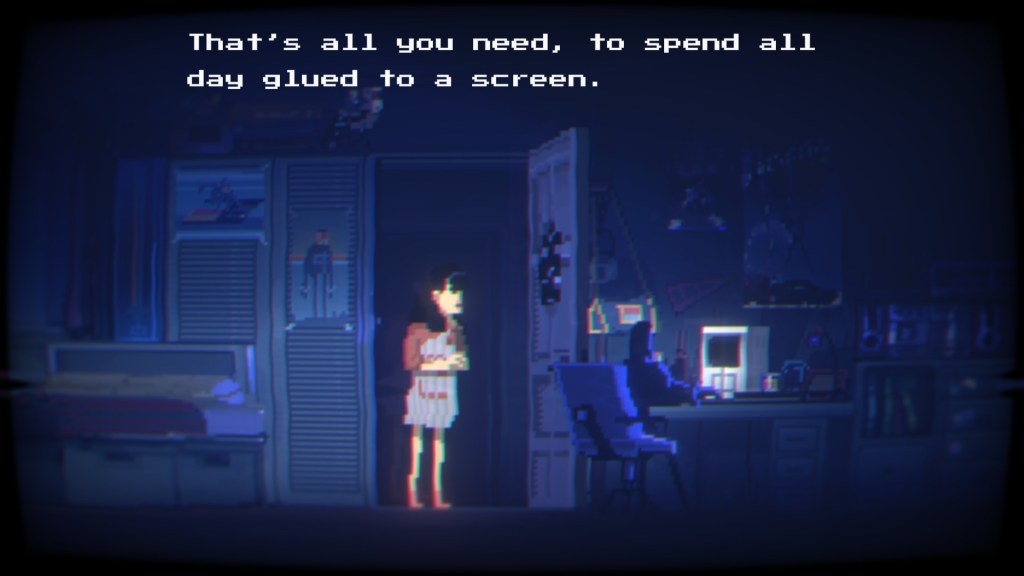
While I think Narita Boy looks cool and has some neat combat mechanics, I don’t think this demo does the full product any justice. Like a lot of these demos, it starts with a world-setting cut-scene, but then it dumps you into a portion of the game that would probably be way more tolerable if it wasn’t the first and longest thing you do in the demo. You have to suffer through endless dialogues about the world and your place in it before you actually get to do anything cool. Even when your task is to go find the cool sword you have to trudge through more dialogue and an obscene amount of screens where you literally walk in a direction until you can press a button to open a door, just to do that again in a different room.

I’m sure the story is interesting, but they front load so much of it in the form of people just talking at you in dialogue boxes that I began to lose interest almost immediately. And it isn’t like a few sentences, these are full on paragraphs that talk about how cool it’s gonna be when you get that sword but first they have to describe the sword’s power in excruciating detail. Needless to say, I buttoned through a lot of dialogue because I just wanted to play the damn game. I think Narita Boy is really cool, but if that demo is indicative of what playing the full product is like, I don’t know that I can handle the pace of it.

STEEL ASSAULT
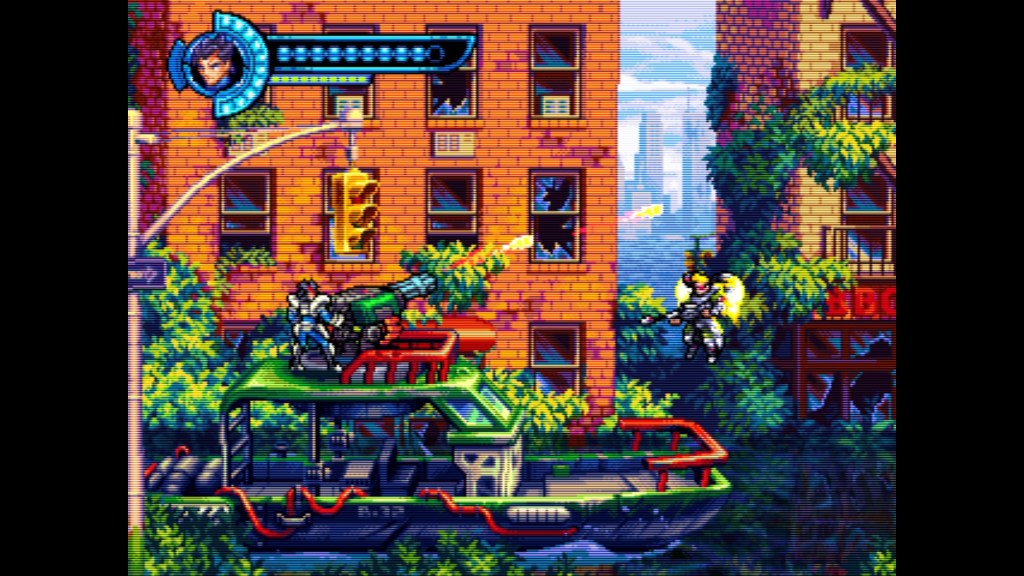
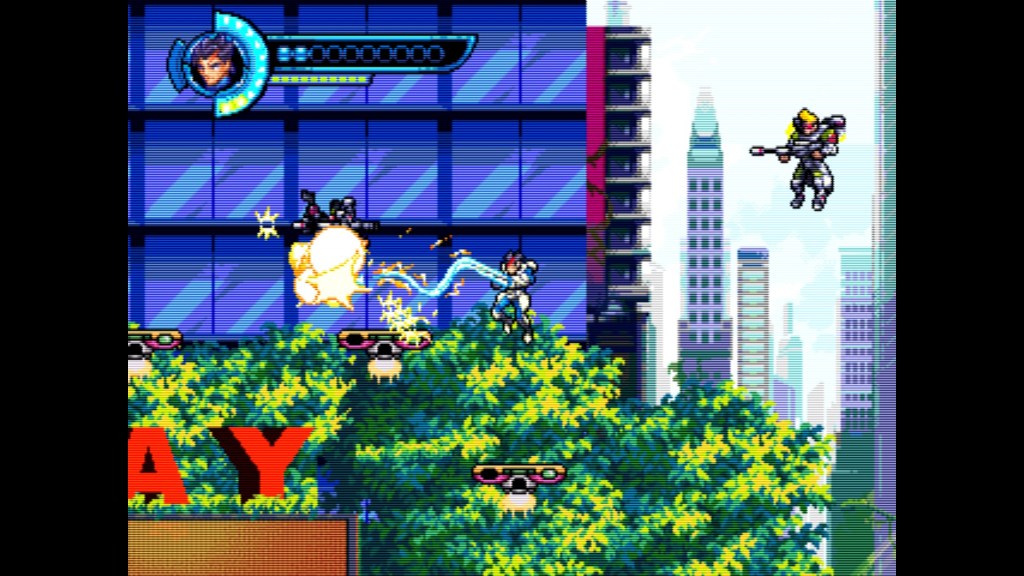
Yes, okay, Steel Assault is a pixelated 2D action game. I feel like I’ve written that so much today, but that’s not the point. Steel Assault reminds me of Bionic Commando, Contra and even the Metal Slug games a bit. It’s very much a “shoot everything” kind of game, but it has this interesting tether mechanic that I unfortunately was never able to wrap my head around, but was still very cool when I did manage to use it correctly.

The basic rundown is that you have a cool laser whip that you can kill bad guys with as well as the ability to fire a tether in two directions at once to make a zip-line or tight rope that you can use to traverse distant platforms. For instance, if I’m on a platform and fire the tether up, one end connects to my current platform and the other tethers to the one above me. From there I can climb up the rope and also whip guys while hanging from the rope which looks very cool.

Yet despite how cool it looks, I found Steel Assault to be difficult in kind of bullshit ways. First and foremost, the enemies constantly spawn, leaving you no respite whatsoever. Now I’m sure that’s not an issue a lot of folks out there, but when I was trying to get a handle on what was going on it became incredibly frustrating. But that alone wouldn’t sour me on a nostalgia-driven action game, however what did get me was the readability of everything that was going on. I rarely have this issue in games, but I had a really hard time clocking enemy projectiles. The first sequence of the demo is you fighting a flying robot while you’re on a boat that’s speeding through the canals of a city. That robot fires bullets at you that basically vanish into the colors of the boat as well as the background, which might be more of an issue with the heavy retro-styled filter they put over the screen. I died a lot because of that.

Steel Assault was the only demo that I wasn’t able to get through just because of how difficult of a time I had with it. I don’t think it’s a bad game, I just couldn’t get into a groove with it. You’re mileage may vary, but if you think you’re a bad enough dude to play Steel Assault, you should go for it.


And that’s really it for now. I have a couple of other demos I want to try out before the Steam Game Festival wraps up on the 9th, so maybe I’ll gin up a “part 2” before that happens. I haven’t even scratched the surface of what demos are currently available, so I recommend you check out the offerings for yourself because there’s definitely stuff that’s exceptional that I didn’t or probably won’t end up covering here.

The Master of Disaster: Holiday Havoc – 18

I currently play in two Dungeons & Dragons groups, one of which I run and the other I just play in. For my group, we’d been running the newly released Icewind Dale: Rime of the Frostmaiden, while my other was neck-deep in a Dragonlance campaign. However, as we crept closer towards the end of 2020, we found ourselves in the middle of one of the weirdest holiday seasons of all time. So with a lot of people unable to see family and get particularly festive this year, I wanted to do something special for them the only way I knew how to: A holiday themed one-shot. It was also an opportunity for me to move away from the lackluster module of Icewind Dale: Rime of the Frostmaiden, but that’s a story for another time. Instead, I’d like to tell you the story of Holiday Havoc: The Clausening, the holiday one-shot I ran for both of my D&D groups.

The main conceit of Holiday Havoc was that Santa Claus had essentially transformed his yearly package deliveries into a full, Amazon-esque logistics company called The Holly Jolly Corporation. How this was a sustainable business, I don’t know, but at the North Pole Santa had a big ol’ shipping and receiving center called The Holly Jolly Wish Fulfillment Center. The characters were all seasonal hires that were to be couriers for the evening, with the explanation that Santa is old and figured out a way to avoid doing the work himself. Adventurers were perfect for being holiday couriers, considering they have a knack for problem solving and Santa’s list might not be super accurate, resulting in the players wandering into dangerous situations.

They were outfitted with a sleigh, reindeer, and a magic Santa suit that had illusory capabilities that would make people think they were seeing the actual Santa in their house, and not just a goblin wearing a red jacket. I also needed a way to not have them murder everyone they encountered, cause you know, it’s a festive one-shot. So I gave them these magic bracers that transmutate all their spells into nicer and less deadly holiday themed variants of themselves. For instance, casting fire bolt would result in a piping hot beam of hot cocoa being lobbed at their face. Technically it’s still super deadly, but it’s hot cocoa so my players thankfully stopped asking questions at that odd logic. I also turned their weapons into candy canes, hard candies and peppermint bark, all of which still did the normal amount of weapon damage, but were all non-lethal variants of their armaments.

The general flow of the game was broken down into 3 different encounter types, all of which were important and added something positive or negative to the final scene of the campaign. The first encounter was your standard D&D dungeon crawl, where they would fight against enemies that I Photoshopped festive hats onto, and also find items that could help them later.

The second and most prevalent encounter was the delivery aspect of the game. I had around 10 handmade deliveries that I could send them on, but both groups only made it about 5 of them before we moved to finish the campaign. In these scenarios, I’d describe a home or locale where a present or present needed to be delivered. I made sure to let them know that deliveries weren’t complete until a present was under the tree in an effort to keep them in a situation rather than just run away from one. They could look at their bracers to see who the gift was for, their age, and what the present they wanted was. Here’s an example of what I’d read to them to get them started:

Your sleigh touches down on the rooftop of a modest two-story home.  The outside of which is decorated in rainbow colored glowing bulbs, garland lining the perimeter of the windows, and a sagging snowman in the front yard.  The lights on the inside appear to be off.  Your magic bag fills out a little bit, but is still easy to carry.  An illusory bubble surrounds the home, letting you know that you are shrouded and unable to be seen from the outside.  

And once they figure out a way inside of the house I’d read this:

You find yourself in a cozy living room with a bit too many effigies to Saint Nick himself littered everywhere.  The mantle is covered in holiday themed sundries with four stockings hanging from it.  Beside the fireplace is a large tree that’s been beautifully decorated with care.  A nearby end table has a plate of beautiful chocolate chip cookies on it, with a tall glass of milk as well.
Both simple descriptions that give you just enough information with being overly exhaustive. The idea was to essentially let the players help me fill in the blanks of this world via dice rolls and role playing. One of the later houses for instance had a dog inside of it, but the players wouldn’t have known that from the description I wrote of the place. So while they were scoping the perimiter of the house, one of the players gave me a perception check looking for something that I can’t quite remember, but they mentioned a dog. Since they rolled well, I manifested a “beware of dog” sign that was covered in snow that they had uncovered. Building off of that knowledge, they asked if there was a doggy door on the backdoor. They rolled an investigation check and thus found a doggy door that was big enough for their Kenku party member to fit through.

I kept encouraging each player to do something in these scenarios because it would help them in the third encounter type I had made for this campaign. The players were tasked with delivering to 100 houses and a minimum of 1 high-risk location (dungeon crawls). Since I had only made about 10 deliveries like the one described above, I needed a way to simulate their success in these ambiguous deliveries that felt like they had an impact on it, so I devised a new mechanic: the delivery roll. I figured it would be incredibly unfair if I picked a skill from the list and said that it was the delivery skill they’d roll for success, so the delivery roll would just be a straight d20 roll. Something needed to augment this roll though, and I figured tying a modifier to the success and participation level of the previous encounters would be just the thing.

So I told everyone that their successes and failures in the second encounter type would either grant them a +d6 or a -d6 to the ambiguous delivery rolls, and would keep track of their successful and unsuccessful skill checks during these scenes. I told them that not participating meant you’d just get no modifier on the ambiguous delivery rolls, along with the fact that doing well on those meant getting buffs or boons like a random potion or temp HP. There wasn’t an exact science to tracking this stuff, and usually if they ended up doing something hilariously funny or clever I’d reward them for it regardless of how the dice worked out for them.

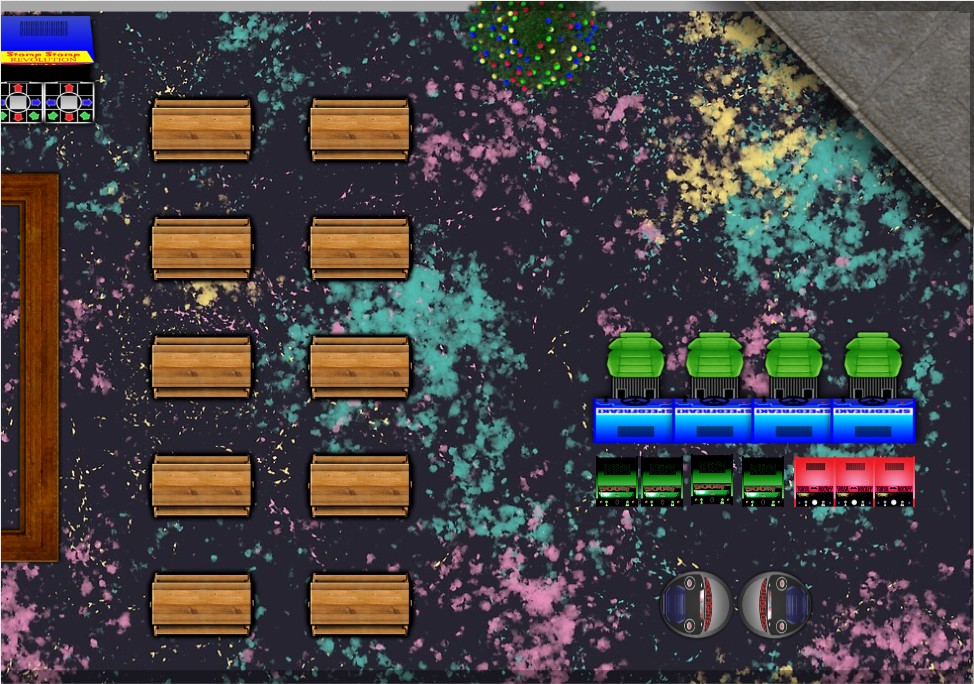
They had other narrative things to contend with like a rival courier group and the prospect of a prize from Santa for completing deliveries quickly, efficiently and safely as well to keep them engaged in the little story that there was. I also included a Chuck E. Cheese analog in the for of Cheddar Chandler’s Exploratorium, a place that was in the middle of renovations to become a more teen friendly affair called Cheddar Chandler’s Extreme Teen-a-torium. It was a place of dangerous and unfinished challenges like rope swings, scaling big walls, and vague obstacle courses, all of which culminated on the arcade and show floor of the establishment, where the party would face off against a monstrous version of Cheddar Chandler himself, along with his army of break dancing teens.

While that was a blast, there were some other missions that didn’t make the cut for time purposes. For instance, there was an abandoned guild hall that a bunch of goblins had turned into an evil snowman production facility, which seems really normal when you consider that the other scenarios were Home Alone and Die Hard related missions. I wanted to really hit those classic holiday themes hard.

The whole thing culminated in a showdown on the warehouse floor of the Holly Jolly Wish Fulfillment Center against the rival courier group and a bunch of Santa’s elves. They’d come to find that Santa had been corrupted by the magic of being Santa for so long and became just wildly evil, to the point where he had brainwashed the rival couriers into fighting the party. There were some cool things in the factory the party could mess with such as dangerously high speed conveyor belts, explosive barrels and forklifts which one player did try to use, but lacked a key to turn the thing on.

At the end of it all, they’d be tasked with picking a new Santa Claus for the next few centuries. I had no idea how that would end or who they would choose, so I just kind of didn’t write an ending outside of some flowery language around how beautiful the holidays were. Alas, neither group ever made it that far but I sure had a blast running this campaign anyway, and I know they did too. And that’s kind of the only thing that matters, isn’t it?
Gut Check: Immortals: Fenyx Rising

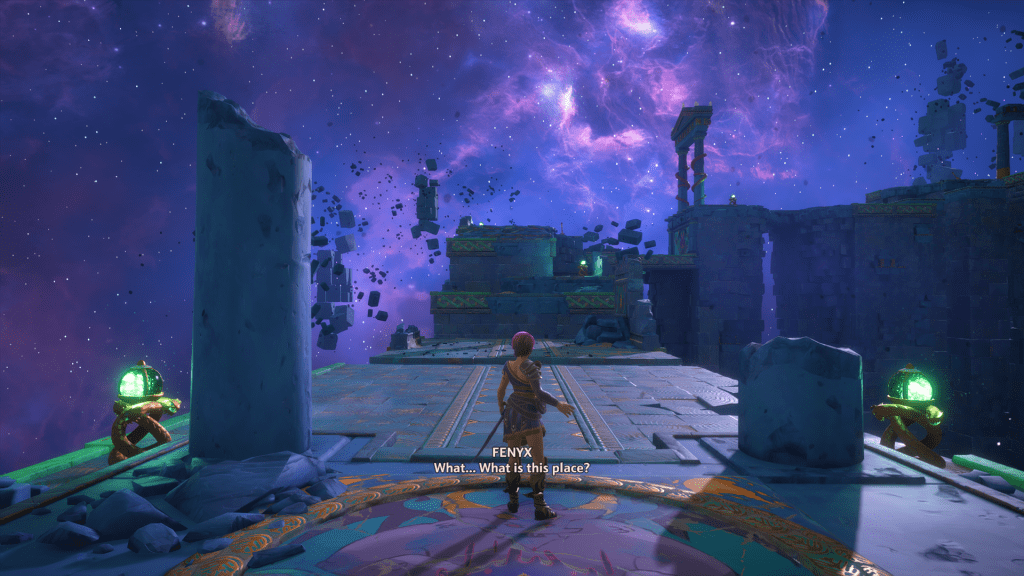
When talking about Immortals: Fenyx Rising, it’s impossible not to bring up 2017’s The Legend of Zelda: Breath of the Wild, an excellent game that was bound to inspire other developers to build upon its success. Enter Immortals: Fenyx Rising, a game that’s so clearly inspired by Breath of the Wild that at times it feels like plagiarism. However, for better and worse, Ubisoft did not make a carbon copy of Breath of the Wild, because that would be an insult to one of the best Zelda games out there. What we have on our hands is a louder, less subtle, yet still solid facsimile of a modern classic.
Immortals: Fenyx Rising is an action-adventure game that is exactly what you would expect Breath of the Wild to look like if Ubisoft had made it. What I mean is that Immortals: Fenyx Rising tries to copy the sense of exploration and expansiveness that Breath of the Wild had, while pumping the game full of checklists and side activities. The outcome is a fundamentally solid game that seems so conflicted in what it’s trying to do that it ultimately feels exceptionally average in almost every way. It lacks the elegance and charm of its inspirator, which makes sense because Ubisoft made it.

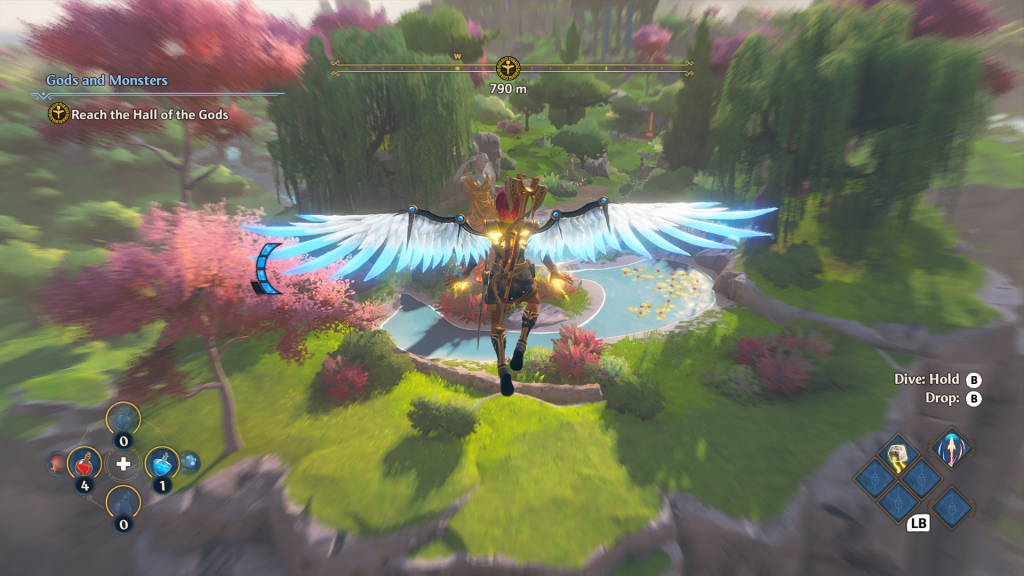
One of the things that Immortals: Fenyx Rising gets right and also happens to be one of my favorite aspects of the game is the breadth and scope of the world. It’s this sizeable landmass that’s beautifully rendered in a lower detailed, watercolor graphical style that’s extremely reminiscent of Breath of the Wild. That classic, “If you see it, you can go to it,” design philosophy is well realized in Immortals: Fenyx Rising, and its art style, world design and the power it leverages from being on consoles other than the Nintendo Switch really make this world worth exploring. The world doesn’t appear to be overwhelmingly large, instead opting for a smaller and more handcrafted experience. While I’m still early on, the world seems to be taking a quality over quantity approach, something I’d take any day over a large, procedurally generated bland landmass… a blandmass if you will.
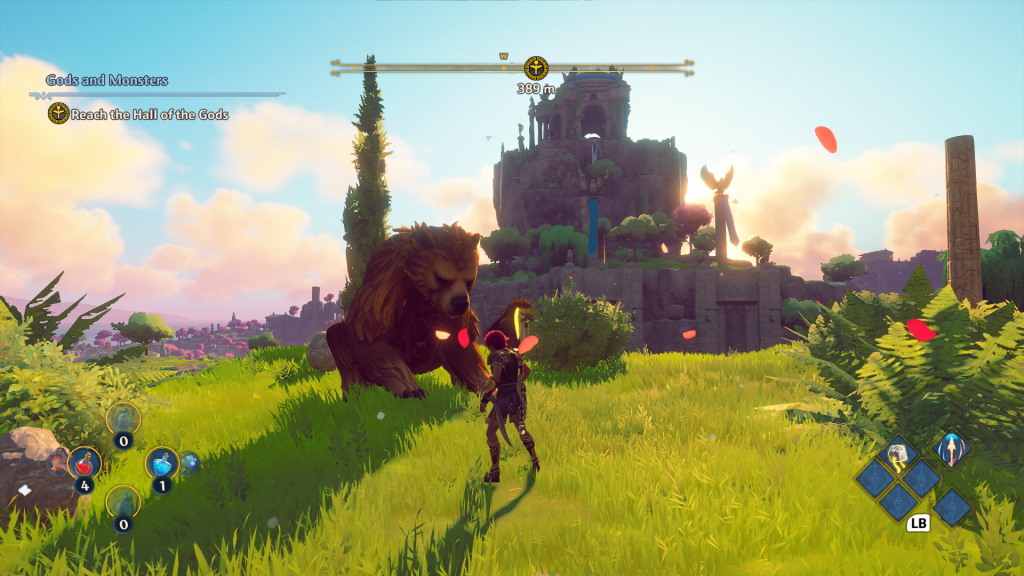
As you explore you’ll be collecting various resources for crafting potions, upgrading your armor and weapons, and so on and so forth. It sounds more daunting than it is though because resource management isn’t really a thing you have to worry about outside of carrying capacity for certain items. You’ll also come across all sorts of hidden puzzles, friendly animals and corrupted beasts, the latter of which makes Immortals: Fenyx Rising really feel like its own game.

I really enjoy the overall combat experience in Immortals: Fenyx Rising, but the best thing that it does, or specifically doesn’t do, is make you endure weapon degradation. That’s right, Immortals: Fenyx Rising fixed the worst part about Breath of the Wild and needs to be celebrated for that. Within the first hour of the game you’ll become familiar with light and heavy attacks, your bow, one magic ability that allows you to pick up rocks and stuff, a dodge, and a parry that I always forget about. Combat is fast is rewarding, and every last enemy you vanquish is hurled into space as they dissolve into ash which is a really satisfying touch. Immortals: Fenyx Rising also does the Breath of the Wild thing where if you parry or dodge at the right moment, everything slows down for you to get this flurry of blows in that deals extra damage. You’ll unlock additional abilities as you explore more of the world, collect more resources, and progress through the story, which might be the only nice thing I can say about the story.

The story in Immortals: Fenyx Rising is bad. Well, that’s not entirely fair, maybe the story is fine, but the way it’s presented is miserable. Evil dragon/god/demon-thing Typhon, who is basically the Ganondorf of this game, has corrupted the land and has turned 4 of the remaining heroes of the gods into his agents of chaos. If this sounds familiar to you, it’s probably because this is almost the exact story in Breath of the Wild. That’s where you, Fenyx, come into play. A terrible shipwreck has you washed up on shore and you come to find that you’re basically the chosen one or whatever and only you can save the world. Sounds fine so far, right?

Immortals: Fenyx Rising is told through an active narration, wherein Prometheus is telling the story of the game to Zeus. This narration tries so desperately to be funny with both narrators cracking wise at each other, usually ending with a joke about how shitty Zeus was. It’s all so brutally unfunny and actively detracts from the good moments in Immortals: Fenyx Rising. And it isn’t just those two dopes that bring the experience down. Every single NPC I’ve met thus far is terrible and actively unfunny. From Hermes being this snark-filled kleptomaniac who is written to be this lovable scamp despite the fact that he isn’t, to an oracle who doesn’t know he’s an oracle because he’s sooooo highhhh, it’s all just so poorly executed.

It’s sad to say, but lately Ubisoft has been churning out nothing but bland and badly written games, and this is no exception. It’s like they saw Breath of the Wild and felt compelled to pump it full of classic open world bullshit. When I think back to Breath of the Wild, I remember a quiet game about exploration and discovery that didn’t hold your hand and was designed with a simple ethos of “the journey should be just as interesting as the destination.” And Immortals: Fenyx Rising is perfectly capable of providing those moments of quiet discovery, but it’s constantly undermined by the chattering old men who crow at you at random times, and the unnecessary amount of cut-scenes that you have to endure. There’s a point where you’re introduced to your hub area where you come to level up and craft and so on, and there are about 6 specific stations to learn about. Each one of them comes with a cut-scene where Hermes comes and snarkily explains these stations to you. Instead of just some text that didn’t have bad jokes in it, I had to listen to that dingus to learn how to upgrade my stuff.

Much like Watch Dogs: Legion and to a lesser extent, Assassin’s Creed Valhalla, Immortals: Fenyx Rising has it’s fair share of performance issues. I swear, each one of these titles has fucked up in a different way, that it’s starting to feel intentional at this point. Watch Dogs: Legion couldn’t maintain a framerate to save its life, Assassin’s Creed Valhalla loved to hang at loading screens, and Immortals: Fenyx Rising just will decide arbitrarily that you can no longer play the game. Every 15 to 30 minutes or so, Immortals: Fenyx Rising will just freeze up and hang there. I haven’t found any rhyme or reason to any of it, and it’s been the sole reason why my play sessions are cut short. Maybe it’s my PC, but the fact that all three of these Ubisoft titles have broken in three distinct and separate ways is wild.

The worst part about all of this is that if the game would let me, I’d sink a lot of time into Immortals: Fenyx Rising. It’s not a perfect game by any means, but there’s a lot to like about it. The combat, world design, and sense of exploration all seem great, but the story and performance issues really undercut the entire experience. I like Immortals: Fenyx Rising, but it just isn’t as refined or as cohesive of a package as Breath of the Wild was. I know it’s unfair to compare a flagship Nintendo title to a Ubisoft title that’s been pushed out in December as an afterthought, but when you wear your inspiration so blatantly on your sleeve like Immortals: Fenyx Rising does, you can’t help but point out its shortcomings.

Gut Check: Fuser

Somewhere between my first and fiftieth Smash Mouth and Carly Rae Jepsen mashup, the comedic flair that initially attracted me to Fuser faded into the background and was replaced with a genuine desire to make a song that actually sounded good. While Fuser isn’t much of a “game,” it is a pretty powerful and accessible piece of software that’s capable of generating some genuine ear-worms of songs in an easy and accessible way.

Just like previous Harmonix titles such as the Rock Band series or the early Guitar Hero games, the fun doesn’t necessarily stem from making your way through the career modes, but rather in the simple act of playing the game is the real draw. Just like those games, Fuser has a story mode that grants you different unlocks as you progress, but in reality it’s more of a tutorial than anything else. During the course of a set you’ll get some requests for certain instruments and genres as well as some objectives that usually revolve around you utilizing a technique you just learned.

The idea is that you’re an amateur DJ who like anyone at this event, is just allowed to hop on stage and mix it up at what must be the weirdest music festival in the universe. There’s no logic to it, but there doesn’t really need to be considering that no one is actually coming to a music game for its story. The career is split into several sets of levels spread across a few different uniquely themed stages where you’ll be taught something new. The first stage is about the basics of timing, whereas later on you’re taught about soloing certain tracks, queuing up new sets, and adjusting tempos.

It’s incredibly helpful and provides you with a decent amount of cosmetic and song unlocks depending how well you score in a level, but Fuser isn’t really good about giving you feedback which isn’t great if you’re trying to improve. I rarely understood why I got three stars on a level versus four or five, because the game only seems to show you what you did right without offering anything in the way of criticism. It wouldn’t be such a bummer if it wasn’t for the fact that songs and song currency are usually unlocked when you reach a five star score.

But once you complete a few stages and learn some of the advanced techniques for mixing, I’d suggest you just leap into the freeplay mode and never look back. That’s what I’ve done, and I’m truly having a great time just mixing up songs for half hour sets at a time. Without the pressure of having to keep the crowd happy or worrying about the various objectives that might pop up during a set, freeplay is the actual mode you’ll be spending the majority of your time with .

You start any session by picking your crate of 30 songs to bring on stage with you. There are a lot of songs from different genres and eras, all of which have been broken into up to four tracks: vocals, bass, drums and guitar. Sometimes the guitar and bass will be synths, pianos or horns, but the idea is that you have four pieces of a song to play with. That means you can use Smash Mouth’s “All Star” vocals, with A-ha’s “Take on me” drums, and some other stuff that shouldn’t ever be in the same song, and make them be in the same song.

Fuser will force these songs to work together under any circumstance, even if that means ruining the very concept of music for you. This will manifest in the form of incredibly sad sounding pop songs that are in a minor key and played really slowly, or the exact opposite where “Linger” by The Cranberries suddenly becomes a high octane pop song. It’s wild and shouldn’t be capable of producing anything other than ear poison, but it all manages to hold together while producing decent sounding music

It probably took me a total of ten minutes in freeplay to create something I actually would listen to in my car. That realization was both comforting and horrifying because none of this should be working, but yet I still find myself nodding my head along to the music I create. I truly have loved my time with Fuser but I do fear that it might not have the legs that Rock Band did. It seems like a fun thing to show your friends that might ultimately not have the longest lasting appeal, but for a time it can be a genuinely good time.

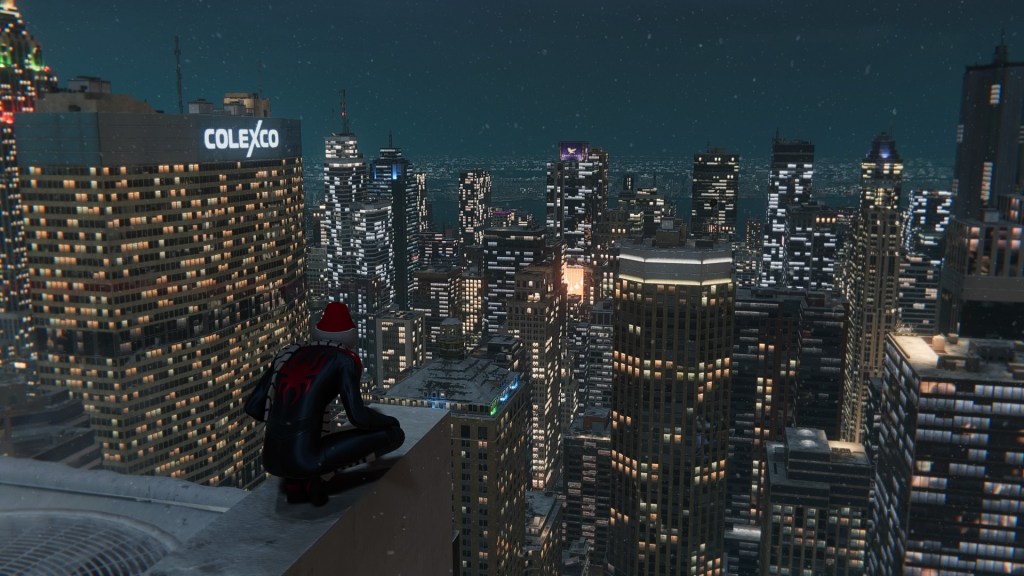
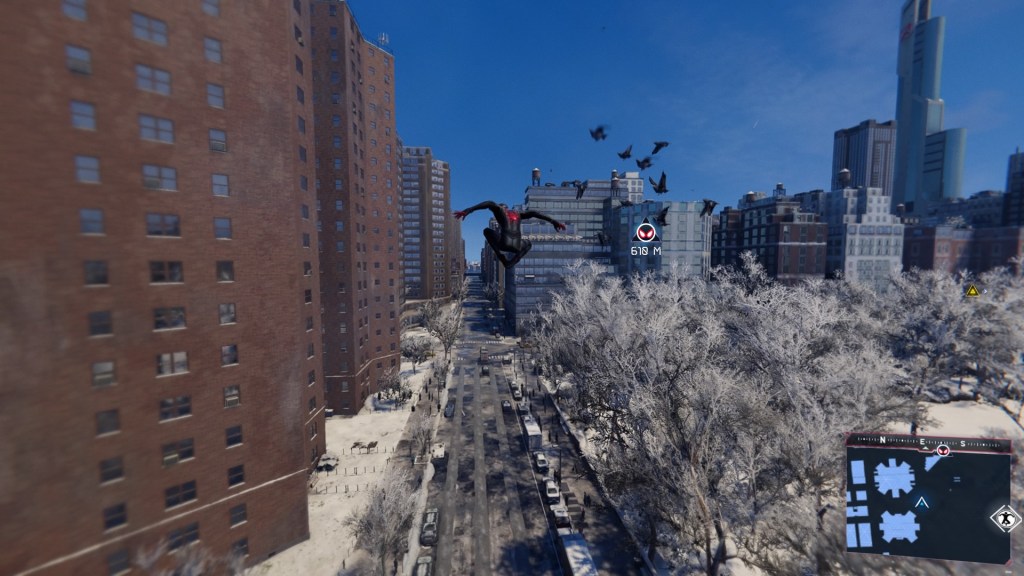
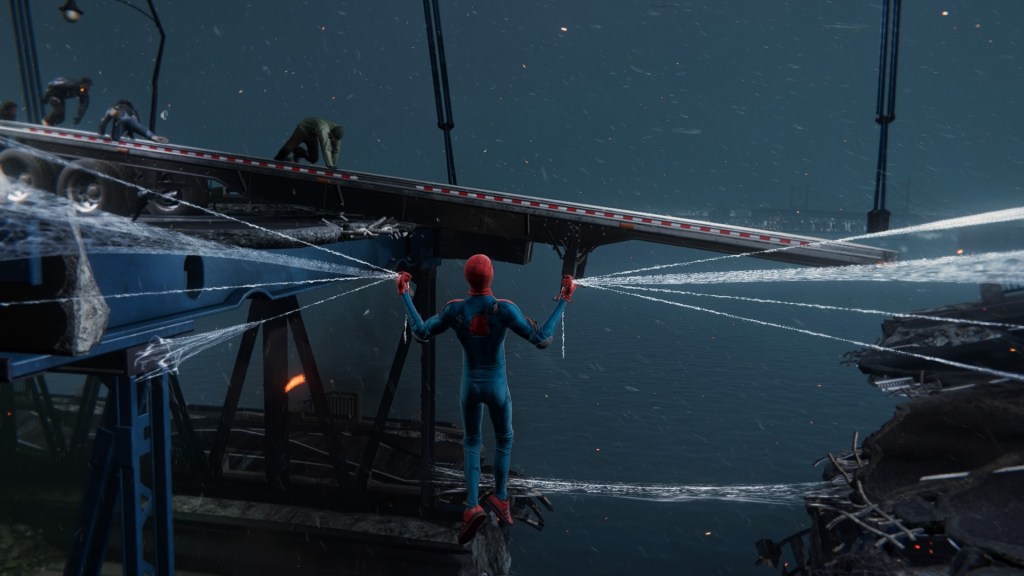
Review: Marvel’s Spider-Man: Miles Morales

Marvel’s Spider-Man: Miles Morales is a game that not only builds on the incredible foundation that was Marvel’s Spider-Man with a new protagonist and mechanics, but cuts out a lot of the bloat that plagued its predecessor. The refinements overall result in a tremendously well-paced experience that every Spider-Man fan should check out as long as they aren’t using a launch PlayStation 4.

In Marvel’s Spider-Man: Miles Morales, you play as the titular Miles Morales who has been tag-teaming New York City alongside his mentor and OG Spider-Man, Peter Parker. The main conceit of the story is that Peter and Mary Jane have gone on something of a working vacation in Europe, leaving Miles to be the sole protector of New York City for the next three weeks. Peter, having never been able to take a break from protecting the city gets a much needed respite from it, while Miles finally has his chance to prove that he’s just as legitimate a Spider-Man as Peter is.

That chance comes when Miles uncovers a new gang that’s risen from the ashes of the defeated criminal enterprises from 2018’s Marvel’s Spider-Man, along with a corporation doing unsurprisingly unscrupulous things. Marvel’s Spider-Man: Miles Morales doesn’t waste much time before thrusting you into the heart of this ~10 hour experience, keeping the story and the intrigue moving at an enjoyable brisk pace. Marvel’s Spider-Man: Miles Morales also cuts out all of those dreadful stealth missions where you played as “not-Spider-Man,” which is an overwhelmingly good decision.

What I love about Marvel’s Spider-Man: Miles Morales is that not only in its storytelling does it respect your time, but the missions and side activities have been tuned in such a way to keep things fresh and engaging without bogging you down with an enormous activities checklist. To be clear, the game does have mildly repetitive challenges and side activities within it, but their volume has been greatly reduced. While random crimes are still recycled ad-nauseam, the bigger side missions are all unique in their structure. It’s one of the few times I’ve been able to look at a follow-up to a game and see a developer actually respond to the criticisms they’ve received.

When you start Marvel’s Spider-Man: Miles Morales, you’re already way more capable than Peter Parker was in Marvel’s Spider-Man. Allowing you to have access to advanced swinging mechanics and combat abilities right from the jump makes the game much less of a grind, while also making narrative sense as well considering there would be no reason for Peter not to teach Miles all he’s learned in the course of his adventure.

From top to bottom, I had an excellent time with Marvel’s Spider-Man: Miles Morales both from a narrative standpoint and its new gameplay mechanics. Miles has access to electrically powered attacks, dubbed “venom strikes,” as well as an inherent cloaking ability that I probably didn’t use as much as I should have. Miles doesn’t have the same amount of gadgetry and tech that Peter had in his game, but these abilities more than make up for it. Besides, there was only like one or two suit modifications and gadgets worth using in Marvel’s Spider-Man.

My only real issue with Marvel’s Spider-Man: Miles Morales comes with its technical performance. Being that this is a cross-generation game appearing on PlayStation 4 and PlayStation 5, the game felt half-baked on my launch PS4 in a way that Marvel’s Spider-Man did not. At the beginning of the game it both ran well and looked incredible, but as time went on, the cracks started to show. My running theory is that as time progresses in the game, the time of day and weather also change with it. When nightfall would hit or snow would fall, the game would run heinously in a way that I imagine newer hardware could handle with ease.

I experienced a ton of frame rate hitches and even had the game just lock up in certain places for a few seconds, but to its credit the game never crashed or made me lose progress. But it really made the best part about these games, which is to say the swinging around, feel like a chore. Having to battle the frame rate every time I dared to take to the skies truly detracted from an otherwise outstanding game. Even aside from that though, the version I played was plagued with other technical errors like dialogue just not playing in cut-scenes, cut-scenes just freezing completely, and my least favorite of all, the game playing two music tracks on top of each other. That last one was something that literally ended up giving me a headache until I rebooted both the game and console.

It’s a shame that the technical quality of Marvel’s Spider-Man: Miles Morales wasn’t up to snuff, because the rest of the game was so good that it made me power through these issues just to see the end. Hell, I still want to hop back in and sweep up all the stuff I missed, but I’ll have to wait until I can get my hands on a PS5 before I attempt it. If you’ve got a system capable of running it properly as well as a love for Spider-Man as a concept, I cannot recommend Marvel’s Spider-Man: Miles Morales enough.

Gut Check: Watch Dogs Legion

When I think about my time with 2016’s Watch Dogs 2, I’m reminded of its many ups and downs both in terms of gameplay and story, but at the end of the day it’s a game that had a lot of heart and charm that managed to make it a memorable and satisfying experience. Watch Dogs Legion however, lacks any of the joy and fun that its predecessor had, contains repetitive and frustrating missions, and also runs like hot garbage.

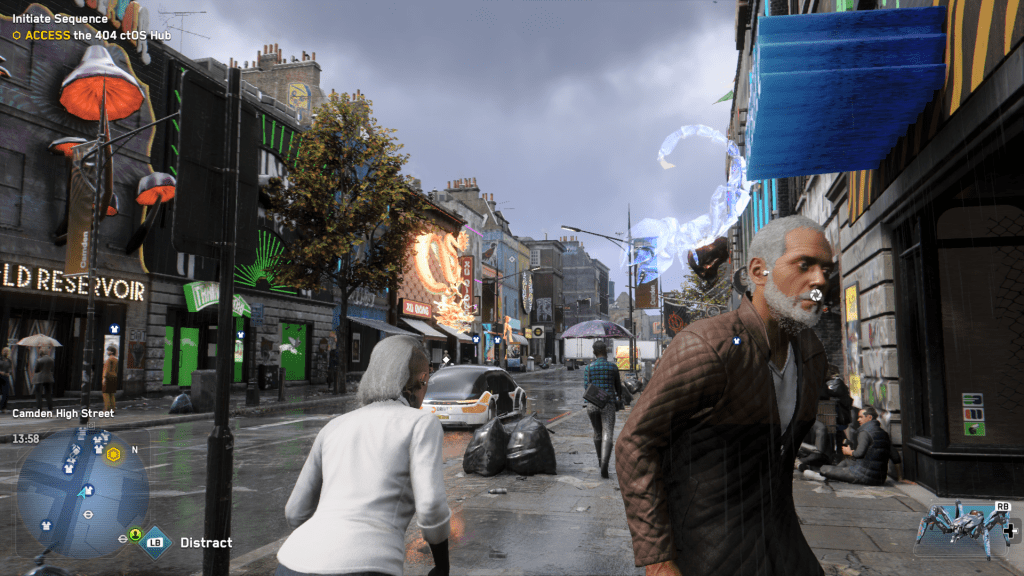
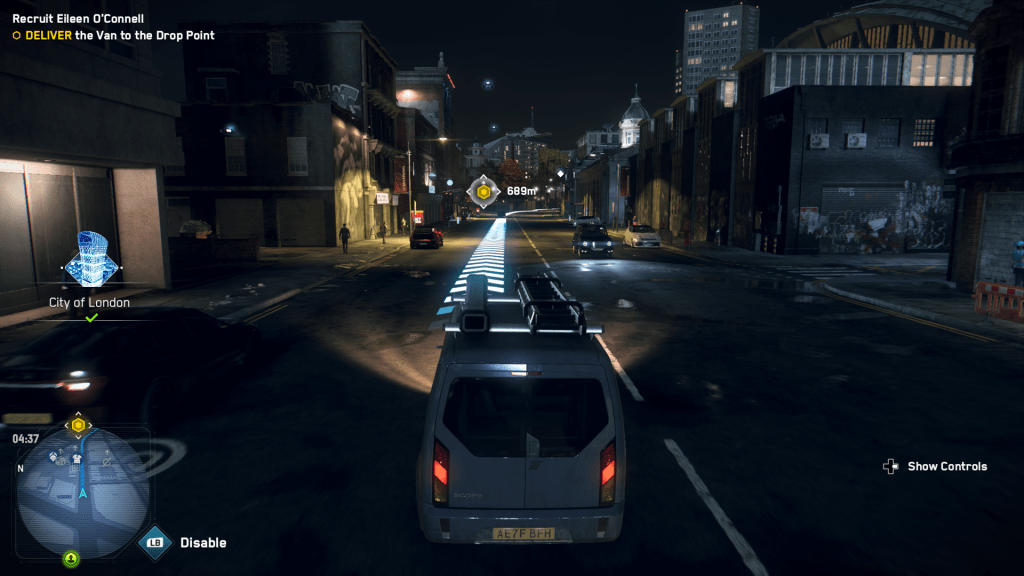
Watch Dogs Legion is a game that focuses more on the hacker organization DedSec instead of any single character by allowing you to effectively recruit and control any person you find on the street. The goal is to rebuild the organization with these recruits, each of which have randomly assigned traits to them that make them more or less viable candidates to add to your ranks. You might find a guy with a cool car, or a drone expert who knows how to hack more effectively, or even a lawyer who can bail your team out of jail faster if they happen to get arrested. It’s an interesting concept that rarely feels worth engaging in and unfortunately presents its own suite of complications to providing a cohesive gameplay experience.

The lack of any primary character to really focus on in the game wouldn’t be such an issue if Watch Dogs Legion wasn’t also trying to make you care about the narrative. The quick version of the story is that DedSec was framed for a terrorist attack on London that prompted a private military company (PMC) called Albion to turn London into an oppressive police state. While the story itself doesn’t do a great job of handling or presenting any of these topics with the care they require, the whole narrative falls flat because every character you play as just spouts the same bland responses to everything no matter what the context is.

For instance, there’s an early mission where you find what effectively is a prison camp set up by Albion that just exists in the middle of the city. You literally just stroll on in there to see the many, justifiably distraught people just kinda hanging out. Interestingly enough, they all have their cellphones on them which is a weird thing to let political prisoners have, but whatever. Yet after completing the mission in the camp and casually waltzing out the front door, the voice of your boss chimes in and remarks about how terrible the situation is. My character, a bland and procedurally generated ding-dong, proceeded to simply respond with, “I could get used to this DedSec thing,” or something to that effect. That kind of thing happens almost every single time you complete a mission, and it really robs Watch Dogs Legion of any real chance at telling a compelling story by having your blank slate of a character just spit out random one-liners in the hope that it makes any sense contextually.

On the topic of procedural generation and characters, Watch Dogs Legion tries to inflate the “uniqueness” of the citizens of London by pitch-shifting their voices to artificially expand the diversity of people you might encounter. As you might imagine, this leads to a lot of people with the same voice, just one happens to be unnaturally deeper, talking at each other as if you were listening to two robocalls try to scam each other.

Even the missions are bland and uninspired, regardless of whether they were procedurally generated for a recruitment mission or if they’re part of the main story line. These procedurally generated missions will often make you return to places you’ve already infiltrated for either story or region unlocking purposes, and the region specific missions are wildly dull and carry the stupidest implications with them. The main conceit of these region unlocking missions is that you do enough to inspire the people of a certain part of the city to enter a state of “defiance” and rise up against Albion. Even wilder is how Watch Dogs Legion considers putting up a cool DedSec banner over an Albion one to be just as important as uncovering an organ-harvesting operation. The level of cognitive dissonance that’s on display at any moment in Watch Dogs Legion, combined with the lack of any charm or character, really overshadow the few existing high points in the game.

Cognitive dissonance aside, the core gameplay loop of Watch Dogs Legion is still extremely solid despite the overall game feeling like a shell of its predecessor. Being able to take down outposts without ever stepping foot inside of them by utilizing cameras, drones, and traps littered throughout any given locale is still really satisfying. I’ve been able to play most of Watch Dogs Legion without ever firing a gun, with the exceptions being the missions where you’re thrust into combat scenarios against your will. There’s just something infinitely enjoyable about terrorizing a bunch of PMC dipshits without ever laying a finger on them.

But the same could have been said about Watch Dogs 2, hell, even the original Watch Dogs was good at making you feel like a hacking god. Whereas Watch Dogs 2 made its digital version of San Fransisco feel alive and packed with things to do, Watch Dogs Legion feels oddly empty. You can go buy a bunch of clothes, do package delivery missions, get drunk and play kick-up with a soccer ball, but that’s kind of it. For as big and dense Watch Dogs Legion‘s version of London is, it still feels surprisingly empty. It’s even more upsetting when you remember that Watch Dogs 2 gave you reasons to explore the city and hunt down famous landmarks in San Fransisco. Watch Dogs Legion could have really benefited from having something like this present, encouraging people to get to know London and its iconic locations.

But I could get past all of those issues if it weren’t for the miserable state of the PC version of this game. My computer isn’t new and I recognize that, but there is no reason that I should have to play Watch Dogs Legion on its lowest settings, and still be unable to have it run at a steady 30 frames per second. The game is so heinously optimized that moving around the world, getting into combat, or even turning your camera too fast turns the game into a slideshow. It’s all the more upsetting when you look at the console versions that look much better and run more stably despite being on hardware that was released in 2013.

Despite all of this however I kept playing Watch Dogs Legion because that core gameplay loop is still satisfying. The problem is, Watch Dogs Legion has a few missions that strip you of your ability to get creative, opting for a more linear experience. These crop up from time to time, but they were rarely anything that I couldn’t overcome with enough bashing my head against a wall.

However, after ~13 hours of playing I finally ran up against a quest that was so bad and so infuriating that I finally decided that my time with the game was over. Without spoiling anything specific, the mission in question is a forced stealth section where you are basically stripped of any tools you have and have to just kinda of worm your way around the threats. During this time, you’re forced to listen to a plot dump about the leader of Albion via what essentially boils down to an audio log, and then you can progress further. However, if you are spotted, the mission restarts and you have to do it all over again. I must have heard this stupid info-dump about 6 times before I decided that Watch Dogs Legion isn’t worth anymore of my precious time on this earth.

Watch Dogs Legion is a pale reflection of its predecessor, lacking any aspect of charm while failing to actually do anything interesting or insightful with its setting. Bad characters, bad missions, and terrible performance, all combined with Ubisoft’s pathetic attempts to tell an apolitical story about a post-Brexit, police state version of London results in a game that fails to deliver on any of the good will that Watch Dogs 2 built up. In short, Watch Dogs Legion is a colossal disappointment and I don’t think it’s worth your time.

The Master of Disaster: God – 17

It’s been a bit since I’ve actually told a story from my D&D games, hasn’t it? Lately I’ve been prattling on about my ethos and how I prep for games, but sometimes all you need is a good story about players being overly confident. So buckle in everyone, cause this one is short but oh so sweet.

For context, our DM had a lot of affinity for the Dragonlance universe, so we ultimately decided to play through a module of their choosing using the D&D rule-set. I don’t know if Dragonlance is its own game or set of modules or something, but I was interested to play it regardless, and so was the rest of my party.

The story was mostly spearheaded through our cleric, a man on a mission to restore the power of the gods who had abandoned the region for some reason. So in a very Wizard of Oz kind of way, the backstory was set up with the cleric meeting each of us on his travels, conscripting us into is mission. Each character had their motivation for finding the gods except mine, who was more loyal to the cleric than his mission. They were buds.

So we wandered around, going village to village in search of anyone who could help point us in the direction of a way to achieve our goal of bringing the gods back. After a few sessions, an NPC we all hated, and a terrible boating incident, we found ourselves deep in a forest where we were on the trail of a derelict temple to the gods. In said forest, we found a village of these dragonborn folks who were praying to an effigy of a big dragon. We had no reason to engage with them outside of the fact that this was the first non-swamp related thing we’d seen in about 3 sessions.

One of the many problems we had was that we’d been fighting these dudes in small packs all throughout the swamp, so they had made it clear they were hostile. We luckily had the drop on them, as they were staring at their effigy in prayer while we approached from behind them. Just to be clear, there were enough of them to fuck us up as efficiently as possible. So we had to devise a clever plan to get by them for reasons I still am not entirely sure about. But unfortunately, overconfidence trumped careful planning which prompted our warlock to flex his charismatic muscles.

He elegantly pranced over to the dragonborn clan, whispering sweet nothings into their ears and caressing their cheeks with the back of his palm. It was like watching a ribbon dancer perform without said ribbon. As he performed his floor routine in front of the dragonborns, who were now facing in the direction of where we were hiding, he played his dumbest card yet. Quick side note here, he was not a dragonborn, he was just a dude. That’s important to know because he literally tried to convince these fools that he was their god in humanoid form as a way to get them to not attack us anymore.

It was sultry, it was sexy, and it was the best plan he could come up with. With a plan this stupid, how could it not work? Well the dice found a way to fuck us, and our warlock couldn’t charm these lads with his puny roll of 13. So suddenly our warlock found himself on the wrong side of a wall of fire that placed him in a closed arena with about 15 angry dragonborn who just witnessed this megalomaniac try to be the focus of their idolatry. Not a great position to be in.

Initiative was rolled, the dragonborn all got into perfect ass-kicking formation around our warlock, and then my turn came around. I was a tiefling monk, which meant I could both move very quickly and resist fire damage. Wall of Fire is a spell that requires you to make a dexteriy saving throw that if you fail, you take 5d8 fire damage, also known as just enough damage to kill a stupid warlock. So I used my mobility spells and natural fire resistance in tandem, couple that with a good saving throw to avoid the brunt of the fire damage, and I was able to leap through the wall of fire, grab a stupid warlock, and drag him back to the other side.

He failed his saving throw to get through the fire, but we were able to heal him quickly enough and bail out on the entire dragon cult thing. We chastised him appropriately and continued our adventure. But for the briefest of moments, there was the possibility that we could have made an army of dragonborn wreck shop in our stead. And honestly, isn’t that what D&D is all about?

Review: I Am Dead

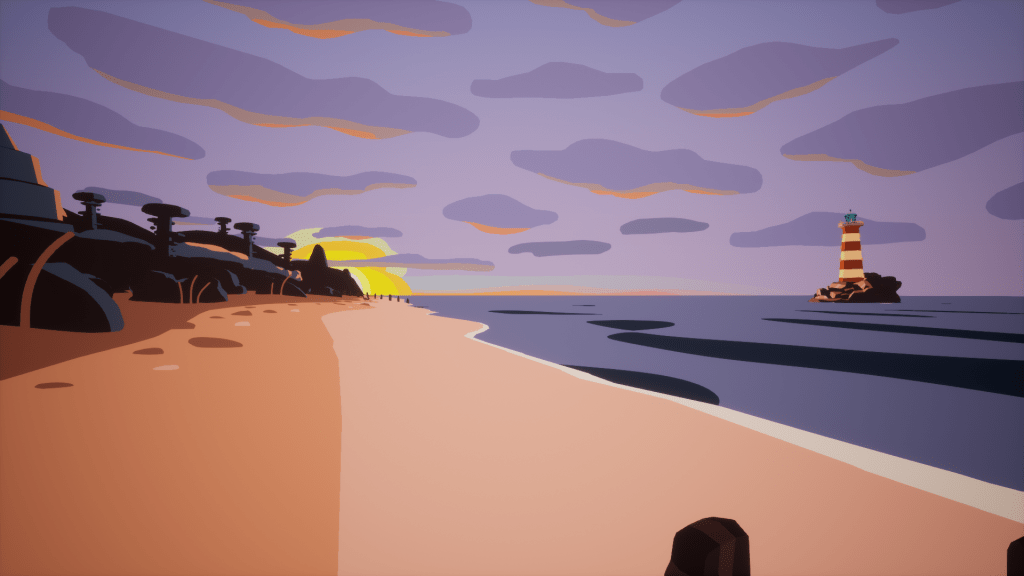
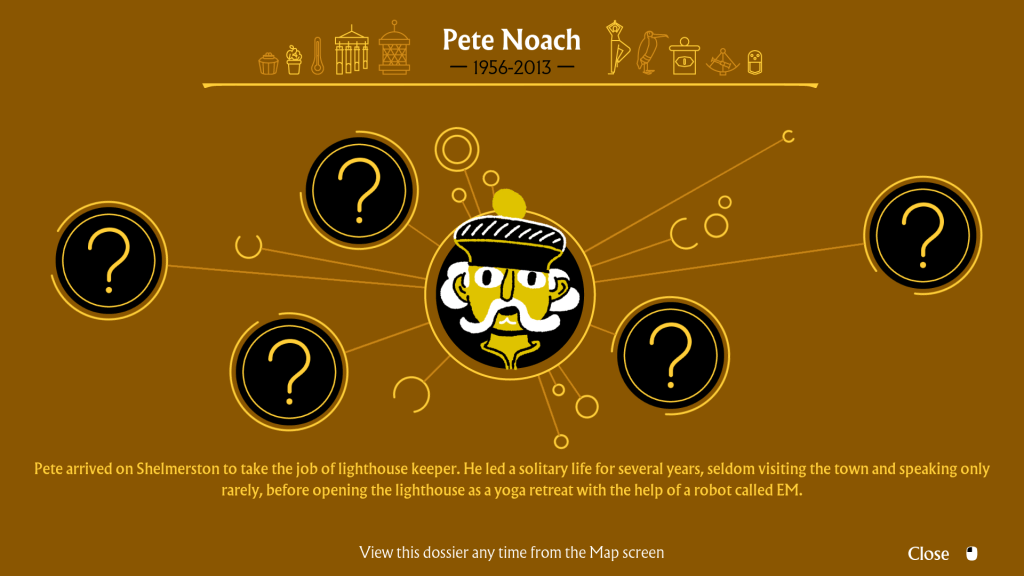
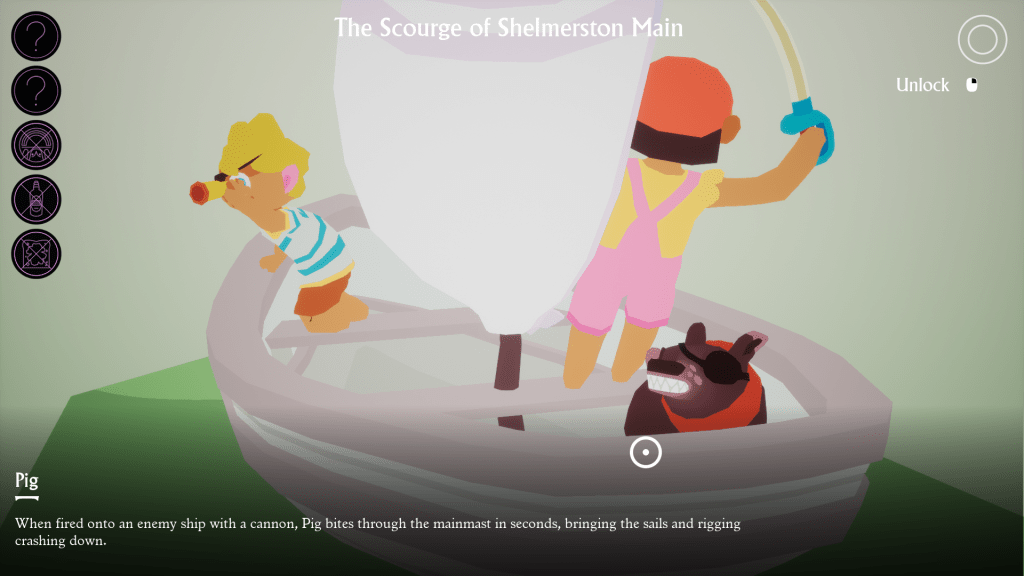
Contrary to what its morose title might suggest, I Am Dead is a genuinely touching and pleasant puzzle game that has you uncovering the history of the small port village of Shelmerston in an effort to secure its future.

In I Am Dead you take on the role of Morris Lupton, a recently deceased citizen of the village of Shelmerston. In his life, Morris was the curator of the Shelmerston Museum, a role that he took great pride in as a lover of his hometown. In death however, Morris teams up with the ghost of his dog Sparky to uncover the true nature of why the dormant volcano that the village is perched around has begun to rumble for the first time in centuries.

Shelmerston has long been kept safe from a fiery demise thanks to a spirit who sacrificed going to heaven in order to watch over the village, taking on the role of the Custodian of Shelmerston. Aggi, the Custodian in question, had her remains dug up and put in the museum by none other than Morris himself, which is what seems to have caused her power to wain. So Morris and Sparky set out on a journey to find a new spirit to take up the mantle and keep the village safe for years to come.

You do this by diving into the memories of people who came in contact with a potential replacement Custodian, learning about who they were and what their impact was on the town. One of the first spirits that you’ll investigate is the daughter of a prominent artist in the village who had no interest in following in her father’s creative footprints.

You’re then presented with this tableau of an outdoor art installation filled with various tourists and artists. You’ll eventually come across someone with a thought bubble above their head which signifies that they’ve got a story about this potential new Custodian. Upon entering their mind, they’ll begin to narrate a story about their encounter with whomever you’re investigating at the time. You’ll also play this not-so-great mini-game where you drag your mouse up and down until you make a blurry image that encapsulates their narration into a clear one. The story being told, while very interesting and enjoyable, is in service of revealing an object that held meaning to the potential Custodian.

This is where the “puzzle” aspect of I Am Dead comes into play. You’re never really solving anything when it comes to the main plot-line of the game, instead you’re trying to locate the object that was discussed in the memories you invade. It seems simple at first, but the way you go about finding these objects is pretty fun, but might be better explained through example.

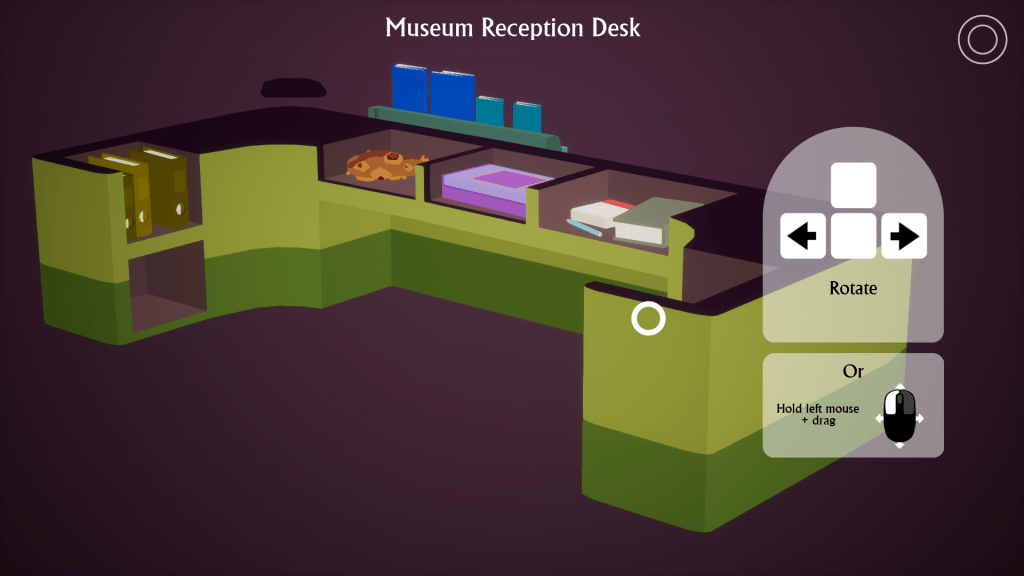
One of the objects on my list was a Frisbee with some stars on it that was confiscated by a real uppity campground manager. In each level, there are these smaller inspection areas where you can focus on individual objects and structures. In this example, the manager’s RV was one of these inspection zones that I could zoom into and peel back the layers of. As you zoom into the RV the walls melt away to uncover a messy interior littered with various flotsam and jetsam to look at. You can click on cupboards, bottles, coolers, toys, plants and much more to see what’s inside of them by zooming in. Eventually I zoomed in on a chair that had a storage space underneath it and found the Frisbee, crossing it off the list of items in the level I needed to discover.

The idea behind finding these objects is to awaken the spirit of said influential person that once inhabited the island in order to ask them to take on the mantle of the new Custodian. And that’s kind of the core loop of I Am Dead. There are other challenges in every level that you can accomplish that fall into two categories.

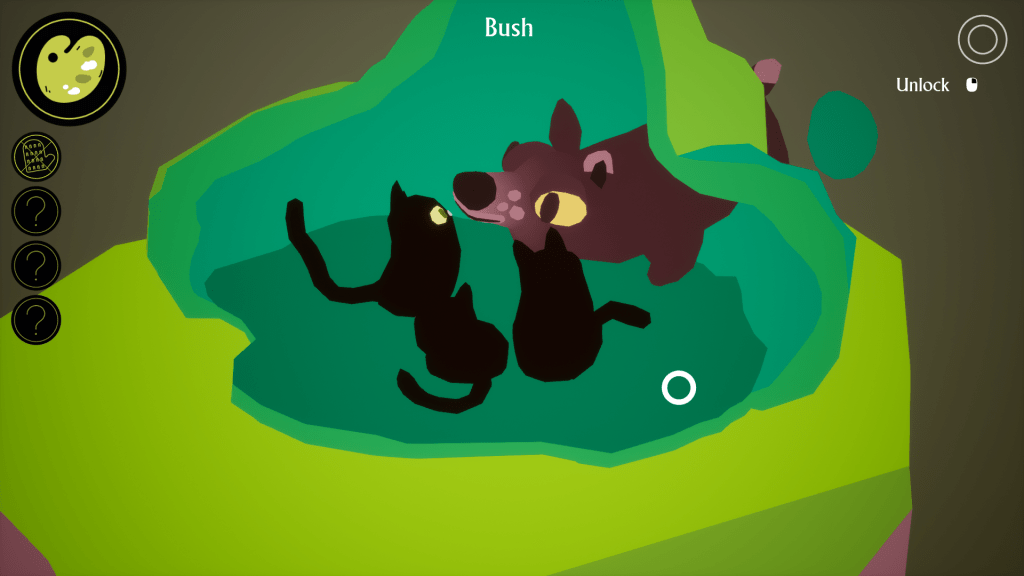
The first comes in the form of these tiny little spirits called Grenkins. Unlike the plot relevant objects you need to find in I Am Dead, the Grenkins are tougher to find and even tougher to collect when you do find them. Whenever you click on a tableau with a Grenkin hidden in it, Sparky will bark a bit and show you an icon that most of time, looks like nothing. In reality, what you’re being shown is the cross-section of an object that is at a particular angle and level of zoom. Luckily the game gives you an indication if the object you’re highlighting has a Grenkin in it, but finding the correct angle can sometimes take longer than any other objective on the island.

The other challenge comes in the form of riddles. Some bizarre spirit will list off some objects that are pretty well hidden and provide you a riddle to their location. I found these to be the hardest challenges in the game, because they’re phrased fairly vaguely and usually point to objects hidden inside of other objects. An example that sticks out to me was a clue that alluded to a steeped art supply, which turned out to be an eraser that was dropped into a cup of tea. You’d never even find it unless you were inspecting this one particular cup of tea very closely for some reason. That, or you’re really good at riddles.

To me, the story of Shelmerston, its history and inhabitants were the real star of the show. Learning about the village and the stalwarts who lived in it very quickly out-shined the hidden-object part of the game. The characters are all pretty interesting and seeing the impact they had on the lives of those around them was delightful and quite frankly, heartwarming. I also thought that I Am Dead ended very strongly, delivering on the emotional weight that had been built up over the five hours or so it took me to complete it.

I Am Dead is a great story wrapped up in a low impact game that touches on so many aspects of coming to grips with mortality in a surprisingly hopeful way. It’s funny that a game that’s quite literally about death and being dead can be such a pleasant experience, but I think that was the point. If you’re looking for something lightweight and cheerful, oddly enough, you should check out I Am Dead.

Gut Check: Solasta Crown of the Magister

Not so long ago I wrote a lengthy piece about my issues with the state of the early access release of Baldur’s Gate III. Without rehashing that entire article here, the main crux of it focused on the mechanical liberties Baldur’s Gate III took with the rules of Dungeons & Dragons 5th Edition. My initial thought was that translating the rules of D&D into a video game would naturally require a ton of concessions, however another CPRG named Solasta Crown of the Magister recently entered early access and proved that theory wrong.

Solasta Crown of the Magister is a turn-based, isometrically viewed, party-focused RPG that might not have the best presentation, but impressively implements the rules of D&D in an easy to understand fashion. It’s actually been quite refreshing to be able to jump into a CRPG and know exactly what I’m doing for once, because usually it feels like I’m trying to learn a new language with these types of games. Solasta Crown of the Magister uses the SRD 5.1 rule set to great success, managing to appeal to veteran players of D&D without compromising accessibility to new players, and that’s something that deserves to be praised.

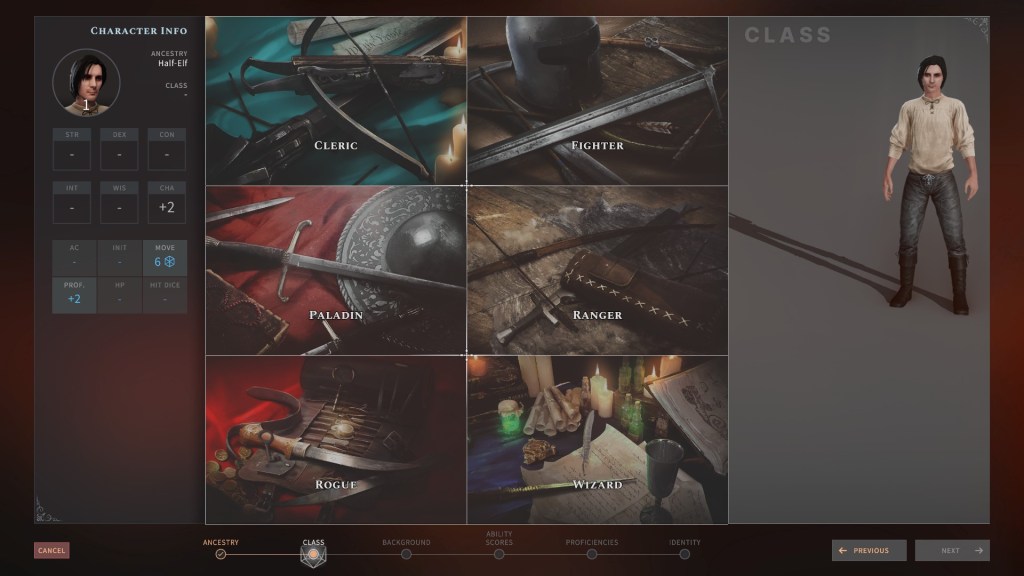
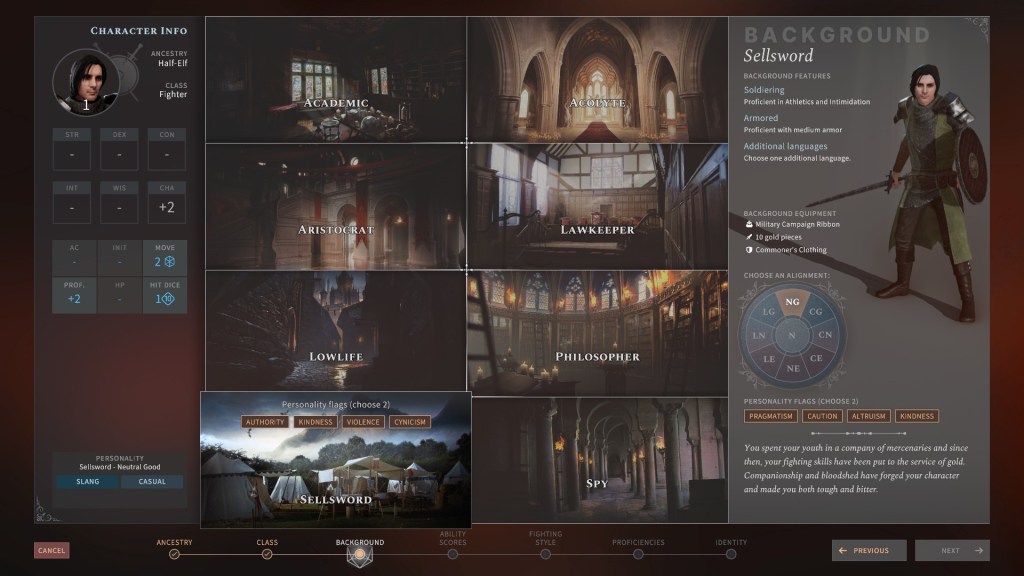
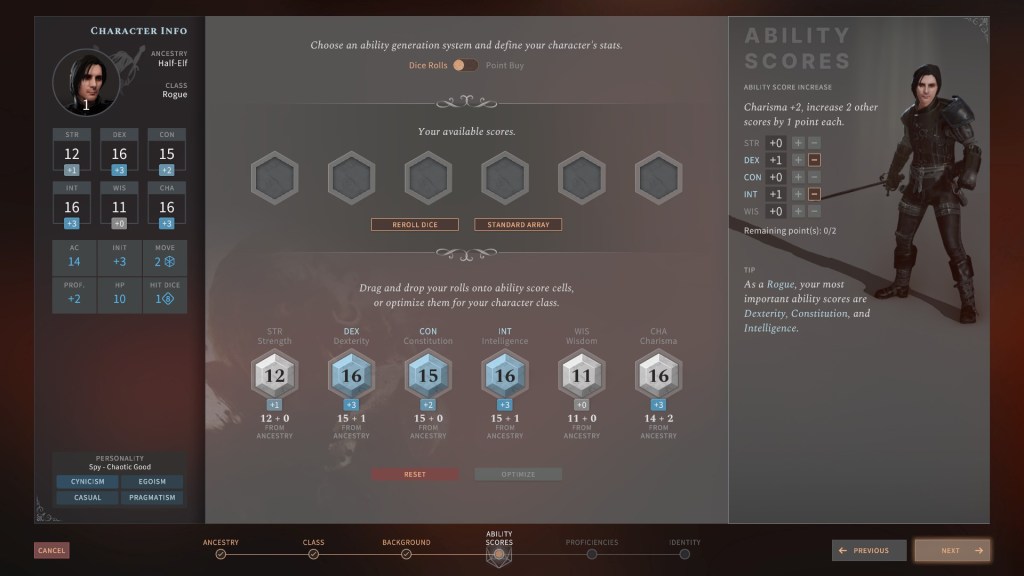
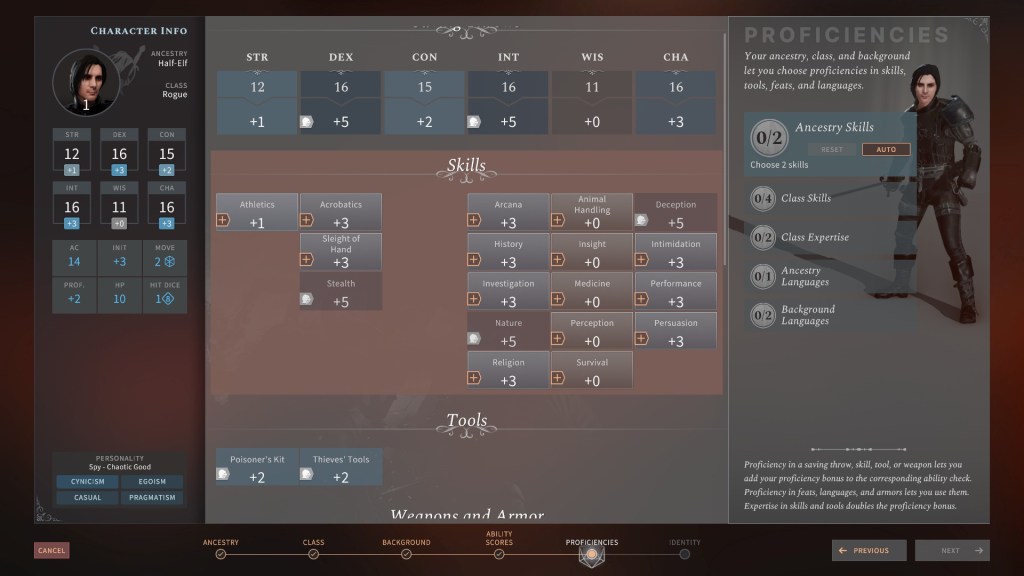
When you start Solasta Crown of the Magister, you can build an entire party from scratch or use some of the pre-generated offerings if you like. When building a character, you can choose from 8 playable races which include specific race variants (i.e. High Elf & Sylvan Elf), 8 backgrounds and 6 character classes. You are walked through character creation step by step, letting you know everything from what a particular god is all about, what benefits a certain background might grant and much more. I genuinely love the process of creating a character and think it’s fantastically well done, with the exception of how the character actually looks.

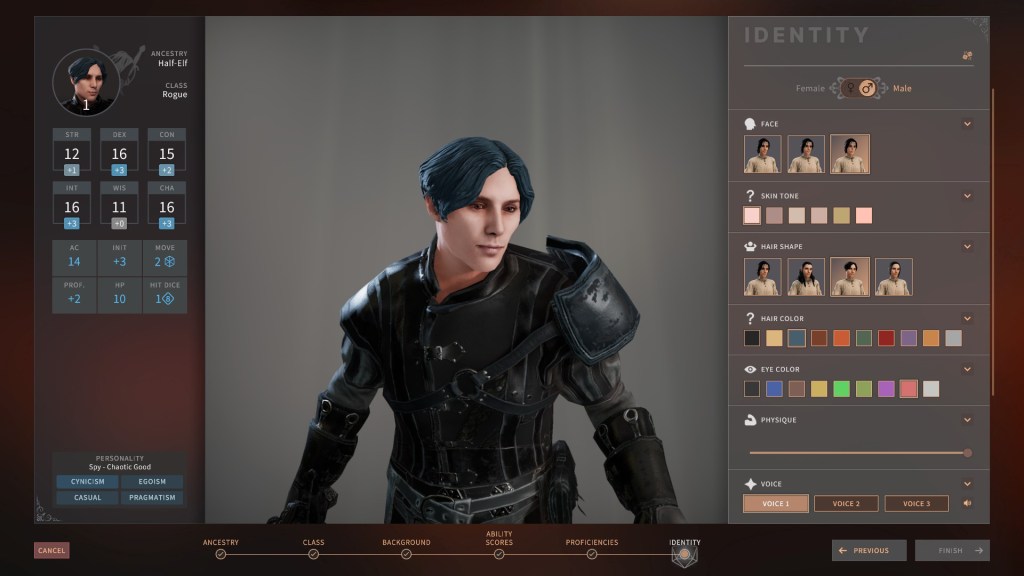
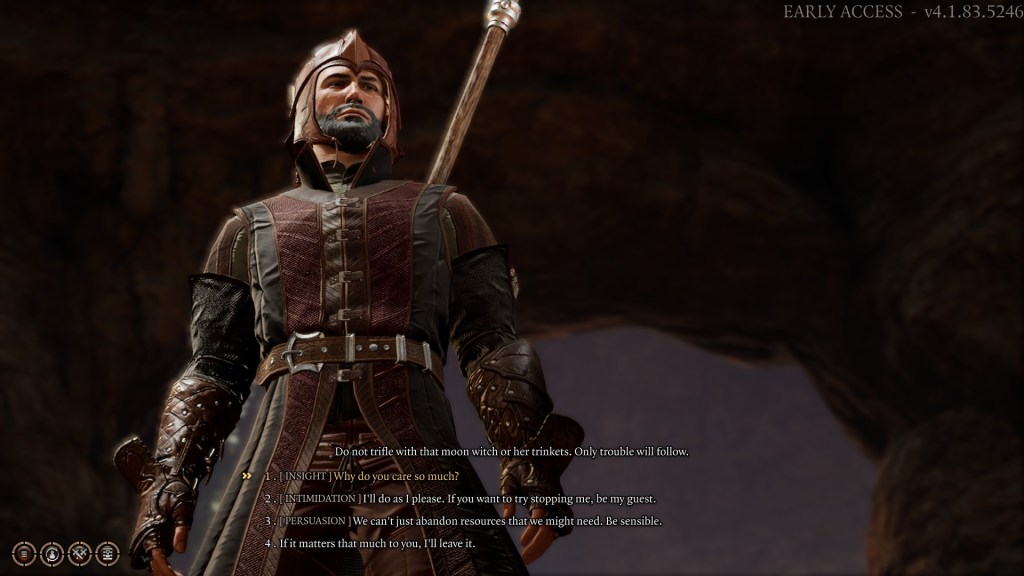
Therein lies my main hangup with Solasta Crown of the Magister. The actual appearance of your character is pretty rough. There’s only a handful of face and hair options to choose from which is particularly underwhelming for any role-playing game, but it highlights this hilarious imbalance between how mechanically sound the game actually is, versus the customization stuff. That point is only exacerbated by the facts that not only do the character models look very rough, but all of the NPC’s in the game are made from those same options. It led to a lot of moments where I’d see the same “dude with a beard” as both a quest giver, and a random bandit attacking me in the night. There isn’t any real variety for physical appearances, which desperately needs to be addressed.

But hey, it’s early access, and I honestly prefer having a mechanically sound game versus a pretty one. If I could mash up both Solasta Crown of the Magister and Baldur’s Gate III, we’d have ourselves one hell of a CRPG to contend with.

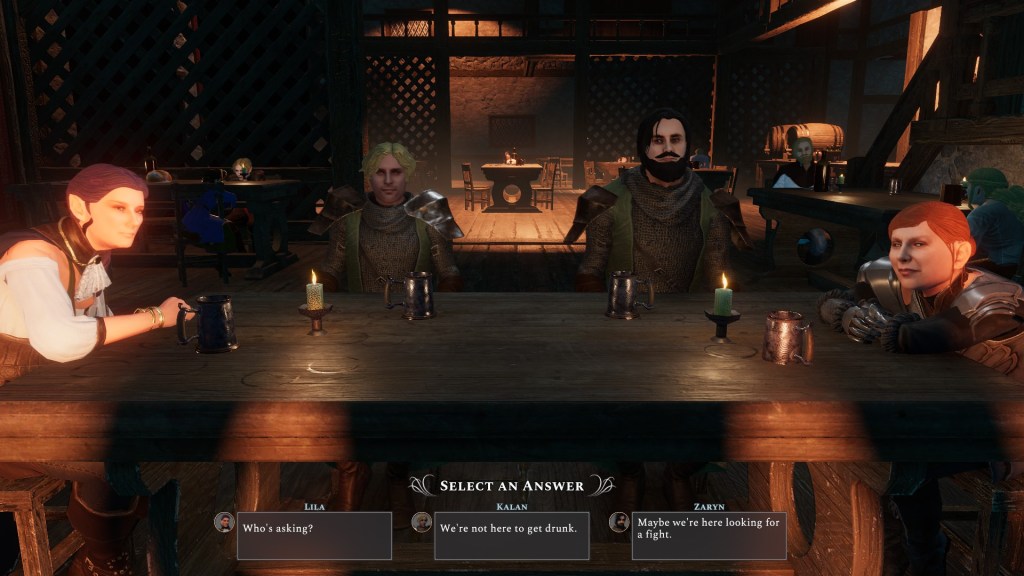
I also really appreciate that this game starts with your adventurers meeting in a tavern and sharing their stories (tutorial missions) about their journey here to each other. It’s a very funny jab at the fact that all good D&D campaigns start in a tavern, although it really tries to force some of your characters into specific tutorial boxes. For instance, my party is comprised of a paladin, a fighter, a cleric and wizard, all of whom shared their “tale of triumph” with one another.

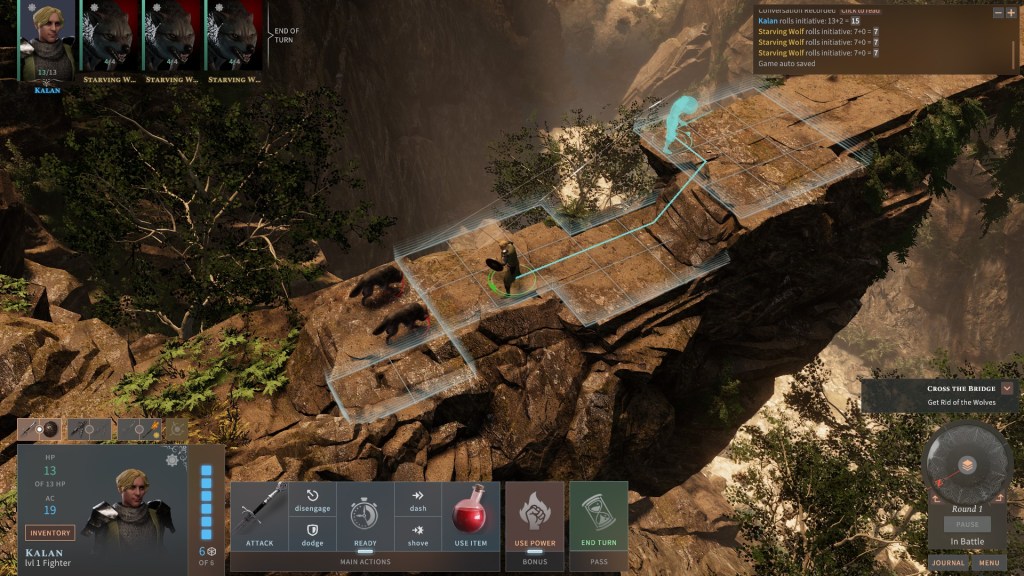
The first tutorial taught me how to just move around the world via escaping a prison, the second taught me how to kill wolves and push them off cliffs, the third taught me how to utilize light, resting, and healing potions, and the final one was a stealth mission. Now, you may have noticed it too, but I don’t have a rogue in the party. However, Solasta Crown of the Magister made a decision and decided that my cleric was the perfect fit for the job. She handled it well enough, but I’m certain the rolls were weighted in my favor for the tutorial. It’s nothing game breaking by any means, but it certainly is immersion shattering when the game just decides on a character trait for the sake of a tutorial.

Once through the tutorial, you get your first chance at navigating dialogue situations. Each player was given a set of tags to choose from during character creation based on their alignment and background, which I believe (although I’m not certain) impacted who had a certain dialogue option to use. I didn’t see any dialogue choices in the traditional sense, but a tutorial tooltip made it sound like the game would automatically select the character with the highest stats to perform a particular dialogue skill check. But from what I saw in the first hour or so of playing was that each character just has one dialogue option to interject into the conversation. Hopefully this expands as I play more of Solasta Crown of the Magister, but as is, I do appreciate how every character is at least involved in the conversation.

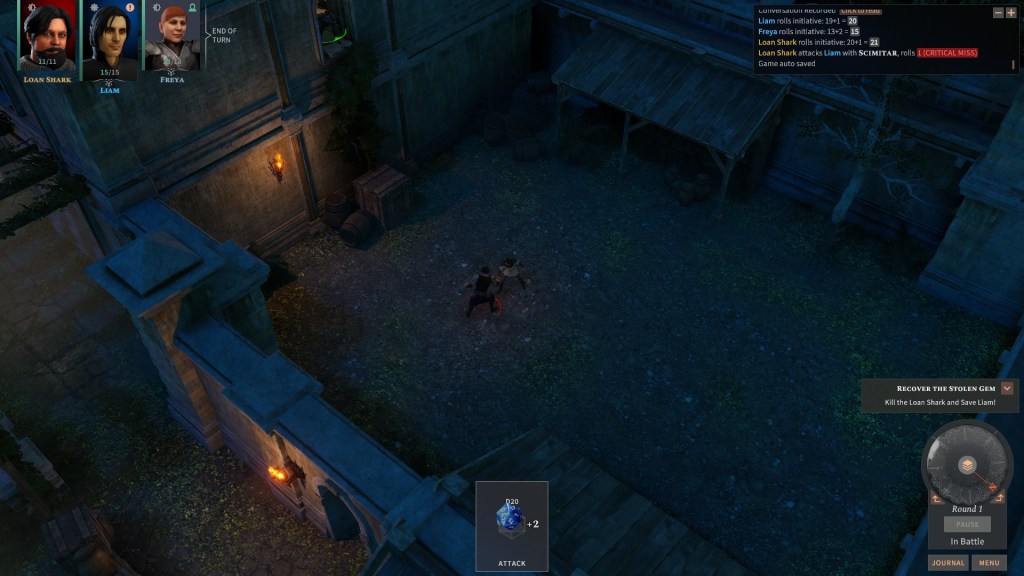
Solasta Crown of the Magister really shines in a lot of different areas despite being pretty rough in the presentation department. The voice acting is hit or miss and the characters all look pretty bad, but it’s mechanically competent for a D&D video game. One of my favorite touches is how you’re placed into a visible grid when you enter combat, leaving no ambiguity about where you are or who you’re vulnerable too. Honestly, the user interface in general is much easier to follow than it is in Baldur’s Gate III.

Another really intriguing aspect about Solasta Crown of the Magister is how it’s structuring campaigns. From the looks of things, there isn’t going to be one overarching campaign that will occupy you for hours upon hours. Instead it looks like they’re going for a more anthology approach, with Crown of the Magister being the first playable campaign. It’s a really interesting approach that comes with its own set of pros and cons. For instance, I can see a really easy post launch support structure that just injects new campaigns into the game, but it also makes you wonder if you’ll get any of the inter-party drama that you would get from other games like romance options and new recruits.

Solasta Crown of the Magister is in early access, so my gripes with the game as it is are bound to change, but without a development roadmap to refer to, all I can do is speculate at this point. Most importantly, it should be noted that this comes from a very small studio that hasn’t shipped a game before and found their funding via Kickstarter, so their resources are a bit more limited. To expect Solasta Crown of the Magister to offer the same amount of features and intricacies that something like Baldur’s Gate III is implementing would be unfair, but in my opinion they’ve already tackled the hardest part by successfully translating the D&D rules into a video game. That alone might be a good enough reason to check it out.

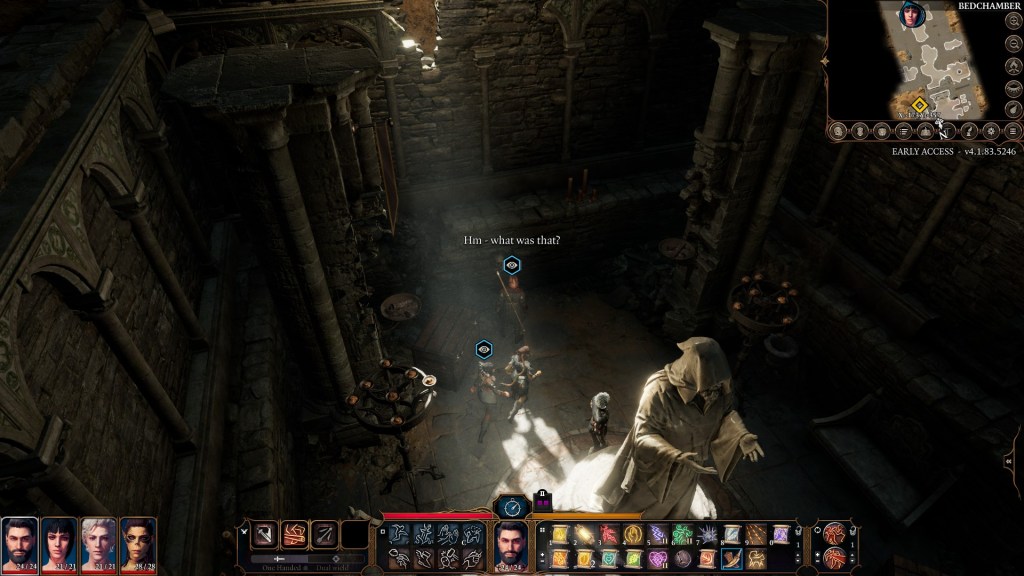
Some Notes About Baldur’s Gate III

Before I dive into the bulk of this article, it should be mentioned that no video game could ever truly capture the Dungeons & Dragons experience solely because there are static limitations to any video game. You can account for a lot of things as a game designer and try to cater to dozens of styles of play, but no game could adapt to the wild and imaginative things that players regularly ask of their DM’s quite like a living, breathing person present. Yet in spite of all of that Baldur’s Gate III already shows incredible promise when it comes to representing D&D and is a game I’m genuinely enjoying.

Don’t get me wrong, Baldur’s Gate III is a technical mess at the moment but I know what I signed up for when I decided to buy a game that’s in early access. I’m not going to harp on the performance of the game too much, but if you’re curious about what I mean by a “technical mess,” I can summarize that really quickly.

In its current, fresh into early access condition, Baldur’s Gate III runs inconsistently, usually fluctuating anywhere between running at 20 fps to 144 fps on my machine. Lip syncing for the new “cinematic” conversations is basically non-existent, and graphical glitches from T-posing, duplicating NPC’s you’re actively talking to, and ragdolls going wild are common occurrences. That kind of stuff is all bound to be smoothed over during the course of their early access period, so I’m not worried about that.

With that said, there are some things I would very much like to see fixed, changed and improved that pertain more to how the Dungeons & Dragons rules are translated into a video game. While this article isn’t a comprehensive list by any means, it does represent the things that I have personally noticed. I really love D&D, but I wouldn’t consider myself an expert in its mechanics or lore, so this is truly just representative of how I enjoy playing Dungeons & Dragons.


SHOW ME THE NUMBERS

In D&D you have a core set of skills like strength or wisdom, that as you pour stat points into them you’re granted a higher modifier. A modifier is the number you add to your roll or in some cases subtract from it, representing…well your skill at a particular ability. For instance, a rogue is going to be pretty good at sneaking around, picking pockets and doing cool flips, so their dexterity score and thus, modifier are going to be higher. Without just explaining the rules of D&D anymore than I already have, the rogue would have a couple of numbers they can add to a D20 roll in order to clear the difficulty class (DC) that represents how hard what they’re attempting is.

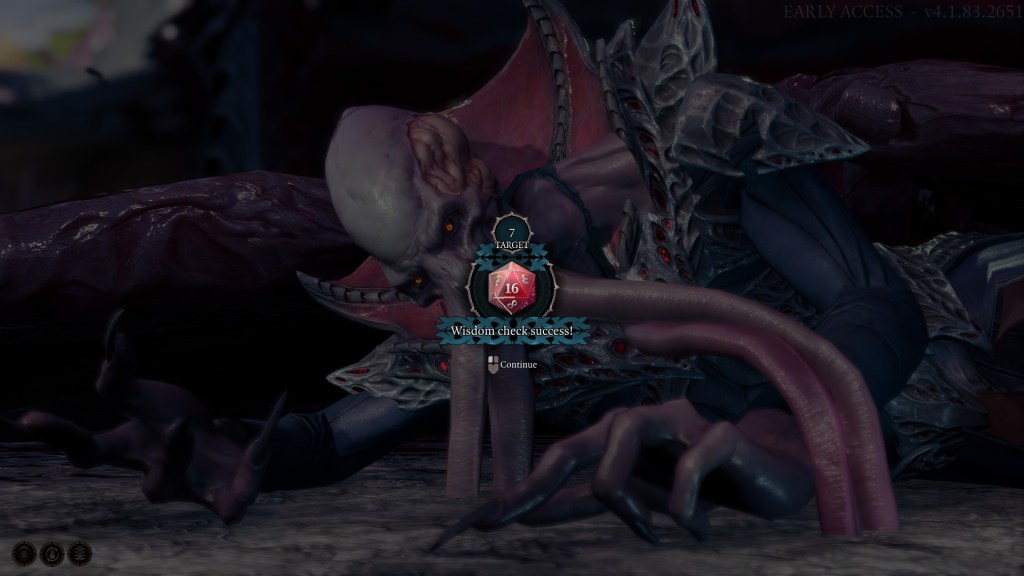
A DC of 7?

Baldur’s Gate III does this as well, but oddly enough reverses it. Instead of you adding numbers to a roll to clear a DC, all of your stats and bonuses subtract from the DC. It may not sound like a big deal, but after years of playing D&D it’s an incredibly jarring change. I suspect that the reason for this change is to make it simpler for new players with little to no experience with D&D to comprehend what’s going on. It’s obfuscating the math as not to confuse people and just have them focus on the dice roll itself, but that should definitely be something I can toggle on and off. As a player and a DM, I want to see those numbers.

Also, it just feels better to roll higher numbers than it is to roll low ones.

CHECKS, PLEASE

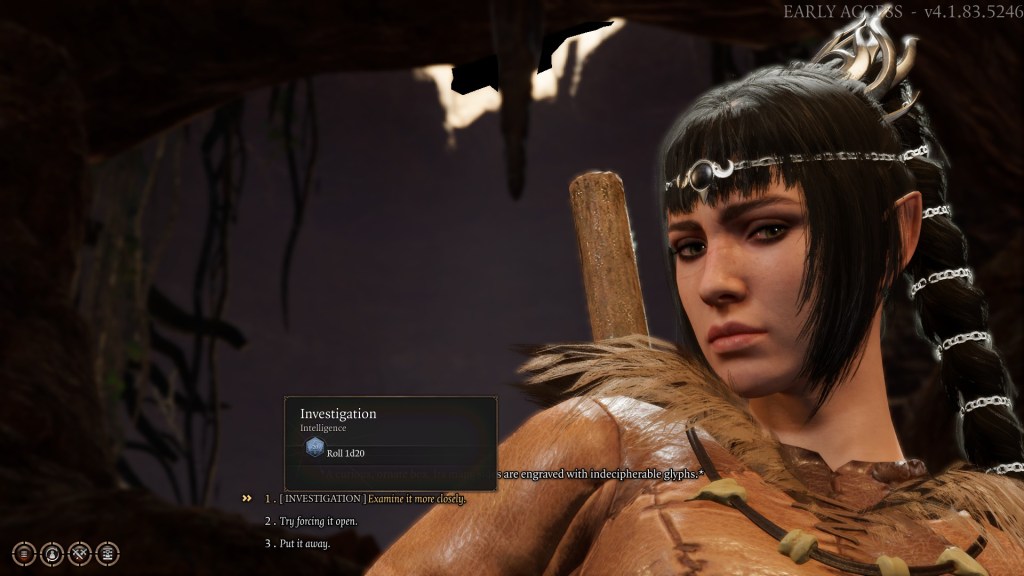
Considering that there isn’t really a DM in Baldur’s Gate III outside of a narrator who pops in regularly to make you feel like everything you’re doing is wrong, there isn’t much of a way to just perform random skill checks as far as I can tell. In D&D, if I find myself in an ancient library as a barbarian, I’m going to just sit back and contemplate how flammable these “books” as you call them, actually are. Yet if I’m a big brainy wizard, I’m going to be rolling arcana and history checks like they’re going out of style.

Half of the fun of playing D&D is being able to uncover clues or lore about the world through performing well timed checks. Being able to do a perception check when I enter a room or run a nature check on a potentially poisonous berry are just a sliver of ways that players get to feel powerful and useful as their characters.

There isn’t really any of that going on in Baldur’s Gate III however. The way that certain skill checks are handled is kind of bizarre and a little too passive for my liking. The only active checks I can perform are in dialogue situations, where I pick the line of dialogue that allows me to roll an insight or deception check. I understand this limitation in conversations because the alternative would be an colossal feat of programming. Allowing me to just roll whatever check I want in any and all conversations seems akin to asking Larian Studios to work on Baldur’s Gate III till the end of time.

But outside of conversations and combat, it’s just weird to me how pushed into the background a lot of these checks are. Almost every skill check that occurs while exploring is transformed into a passive check. I assume the game is rolling a dice in the background, but it’s still incredibly weird that I have no say over what check I’m rolling and when. I wouldn’t mind if there was some sort of “active DM” situation that would prompt me to roll a stealth check when I wander into a bad situation unwittingly. And if I do succeed on a passive perception check it would be nice to know what it is I noticed, because virtual Ari might see it, but flesh Ari does not.

While I’m bellyaching about the checks in Baldur’s Gate III, I wouldn’t mind if the game slowed itself down entirely to act like a DM. If there’s a trap I’ve wandered into, stop the game and bring up a menu that says, “hey, you fucked up and didn’t check for traps cause we don’t let you just do that, and now you’ve gotta roll dexterity saving throws for these party members. Good luck!” That’s the kind of D&D stuff I’m looking for from Baldur’s Gate III.

I think I just want Baldur’s Gate III to capture the feeling of sitting down to play D&D more than I want it to capture the world and lore. Sure those things are important to me, but when I ask for more transparency in dice rolls and checks, it’s because I’m trying to get that rush of playing D&D out of Baldur’s Gate III first and foremost.

PARTY PLAY

This one is genuinely confusing to me, because it’s such an important part of the communal experience of D&D that its absence from the game is beyond odd. In D&D, your character cannot and should not be a skeleton key that can just do everything. Your characters are supposed to be flawed and fallible, which is why adventures travel in parties. The wizard may be a really smart magic-man, but he needs the fighter and her strength to defend him cause he’ll just get squished like a bug.

In its very early access state, Baldur’s Gate III seems to miss that mark by a wide margin. At the moment, my party has a cleric, fighter, rogue and a warlock, all with different skills and proficiencies that should work fairly well together. In combat, different skills and abilities work wonderfully together. Having the rogue shoot an oil barrel causing its contents to create a puddle under my enemies, followed by my warlock igniting said oil was a satisfying example of synergy, but outside of combat that isn’t really the case.

What isn’t in Baldur’s Gate III is an easy way to compare the skills and proficiencies of your characters without having to dig through a menu. So when I’m trying to break down a door or disarm a trap, I have to make an assumption on the fly of who to send to tackle said obstacle. Giving me a prompt or tool tip that just says like, “lock picking check” and then an ordered list of who in my party has the highest relevant skill for it would be nice.

But the most infuriating example of this is in situations where you have to talk to people. Baldur’s Gate III doesn’t do a great job of incorporating the rest of your party into your conversations. Sure, their lifeless husks will loom in the background unblinking while a man tells you the sad story about his brother or whatever, but they won’t help you in any way. For instance, if my character had a super low charisma score, I’d have to live with that every single time I entered into a conversation with someone. I wouldn’t be able to let the smooth talking bard (who isn’t in the game yet) do their thing and schmooze people over, no, instead Gronk the dwarf with a brain injury is going to ruminate on the income disparities that run rampant throughout the city of Waterdeep. That’ll fucking go well.

All I’m saying is, the adventuring party relies on one another for their talents and abilities, and I feel like Baldur’s Gate III doesn’t deliver on that in certain aspects of their game to varying degrees.

WAIT, I WANT TO GO BACK

There are times in D&D where a player might have a plan in their mind that they try to enact, only to find out that mechanically it wouldn’t be possible. That’s the good thing about having a cool DM, they’ll let you know that your harebrained scheme isn’t going to work or they might even work with you to make that nonsense happen. What’s even cooler is when a DM let’s you rewrite your turn upon finding out that said nonsense isn’t going to work.

Baldur’s Gate III is not a cool DM and is a bit of an asshole when it comes to you being able to fix your mistakes. Now I’m not asking for Baldur’s Gate III to allow me to just try out spells on enemies till I get the result I like or anything, but I don’t think it would be a big deal if it let me undo my movement if I haven’t taken an action yet. With the camera and path-finding in Baldur’s Gate III being what it is, which is to say it’s bad, being able to undo your movement in your turn would be extremely helpful.

Too often I’ll find that I’ve wasted my movement, taken an opportunity attack, and ended up in prime position to be blasted by 3 wizards and an archer. All of this could be fixed with a simple “undo” button. To be entirely fair though, that button may exist somewhere, but lord knows I haven’t found it yet.

STOP, NO, WAIT, GO THERE

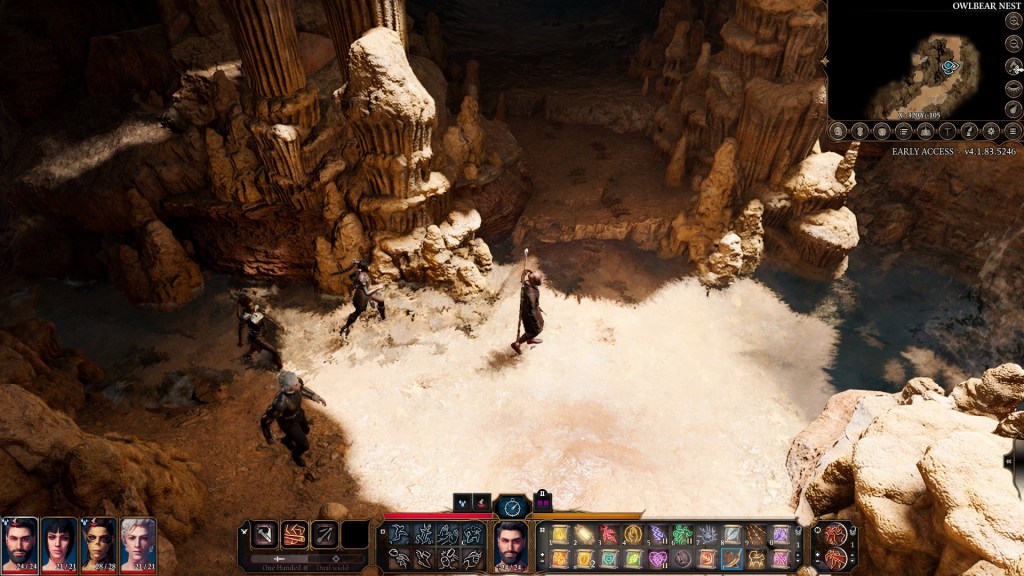
I never thought an isometrically oriented game could have so many camera and movement control issues, but here we are. It’s borderline maddening how many times I’ll try clicking on something that I can clearly see, only for my character to interpret “go there” as, “climb that mountain behind you.”

Part of this frustration has to do with the camera, which might function exactly like it did in Larian’s previous titles, but I couldn’t say for sure. But in Baldur’s Gate III, the camera does this cut away trick to reveal the area in front of and around you while dissolving any trees or natural coverings that would normally obscure you to account for whatever angle you’re viewing the action from. Think of how The Sims does it, where those things are still there, but you need to rotate the camera to see them again.

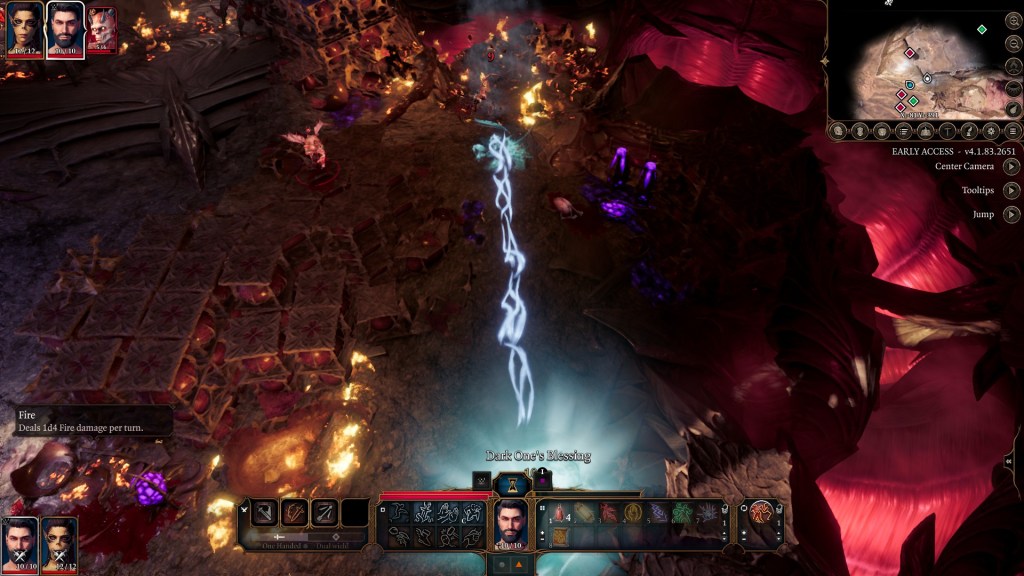
What Baldur’s Gate III does which has resulted in my great frustration, is allowing me to click on things that I can’t see. There was an instance where there was a natural stone archway that formed out of the side of mountain that had a road running underneath it. I made the mistake of stopping too close to the archway I suppose, which resulted in me trying to click further up the road to progress forward, but the cursor actually clicked the top of the archway that was dissolved away by the camera. I couldn’t see the thing I just clicked on, but my party tried to climb that archway with gusto.

Luckily for me though, there wasn’t an actively burning fire on the way up the mountain or else my party would have just charged right in there without any sort of self-preservation in mind. For instance, during the tutorial you find yourself in an area where fire is happening all around you and you need to kind of just walk past it. There’s a pretty large path to follow, but your characters only know of the most efficient route to get to where you clicked, which is barreling straight through regardless of what’s in their way.

The amount of accidental fire damage I’ve take in Baldur’s Gate III already is alarming, and I really hope the path-finding gets better cause I’ve already wiped my entire party because instead of running around the combat encounter, they walked right into and stopped in a puddle of grease putting them in prime roasting position. It was a nice present for my enemies I suppose.

WHERE IS IT?

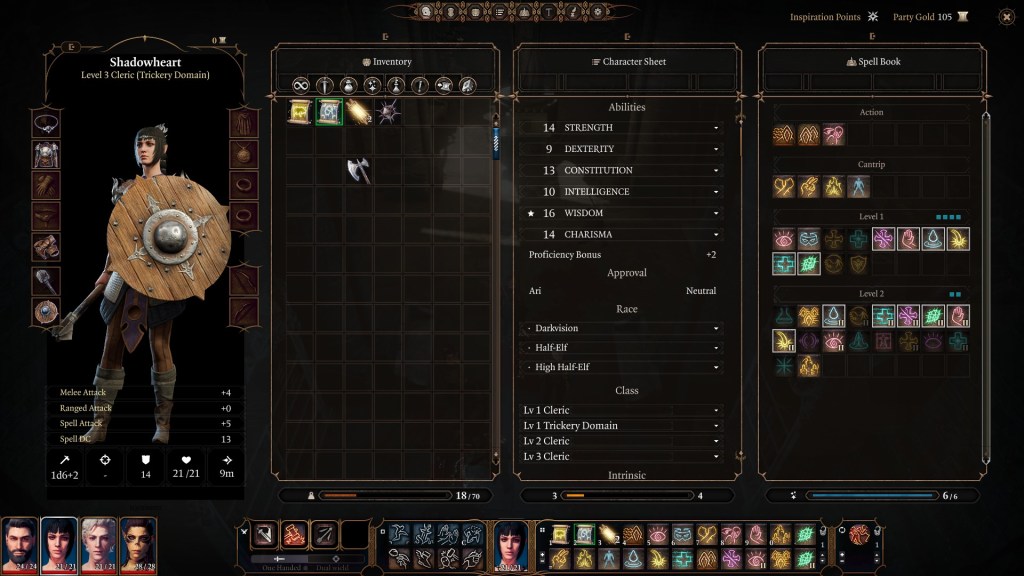
Look, I don’t have a ton of experience with games like Baldur’s Gate III so I’m sure that a cluttered inventory and unorganized hotbar are just expected at this point, but the way in which Baldur’s Gate III “organizes” your spells is truly abysmal. For those who don’t know, casting spells in D&D is a bit of a process that involves making sure you have the spell slots available, picking a level, and then casting the spell and rolling its damage. If that didn’t make any sense to you, that’s fine, just know that Baldur’s Gate III makes finding your spells a chore.

Instead of giving me a list of spells I could cast and then asking me what level spell slot I want to burn on it, they just give you an icon for each spell at each level. Wanna cast magic missile at level 2? Well you gotta scroll through the hotbar to find the magic missile icon with a little roman numeral 2 on it. It’s painfully unintuitive at the moment, but I suspect it’s a remnant of trying to shove the D&D mechanics into Divinity: Original Sin II‘s engine.

Your spells are also just kind shoved into the hotbar all willy-nilly, something I think you can reorganize, but it crams everything your character can do into it with no organization. For instance, I have a fighter in my party who can perform strikes that can cause the fear condition in an enemy. I recently leveled her up in a way where she’s received some spells she can use as well. Instead of separating those skills into folders that are marked as “fighter abilities” or “cantrips,” it’s just all kind tossed in there for you to click through along with the myriad of spell scrolls you pick up, making combat kind of a slog when it’s the turn of a magic user.

In the same vein, the initiative tracker is absolute garbage and needs to be changed entirely. There are times where it’s supposed to be my turn, but then someone else just gets to cut in front of me for some reason. I’ve even had instances where a character I’m controlling will get two turns in one round. It’s bizarre.

AM I THE ONLY ONE PLAYING BY THE RULES?

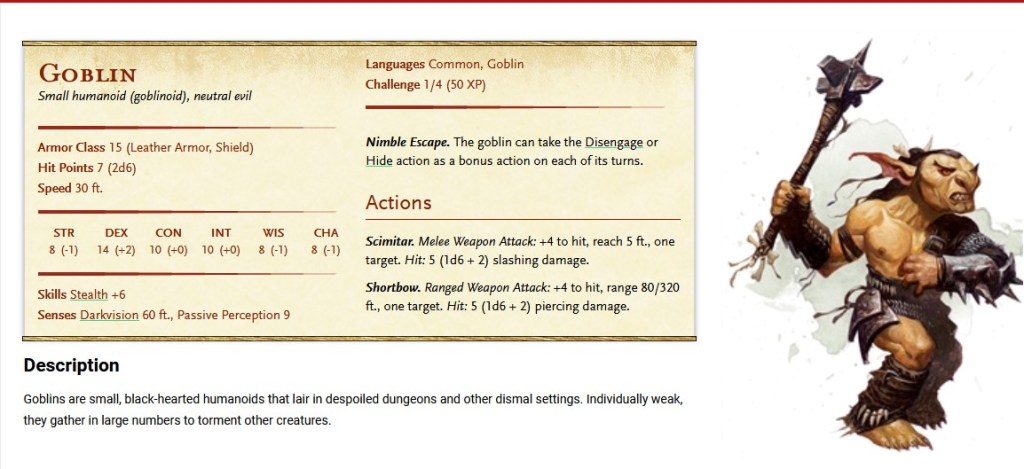
I don’t want to be that guy or anything, but it sure does feel a bit like the enemies in Baldur’s Gate III are just kind of freestyling it when it comes to their abilities. I noticed this very early on when there’s a goblin attack you find yourself in the middle of. I’ve played enough Dungeons & Dragons to know the goblin stats pretty damn well, so I took notice when the goblin took more than 7 HP worth of damage and still lived.

Goblin – D&D Beyond

It’s a really weird an unwelcome choice to tinker around with the stats of enemies when you’ve got literal books worth of reference material to pull from. I understand the need to alter things to make them work in a video game, but this one seemed completely unnecessary. Now I can’t use the Monster Manual as my own personal strategy guide.

I’VE PLAYED THIS GAME BEFORE

If there is one thing to me that is more damming about Baldur’s Gate III than anything else I’ve already mentioned, it’s that this game feels awfully similar to another Larian Studios game, Divinity: Original Sin II. I didn’t play very much Divinity: Original Sin II, but I sure as hell played enough to recognize it when juxtaposed with what’s supposed to be a game recreating the D&D mechanics. Aside from both games having a ton of visual similarity, there are two mechanics that I’ve personally seen that made me feel like I was playing a version of Divinity that was cosplaying as D&D.

First and foremost has to be the movement and map structure. I know it’s way more dynamic and interesting if you can have free access to just about anywhere on the map during a combat encounter, but for a game trying to present the rules of D&D accurately, there should be some sort of grid-based movement. In D&D, each grid block is supposed to represent 5 feet, which is important to know and be aware of considering how many things are tied to your precise position.

I hate this stupid hat, but it gives me +1 to dex saves

For example, I tried to set up this choke-point in a hallway that would effectively be a gauntlet of blades for the enemies trying to escape and alert their buddies. I managed to get 3 of my party members in what I assumed was stabbing range, but these enemies just found this sliver of daylight and plowed throw untouched like they were Barry Sanders or something. It’s things like this that make me yearn for some grid that confined movement or even an arrow I can point that’ll alert me about what I’m getting myself into if I move somewhere.

The other Divinity-esque thing I’ve seen is how much Baldur’s Gate III incorporates environmental effects and hazards into its gameplay. At first, the ability to knock over a bucket of water onto an enemy and light them up with a lighting bolt for extra damage seems awesome, but then you might find a pathway obscured by some fire and have to make the choice of burning a spell slot on it or not. These choices certainly come up in standard D&D play, but the frequency at which these hazards present themselves are a little too much for my tastes.

Like I said, I haven’t played a lot of Divinity: Original Sin II, but from my understanding you have less resource intensive ways of dealing with things like that than you do in D&D.

ROLL THEM BONES

Okay this one is really just me being ridiculous, but I stand by the fact that it should be more fun to roll the dice than it actually is. Clicking a big die and watching the numbers change is fine and all, but what if there was like a physics driven dice I could roll? That would be a lot of fun for me, a simpleton who is easily amused by physics in video games. It would also make it feel more like I was playing D&D proper.


Despite all of my bellyaching about some of the mechanics in Baldur’s Gate III, I’m really enjoying it for what it is. It’s very early and I’m sure I’m not saying anything the developers haven’t already heard, but as someone who plays Dungeons & Dragons regularly these were just some of the things that stood out to me. I haven’t dipped into the multiplayer just yet due to reports of it being busted, but I look forward to giving that a shot once a few patches hit.

I know worrying about certain mechanics that are present in this current version of Baldur’s Gate III is premature at best, and I’m sure Larian Studios will make great strides over the course of their period of early access. It’s going to be a long time before Baldur’s Gate III fully releases, and by then I’m sure I’ll barely be able to recognize it as the same thing I’m playing now.

Ultimately, I might be looking for something that Baldur’s Gate III cannot or isn’t attempting to deliver on. I want that feeling of playing Dungeons & Dragons more than anything else. It’s a big ask for sure, but I feel like this is the closest I’ve come to getting to play a single player D&D game in the rule set that I know. I might take a break from Baldur’s Gate III until some more patches and fixes get implemented, but I can assure I’ll be reading the patch notes that come with every update just to see if it’s the right time to dive back in.