When I finally gave in to all of the peer pressure I felt from the deluge of praise people were hurling at Hades and begrudgingly bought it, I felt this immediate wave of buyer’s remorse wash over me. After playing a little of it however, I can honestly say that it’s one of the most fun action games I’ve played this year. I can also confidently say that I won’t be seeing it through to the end because I’m bad at it.
Hades is a rogue-like action game and the latest release from Supergiant Games, makers of such classic indie titles like Bastion and Transistor. With previous titles like those, Hades had some big expectations around it and a lot of hype that seemed to dull between its release into early access at the end of 2018 and now. That’s at least how I perceived it considering I never really heard much about the game until its official release a few days ago, so I might be entirely incorrect on that front. I know people have a lot of strong feelings about Supergiant’s past games, but I truly think Hades might be the best game the company has released up to this point.
That might come as a surprise to anyone who frequents the site and knows my disdain towards the rogue-like genre as a whole, but that’s how good this damn game is. I won’t lie and say that my feelings toward the genre have changed in any meaningful way, but I am enjoying Hades in spite of the fact that it’s a rogue-like. Hades does some interesting things in weaving the story around the concept of you dying and returning only for you to perish once more. Characters acknowledge these cycles and play off of it in some pretty neat ways that I won’t spoil for anyone who hasn’t played it.
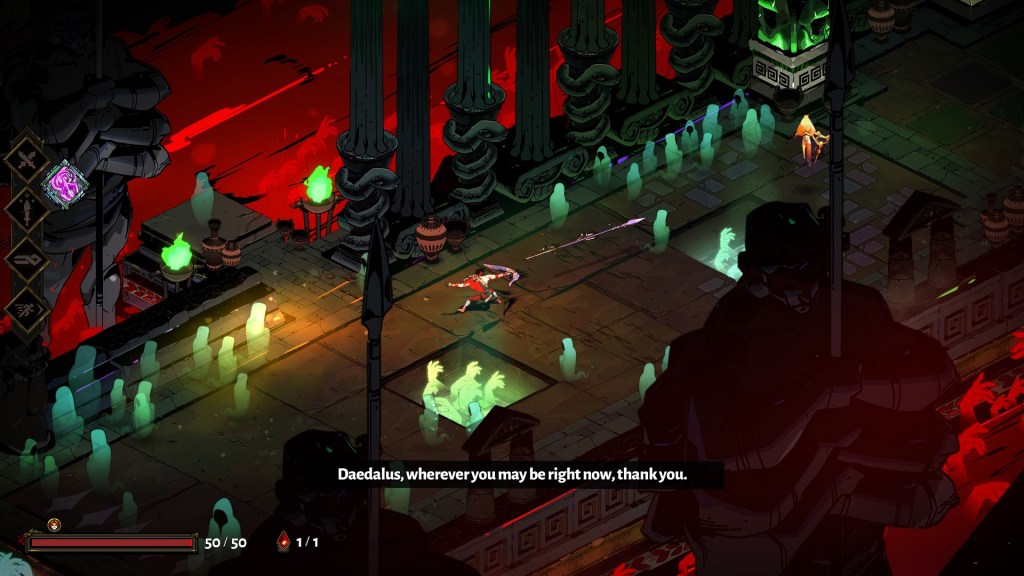
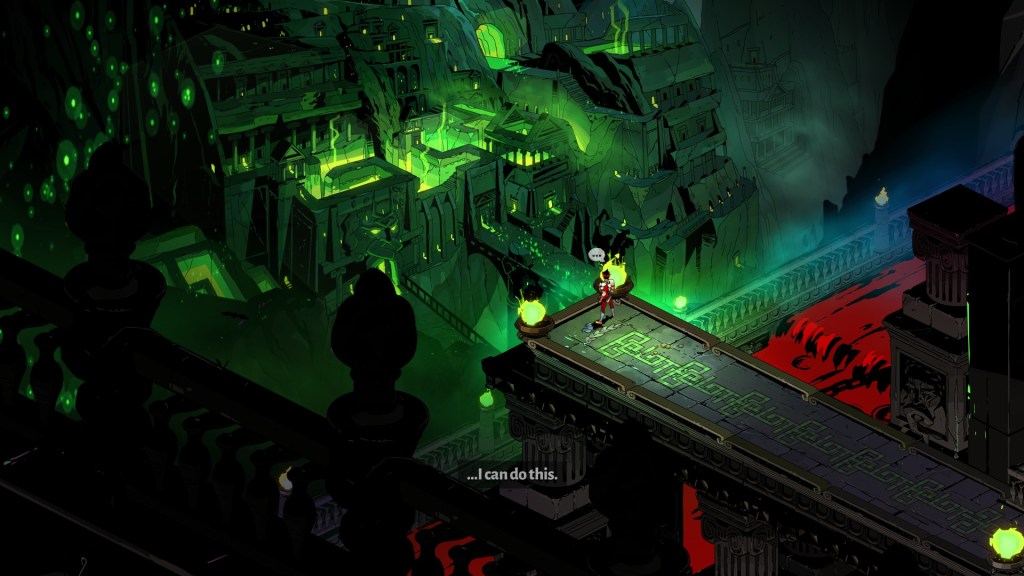
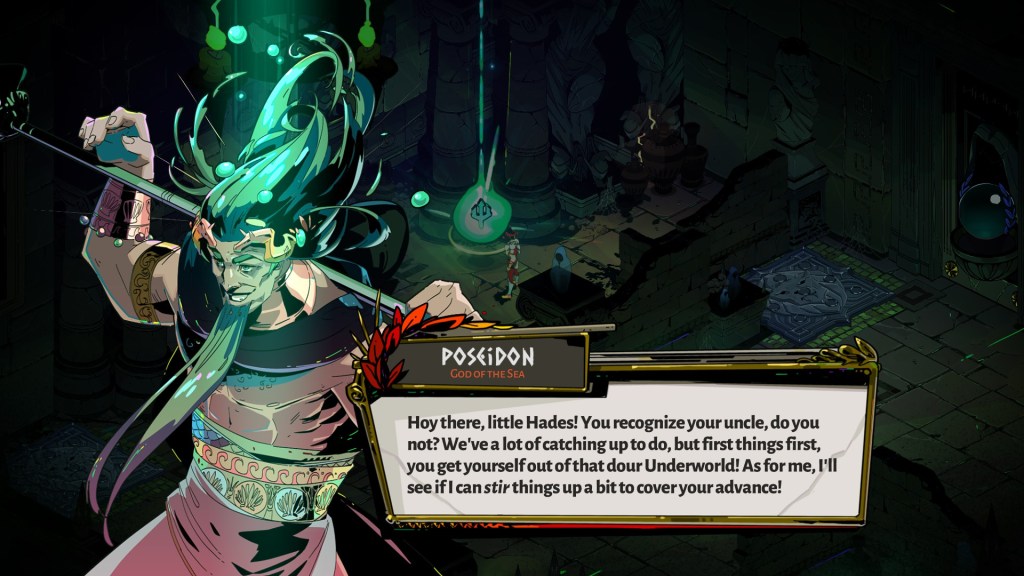
It also helps that the game looks incredible and is just oozing with style on all fronts. The character design is incredible, with NPC’s and enemies alike all rendered in a gorgeous art style that’s even better to watch in motion, Hades has its visual presentation locked in. Even the way menus and title cards explode into frame are exquisitely done, letting it be known that every part of the visuals of Hades were crafted with the highest level of care and attention. Also the soundtrack is rad as hell and you should listen to some of those tracks.
Despite the quality of the writing and the brilliance in presentation, Hades biggest strength is in the quality of its gameplay. It’s honestly been the main factor that’s kept me wanting to keep coming back to Hades. I’ve only gained access to the second weapon thus far, a bow and arrow, but that alone made the game feel completely new and fresh thanks to how it works and the power-ups you can get for it.
Every weapon has a standard and heavy attack that can be augmented by various upgrades you can find throughout the levels, adding higher critical chances, replenishing health, making certain attacks better against armor and a lot of other standard upgrade stuff. But when Hades hits you with an upgrade that allows you to shoot lighting bolts that chain between enemies as you use your dash, that’s when the true fun begins.
From run to run you’re collecting all sorts of different flotsam and jetsam that you can use to trade in for upgrades, items, weapons and some other things that I still don’t fully understand just yet because of early into Hades I am. But unlike a lot of other rogue-like games, Hades doesn’t seem like it’s obscuring information from you. Every power-up and ability increase that I’ve been presented with has very clearly explained what it’s going to do, which I appreciate very much. I’ve always hated when games try to be overly secretive and obfuscate simple item descriptions to seem more mysterious or enigmatic. I don’t have the time or patience to learn about the origins of this health potion, I just need it to keep all of my blood inside of me.
I haven’t seen too much of the game considering I’m still very early on in it, but I’ve heard it only continues to get more and more buck-wild as you progress. I look forward to potentially seeing some of this stuff, but I can’t shake the feeling that no matter how strong every other aspect of the game is, I still won’t be able to shake the fact that it’s still a rogue-like. It sucks because I like just about everything else about Hades except the genre it’s in. Actually, I don’t love when enemies off-screen manage to hurl themselves at you with a speed that’s borderline impossible to dodge, but I’m sure I’ll “crack that nut” soon enough.
I’m genuinely glad that I decided to give in to the heaping helping of praise that people have been dumping on Hades, but I do wish it was more of a standard action game that I could progress through normally. I suppose the way the story is handled in its current form wouldn’t work as well in a genre where constantly dying isn’t a thing, but there is a “god mode” setting I want to try out that allegedly let’s you play it without having to worry as much about dying that seems right up my alley.
I don’t think Hades is going to change your mind about rogue-likes as a genre if you’re like me and just don’t click with them, but it might make you a believer for a little while. But if rogue-likes actually are your thing, then Hades seems like one of the best ones that’s been released in a while.
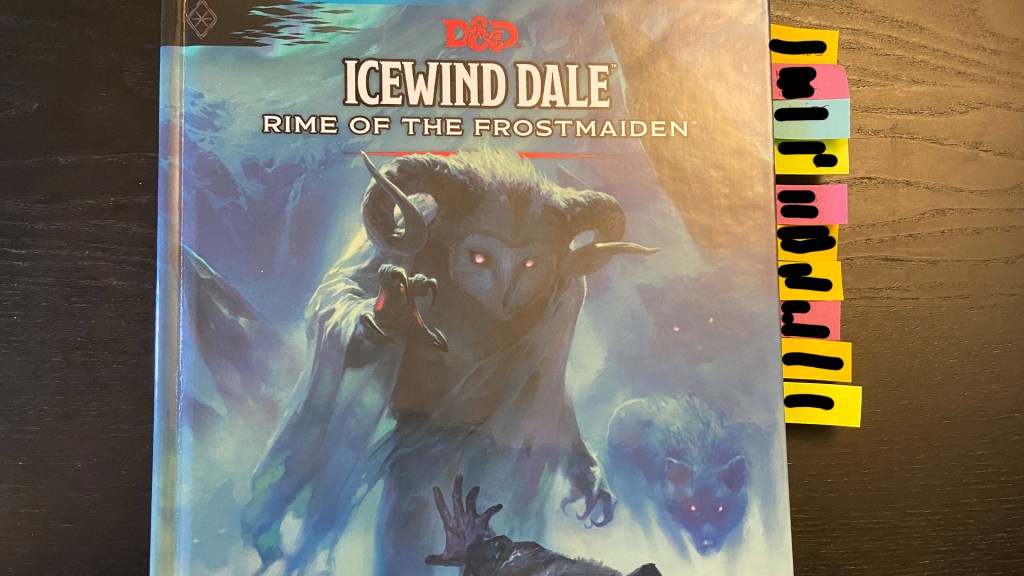
One of the most interesting, fun and tedious parts about being a Dungeon Master is preparing from session to session, but even more of a challenge is preparing a new campaign entirely. My group and I are currently wrapping up our “one-shot” of The Sunless Citadel, a pretty decent Dungeons & Dragons adventure, and are gearing up for our next big campaign. As luck would have it, Icewind Dale: Rime of the Frostmaiden released just as we were finishing up, so we decided that it would be our next adventure. Being that this is my first time prepping a full campaign, I figured I do it as meticulously as possible. Here’s what’s happened.
Considering I’ve always had some difficulty with absorbing the things I read, I had to approach preparing for Rime of the Frostmaiden from an overly redundant and thorough angle. I can’t just read something once or twice and commit it to memory. My brain just never worked like that so I had to bust out old my note-taking methods from my school days in order to properly tackle this behemoth of a book. What that meant was that I had to essentially read the book paragraph by paragraph, rewriting everything I was reading into a notebook.
The notes themselves, while useful, aren’t really why I’m doing all of this extra busy work. The problem I have is that I need to rewrite something to commit it to memory. I don’t think that’s too uncommon, but it definitely adds a lot more time and effort to whatever it is I’m trying to absorb. But I wanted to be as meticulous as possible, and luckily the book is actually really interesting which has fueled me to continue with this overly redundant way of learning.
Rime of the Frostmaiden – Wizards of the Coast
Both my notebook and the module itself have tiny little bookmark tabs everywhere that denote all of the important information I might need at a moments notice. I do it in a way that is more granular than the format of the book itself can account for allowing me to quickly access anything from notable characters, town lore, quests, items, hazards and more. On top of that, my notes also point me to whichever page in the book I need to get to, so I’m covering all of my bases to make sure I am never more than a few pages away from relevant information my players might need.
But I don’t want to paint all of this as an exercise in futility or anything, because I’m genuinely enjoying the book on its own. The story in Rime of the Frostmaiden is interesting and captivating as written, and all of my efforts in documenting it are just so I can provide my players with the best campaign I can muster. I get to enjoy the book as is, but my players are relying on me to deliver them an exciting and cohesive story to go along with the actual game itself. If I don’t nail this thing then they might have a pretty lackluster impression of the module, and that would be upsetting on a lot of levels.
Other things that I’ve done in preparation outside of just reading the book has involved making generic encounter maps for the frozen wasteland of Icewind Dale, along with listening to well over a hundred instrumental pieces of music and “soundscapes,” and categorizing them into several different playlists that I can quickly switch between. Is the place they arrived in a happy town? Well I’ll play the happy town songs for them. Is this battle an intense and dramatic one? Got it covered.
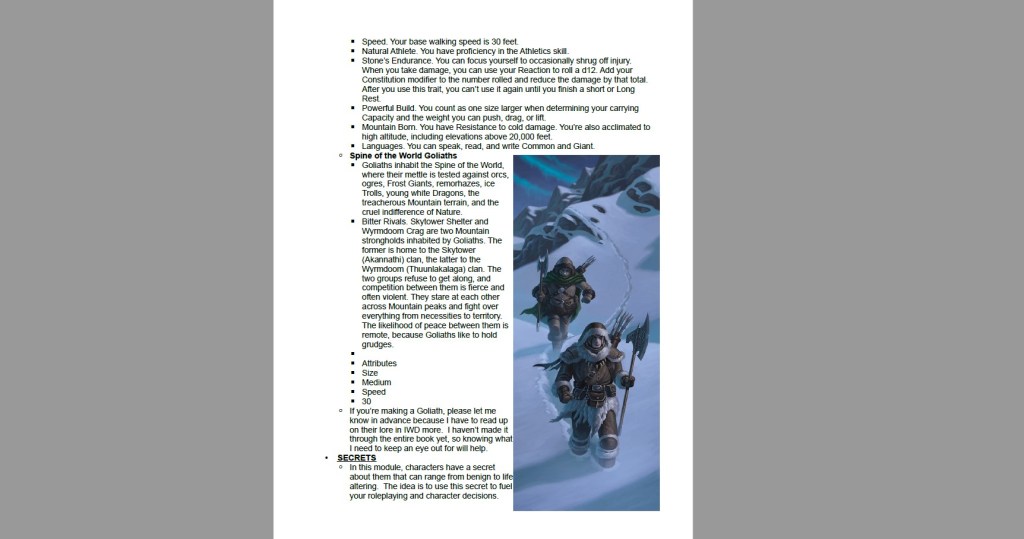
Page 2 of my Character Creation Syllabus
I even went as far as to make a 4-page syllabus of just about everything they need to know in order to create characters for this campaign. When I say that out loud it sounds truly insane, but they genuinely appreciated me doing that. When I’m head down on preparing for campaign, the thought that I might be more “into it” than my players always creeps into my mind, but their reaction to getting a literal syllabus was overwhelmingly encouraging.
All of the little seemingly superfluous things I’ve done in preparation I do because I know that it’s worth it. I can describe a battle in the middle of the frozen wasteland just fine, but having a generic snow-covered battle map I can toss up for them will help give them a sense of place and another opportunity to tangibly interact with their characters. Picking out hundreds of music tracks and categorizing them by their “emotional weight” seems ridiculous, but music is so damn important to setting the tone and atmosphere that I find it’s necessary to a successful campaign.
Maybe this article is just going to be met with other Dungeon Masters feeling like I’ve just described what they all do all the time, but to me I feel like I’m really putting in the extra effort to make this campaign a success. Like I said, this is my first time truly preparing for something this large and intricate, and I don’t want to mess it up. Luckily my players seem just as excited for this new campaign as I am, so I don’t think my efforts will go unnoticed.
It’s rare when something that’s so clearly playing off of your nostalgia actually delivers and makes good on all of those memories you have of a game instead of just reminding you how flawed your brain is. It turns out that the original Tony Hawk’s Pro Skater series was phenomenal and Tony Hawk’s Pro Skater 1+2 brings everything you loved about the series into the modern era extremely successfully.
From the start you’re immediately struck with the first wave of nostalgia in the form of a compilation of skate footage starring the characters of Tony Hawk’s Pro Skater 1+2, set to Guerrilla Radio by Rage Against the Machine. I also enjoy that none of the footage was reused from old games, and instead it’s just modern footage of new and aged skaters doing sick tricks. It’s one of the first examples of this game knowing exactly what it is and who it’s for.
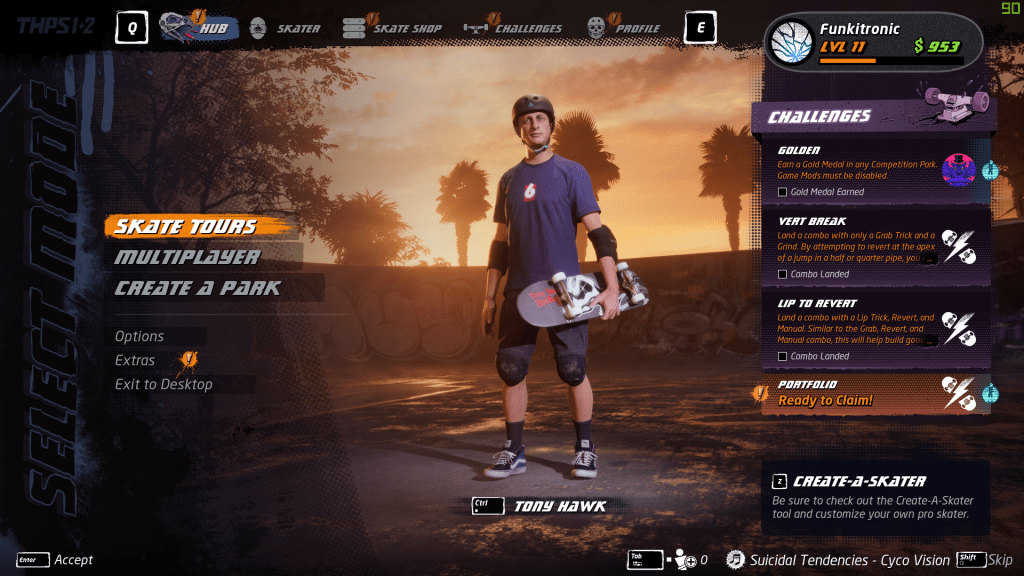
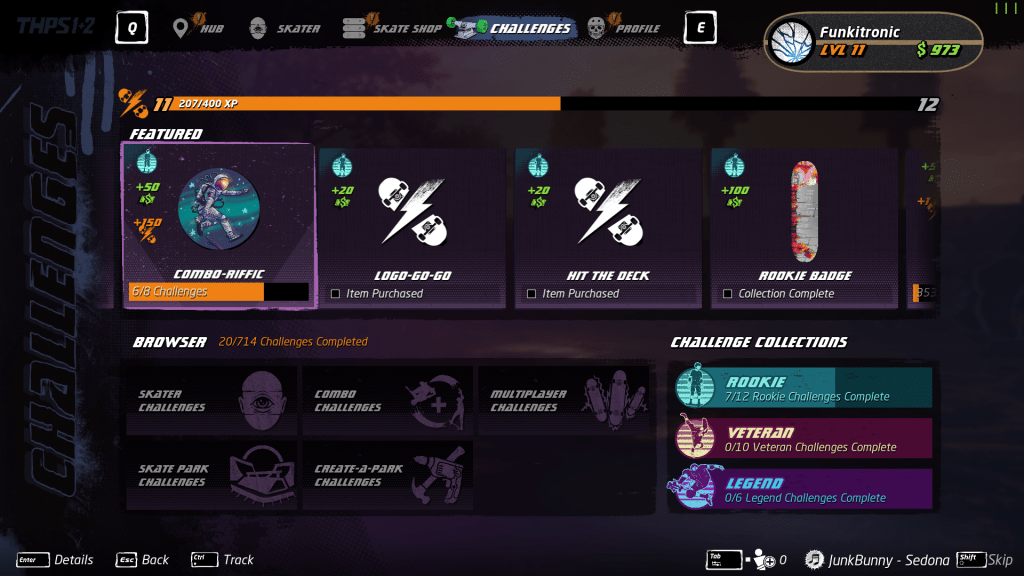
When you get to the main menu you can choose between playing the first or second Tony Hawk’s Pro Skater, along with a third option for online and free skate which I admittedly have not engaged with yet. There’s a pretty decent character and board creator that you unlock more options for by completing in-game challenges across both games, as well as a park creator that I also have not touched yet. The challenges can get pretty wild too, asking you to make specific combos over certain gaps and such, but luckily Tony Hawk’s Pro Skater 1+2 allows you to track specific challenges if you like.
But that’s all ancillary stuff we’re talking about, the real magic is in the gameplay. As far as I can tell, Tony Hawk’s Pro Skater 1+2 feels just like I remember those originals feeling. It’s fast and snappy and borderline infuriating when you over rotate and fall on your ass, just like I remember. Even better is Tony Hawk’s Pro Skater 1+2‘s decision to include various accessibility options that allow you to toggle certain game features on and off along with certain cheats like unlimited special meter an perfect grind balance.
For example, I don’t believe the revert was in the first Tony Hawk’s Pro Skater, but it is when you use the default gameplay options. If you really want that first Tony Hawk’s Pro Skater experience though, you can change the feature set to what was available in that first release. I don’t know why anyone would do that but the option exists if you want to have less fun.
The weird thing about talking about the mechanics of Tony Hawk’s Pro Skater 1+2 is that if you’ve played those original games, you know how this one plays too. It’s the game you remember except prettier. It retains all the good and bad about those first two games, including the one or two bad levels you had to slog through to get back to the fun ones, but I genuinely forgot how much I hated some of these levels until I was confronted with them once more.
Aside from the game itself, I think the most pleasant surprise for me was just revisiting the soundtrack once more. It’s weird to return to the place where a lot of your music tastes were cultivated nearly over two decades ago, but in a good way. I can’t remember what song played in the main menu in the original, but Tony Hawk’s Pro Skater 1+2 immediately starts playing Superman by Goldfinger because they know exactly who their audience is and what song jumps to mind when they think of that first game.
There’s always the worry that you’re remembering a game being way more fun and memorable than it actually was, but Tony Hawk’s Pro Skater 1+2 validates all of that nostalgia by delivering a truly fantastic remake of a those classic games. It’s also hilarious to me that they aged up all of the skaters from the original game allowing us to finally see a man in his mid fifties do a 900 off a rooftop only to get hit by a car that’s whipping around corners at breakneck speeds, and I think we could all use a little more of that in 2020.
You’d think that a game about aiding the souls of the recently deceased in completing their various unfinished businesses would be a downer, but Spiritfarer just might be one of the most pleasant gaming experiences I’ve had this year.
I Spiritfarer, you play as a young child who has been tasked with taking up the morose mantle of being the new Charon, or as you might better know them, the ferryman of the river Styx. You and your adorable magic cat, commandeer a massive boat in the hopes of collecting the souls of the departed and helping them find peace in the afterlife. The boat serves as your primary play space, where you’ll have to fish, cook food, grow vegetables, smelt metals, spin yarn and more in an effort to keep the recently departed happy.
All of the souls onboard your vessel have their own specific tastes and desires, from dietary restrictions to more personalized dwelling spaces. As time goes on you’ll start balancing several objectives at once, like taking food out of the oven or watering plants, all of which give the impression of urgency without actually being stressful. It’s extremely low stakes with the notable exception being whenever your passengers exhibit a change in moods, which is when I as a player will hurl food and affection at them until they smile again.
I mean that fairly literally as well. In Spiritfarer, the main ways you raise the mood of a disgruntled passenger is to either give them food they like, build them a room they want, or to just hug them. There’s a hug option for each of the passengers which is great, but it’s also the most crushing feeling in the world when they say that they’re good on hugs for the day. It’s so brutal.
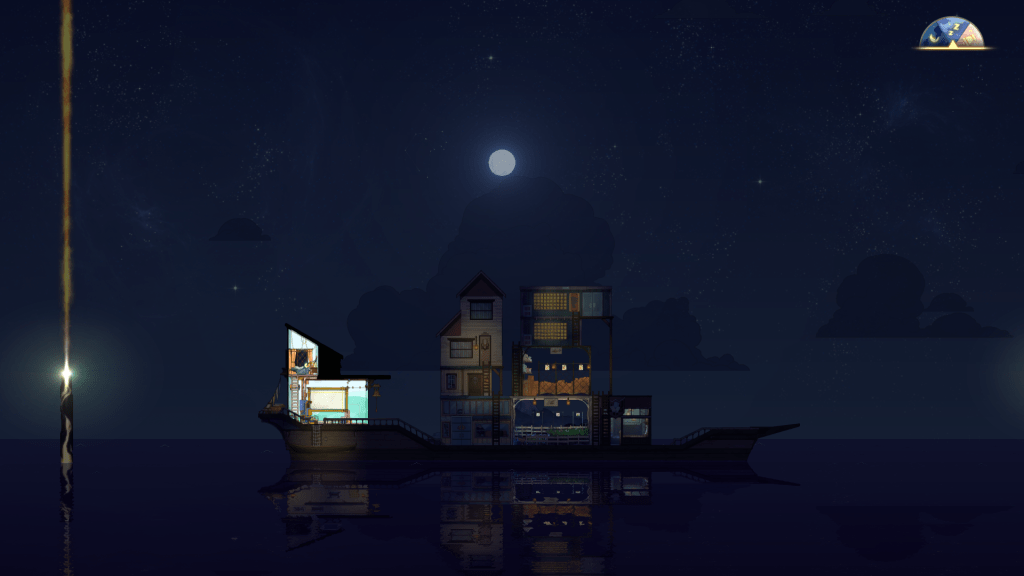
But that brutality is lessened by the gorgeous artwork and animation in the game. The way the plumes of light cut through the gaps of buildings on your boat at sunset is truly something to behold. Even when you disembark from your boat and head onto an island, Spiritfarer displays some truly jaw dropping vistas.
But Spiritfarer isn’t just a pretty looking management sim, it’s also got some light platforming and adventure elements that hold up as well. The platforming isn’t going to blow anyone away by any stretch, but it feels fairly snappy and responsive enough. It only really became an issue when I would try to be faster than the game could really contend with. For instance, there are these lightning storms you can fly through, and during that voyage you can race from point to point in an attempt to collect some lighting in a bottle, which I’m pretty sure is either money or a crafting resource. When you’re trying to be fast and precise, the platforming in Spiritfarer doesn’t really hold up.
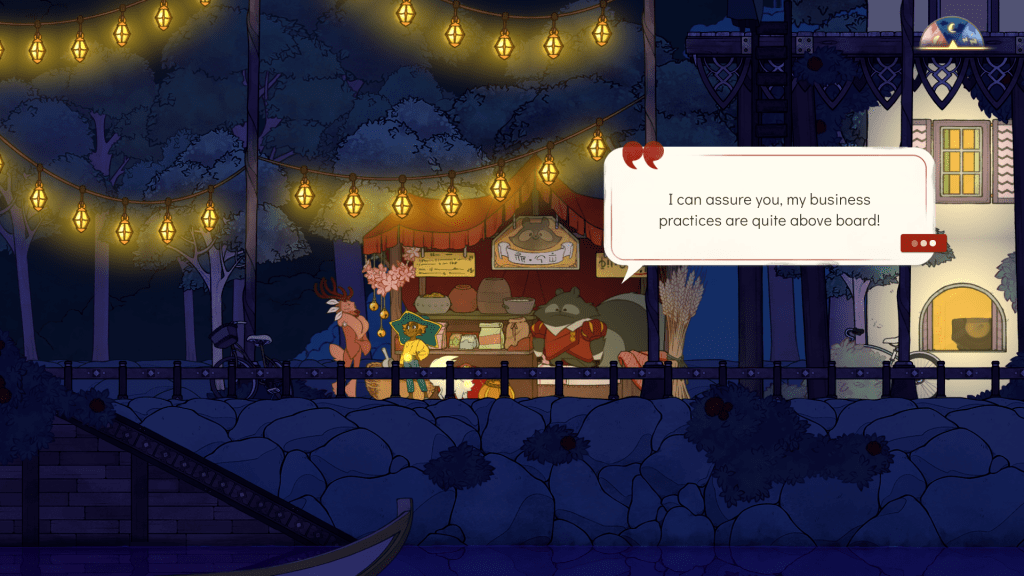
That’s fair though. Spiritfarer isn’t an action game as much as it’s an adventure game. In between managing your relationships with passengers, growing crops, and crafting things, you also have to find more lost souls and complete objectives for the ones already onboard. Sometimes it’s about revisiting a childhood home and confronting the memories that linger in there, and sometimes it’s about being a union representative for spirits that are being taken advantage of by their boss.
One of the only issues I have with Spiritfarer has a lot to do with completing these quests. You have a mission log where you can refresh yourself on what someone wants, or where you should go, but the souls that require you to travel around and collect or build something for them before they join you lack any indication of where that person is.
For example, I found a spirit that wanted me to bring back their lost sheep. One of these overly rambunctious sheep happened to be on another island which I managed to find fairly easily, but the mission log didn’t tell me where the spirit who wanted the sheep actually was. This was a problem because it had been two days between finding the sheep and wanting to bring it back to the spirit. After some searching, I caved in and just consulted the internet which revealed that I was nowhere even close to finding the spirit.
Outside of that however, Spiritfarer has been an utter delight to play. It has that insidious “just one more thing,” quality about it that routinely has turned hour long game sessions into 3 hour affairs. I cannot sing its praises enough and wholeheartedly recommend you give it a shot if you’re looking for that pleasant oasis in this desert of misery we currently live in.
People often talk about the three pillars of Dungeons & Dragons and how crucial they are when making a well rounded campaign. Of the three pillars, exploration, role-playing and combat, I usually tend to focus on the role-playing pillar the most while paying less attention to the others. I’ve always felt that exploration was the toughest one for me, but as I run more Dungeons & Dragons games with different groups, I find that combat ends up feeling the weakest and least interesting.
Combat always seemed like a layup to me, wherein I could just launch enough monsters at the players and call it a day. It wasn’t until I had to deal with a real slog of a combat encounter where everyone was rolling terribly, that I realized just how bad at these encounters I actually was. Simply pitting stronger enemies against a party doesn’t make for an inherently fun encounter, so I wanted to outline some things that I’ve started to fold into my combat scenarios to make them more interesting.
LOCATION
One of my biggest issues with a lot of Dungeons & Dragons adventure modules, particularly the lower level ones, is that they don’t provide much in the way of variety for the players. Take the 5e book of one-shots, Tales from the Yawning Portal (TYP) for example. In TYP there’s a level 1-3 scenario called The Sunless Citadel, in which a group of adventurers has to go to this mysterious citadel that exists at the bottom of a ravine. While I’ve enjoyed running my players through this scenario, I’ve found that the majority of the fights they’ve gotten into basically turn into slug-fests where it’s just about standing your ground and hoping you hit more than your enemy does.
Most of the battles in The Sunless Citadel go this way, where there isn’t enough space or location variety to do any of the crazy stuff that makes Dungeons & Dragons so special. No one is going to swing from a chandelier or knock a dude into a pit if that stuff just isn’t there, and that’s the problem. These locations tend to lack a lot of variety often just being some dusty old dungeon where something was worshiped in a time long forgotten.
Tales from the Yawning Portal – Wizards of the Coast
My solution to this is to invite people to flex their creative muscles by allowing them to basically manifest room features (within reason) if they succeed on a good enough investigation or other appropriate check. It can be something as simple as letting them scoop up dust to throw in an enemy’s eyes to blind them, or finding an empty bottle to hurl at a threat. I’m not gonna let them just find a rocket launcher or anything like that, but I think it’s important to allow players to get wacky and shake up the mundanity of just rolling dice to hit armor classes.
Most of the wildest stories you here when people describe their experiences with Dungeons & Dragons tend to come out of some wacky combat scenario, but planning for wackiness is an impossibility. Sure you can put some fun stuff in every room to entice the players, but they might not always take the bait. Instead, I tend to entertain just about every wild thing they want to search for in the midst of combat, and will make a decision then and there.
LEVEL DESIGN
Level design is incredibly important when making a combat scenario, and I often find that limiting the playing field both in width or height makes for a boring encounter. It’s easy to craft a battle in a single story room, but that doesn’t really afford the players or enemies any opportunities to do much besides just run at or away from each other. Things like pillars and furniture can help for sure, but I find that the best encounters are the ones where the enemies aren’t always in your line of sight.
I prefer battles that span larger areas as opposed to confined spaces, but that’s a broad sentiment that needs to be explained. You can make a combat encounter be on the first floor of a house and call it a day, but it would be far more engaging if the entire house and both front and backyard were in play as well. Sure a battle could just naturally spill out into those areas, but that might not happen which could lead to a bland encounter.
What really makes these encounters slow down to a crawl is when the party starts out all bunched together and there’s no incentive for any of them to move. That’s why you need a diverse location with plenty for the players to explore beforehand that could have them start the encounter off a little scattered. It isn’t a way for me as a DM to punish the party for splitting up, instead it’s a way to make combat encounters more than just a war of attrition. Are the wizard and rogue looking through an office on the second floor while the fighter and cleric explore the lower floors? Great, now the players have to really take into account their strengths and weaknesses and open their decisions up beyond just “what attack do I use?”
Descent into Avernus – Wizards of the Coast
If they’re determined to group up again, make that an exciting event that might involve them using a full dash or disengage action. The act of self-preservation shouldn’t feel laborious, it should feel like a triumph. As a DM, you have be able to paint these less flashy actions as a victory for whoever needs to utilize them. Players have so many non-combat oriented abilities they can utilize, but no one will ever do any of them if it’s just about making sure the tank can take all the hits while casters do their work from a distance. My method is to make sure that every player has the opportunity to shine in a given combat encounter, while also putting them in positions where their characters might not be primed to be in. Just don’t be malicious about it.
Make sure everyone has the chance to bail out and regroup if they need to, but give them a chance to be the focal point at all times in combat. Sure all the characters combined are a party that needs to work together, but being a party shouldn’t steal their individualism as characters. The line is quite thin, but making sure that a character both feels capable and under powered on their own is difficult, but I find that when it’s done right it makes for some very memorable moments.
LESS FREQUENT & MORE INTERESTING COMBAT SCENARIOS
This final point also builds on the previous one, but it’s important enough to be its own thing. There is nothing less interesting than opening a door to a small room, rolling initiative, beating the bad guys, then opening another door a few minutes later to do it all over again. It’s tedious and makes battle feel more like a chore than an opportunity for fun. I think combat scenarios should be bigger than just combat in general, which is confusing at first, but let me explain.
So you’ve got your big open mine where a bunch of goblins hang out. There are various natural ramps along the walls allowing for miners to reach new areas, there’s a mine cart track and a large molten lava pit in the center that’s used for smelting. We’ve got ourselves a big open combat scenario right there, but the party is bunched up together as they entered the room and don’t really have a reason to split up. That’s why you need to give them a reason.
Adding multiple objectives to combat scenarios beyond just killing everything is key. Have the players take a look around and find that there are half a dozen detonator plungers with wires leading off of them in various directions. If you visually track those wires, you can see a few of them are attached to explosive charges that are crammed into cracks in the walls. Also, this mine is right below a village of unsuspecting innocent people! Oh no! Now the party has to survive and accomplish a goal to truly be victorious.
Sword Coast Adventurer’s Guide – Wizards of the Coast
But you need to have a contingency plan for when your players just try mage hand the wires off the explosives or something. Maybe some goblins with fire arrows will show up to detonate the charges themselves, or some fire elemental gets summoned to do it. Maybe the goblins are protected by a massive troll who is going to run interference for the party, thus emboldening the slinkier and more nimble characters to go and deal with the charges while the tankier classes try to push the troll into the lava.
That combat encounter alone is way more interesting than just a flat room with 7 goblins running up to you with swords. I firmly believe that adding in objectives, having waves of enemies show up at different times, and having a big space with a lot of different tiny stories going on in them is key. Some goblins are on planting charges duty, some are running defense, that troll is protecting both of those parties. Having all of that going on at once will make for a longer and more memorable combat scenario than the firing squad of goblin archers standing opposite the party.
I’m not the ultimate authority on this stuff, but I’ve had plenty of experience in making boring combat encounters. Adding in some of these elements alone made for a more engaged party in my experience. It’s a shame that Dungeons & Dragons often paints combat encounters into these random occurrences like something out of a Final Fantasy game where you open a door and enemies pop out.
The beauty of Dungeons & Dragons is that it empowers your players to use their imagination to conquer any challenge in their way. Too often I find that new players will use the rules and their abilities as static things, like it’s all they can do. The rules are there to guide you and give you a way to navigate the crazy shit you want to do and not the other way around. Regardless of if you take my advice in this article or not, make sure you’re emboldening your players to be creative whether they’re in combat or not.
Since their surge in mass popularity during the 2010’s, I’ve been yearning for an Avengers game that would appropriately blend the varied powers of the Earth’s mightiest heroes with actual fun gameplay. Things were looking very promising when Marvel’s Spider-Man released two years ago on the PlayStation 4, but all of those positive feelings slowly drained away as I spent some time with Square Enix’s Marvel’s Avengers beta.
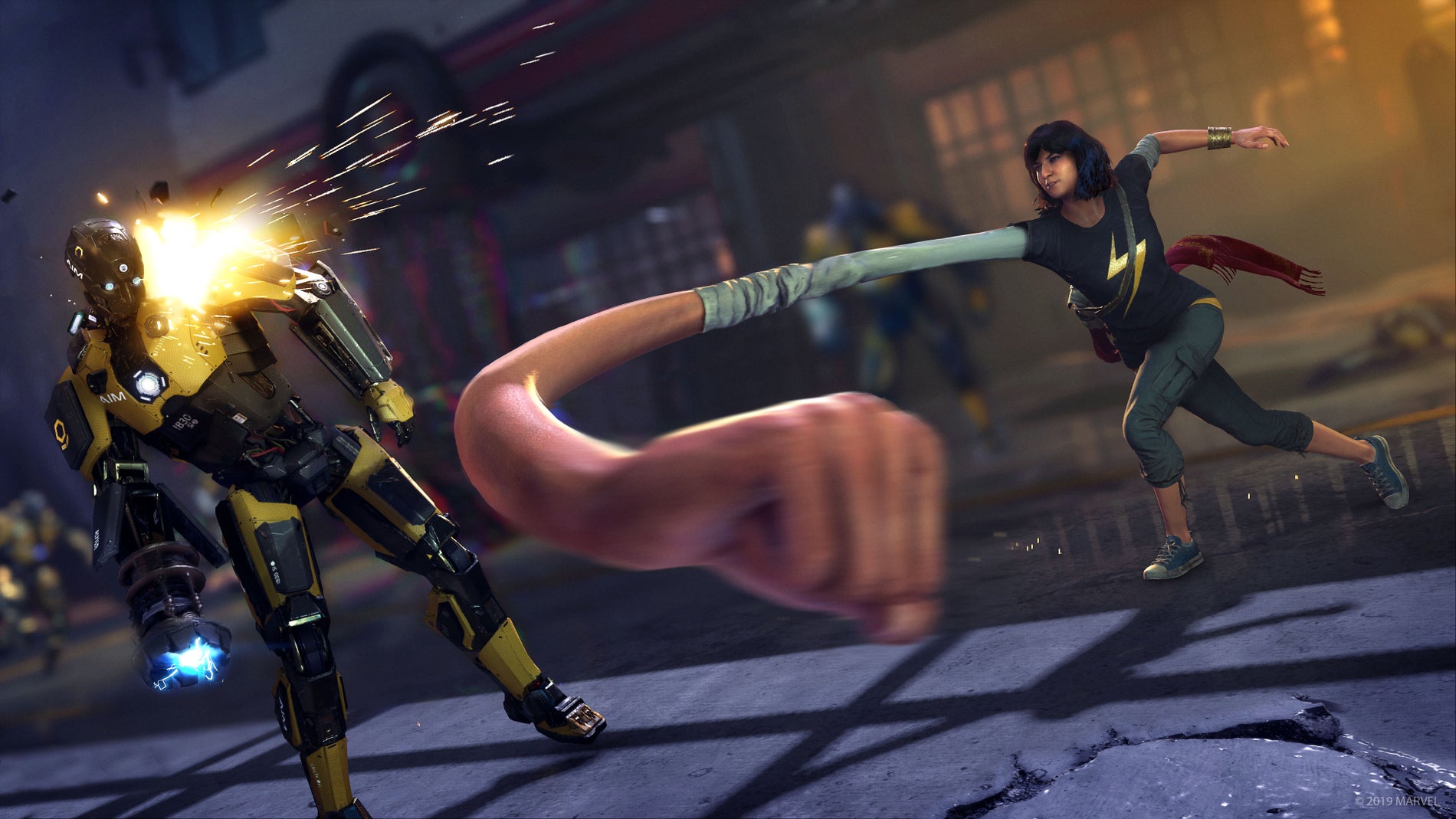
The beta opens with the San Fransisco demo that’s been shown off before, swapping you between Captain America, Iron Man, Thor, The Hulk and Black Widow throughout various points in the level. In another, better game, swapping between the heroes every few minutes would be a lot of fun, granted it managed to nail that blend of power fantasy with the cohesion of team dynamics that the Avengers are known for. But based on this beta, Marvel’s Avengers doesn’t succeed at either.
From the start, you have to confront the awkward and unresponsive controls. Everything feels delayed, undermining the brawler feel that other superhero games have done well like the Batman Arkham series or even Marvel’s Spider-Man did. Some of the special abilities and heavy attacks pack a good punch, but by and large most of what I played in the beta felt pretty bland in the combat department.
Marvel’s Avengers combat failings stem from its desire to be a live-service game. Enemies have bloated health bars and can take multiple massive green fists to the face because my gear score or whatever wasn’t high enough. I understand that’s just an aspect of how a lot of these games are, but this decision honestly robs Marvel’s Avengers of letting the player feel like a superhero. The Hulk should not be getting taken to task by some generic robots holding shields.
There’s also the issue of the game not explaining a lot of stuff to you, but I acknowledge that this might just be a beta issue and hopefully will be addressed, but there’s a lot in Marvel’s Avengers that I just never understood. For instance, you’ve got a health bar at the top of the screen with a mysterious superhero specific bar underneath it. What this bar is, I don’t know. What I do know is that while I was getting my ass kicked by a swarm of robots, the bar went down. Was that the health bar? If that’s the case, then what’s the other one for? Are all of my special abilities on a cool-down that might get faster with better gear or skill upgrades, or can I do something in game to impact them?
Maybe all of this is explained in the mess of a pause menu they’ve got, where the landfill of gear, crafting materials and currencies live. It’s one of those screens where your eyes just glaze over because of the sheer amount of garbage that’s on it. Luckily, there’s a button you can hit that will just equip the best gear for you, letting you avoid the nightmare of that entire menu.
What’s upsetting though is how none of your gear has any visual representation whatsoever. There’s plenty of articles of clothing to equip among the Avengers themselves, but none of it actually shows up at all. I actually understand why that isn’t a thing though. Marvel probably isn’t onboard with people making new Iron man armor from welded together scraps you found in a factory or a jungle. They want to “preserve the identity” of the characters or something, and letting you to adjust their appearances to something that isn’t “on brand” is probably a no. Also, I’m positive that buying alternate costumes is the monetization strategy for Marvel’s Avengers.
Ultimately Marvel’s Avengers just feels like a big miss on every front. It’s not a good action game, it doesn’t make you feel powerful, and it seems rife with ways to nickel and dime its player base. I can’t say definitively that it’s a disappointment yet, considering it isn’t actually out. This is a “beta,” and technically everything is subject to change. Sure the full game releases in just a few weeks, but maybe this is an older build of the game. Whether that’s true or this beta is indicative of what you can expect at release however, this was a miserable first impression.
Approximately 17 years ago at the last E3, the folks over at Devolver Digital had their annual conference(?) in which they revealed among other things, Fall Guys. Looking at that initial trailer, I had no idea what to expect and immediately shrugged it off as some sort of Mario Party clone. Fast forward to just last week when it finally released on Steam and as a “free” PlayStation Plus offering, and it’s completely blown up to the point where the servers couldn’t handle the amount of people trying to play it. It turns out Fall Guys isn’t a clone of a bad game from a bad franchise.
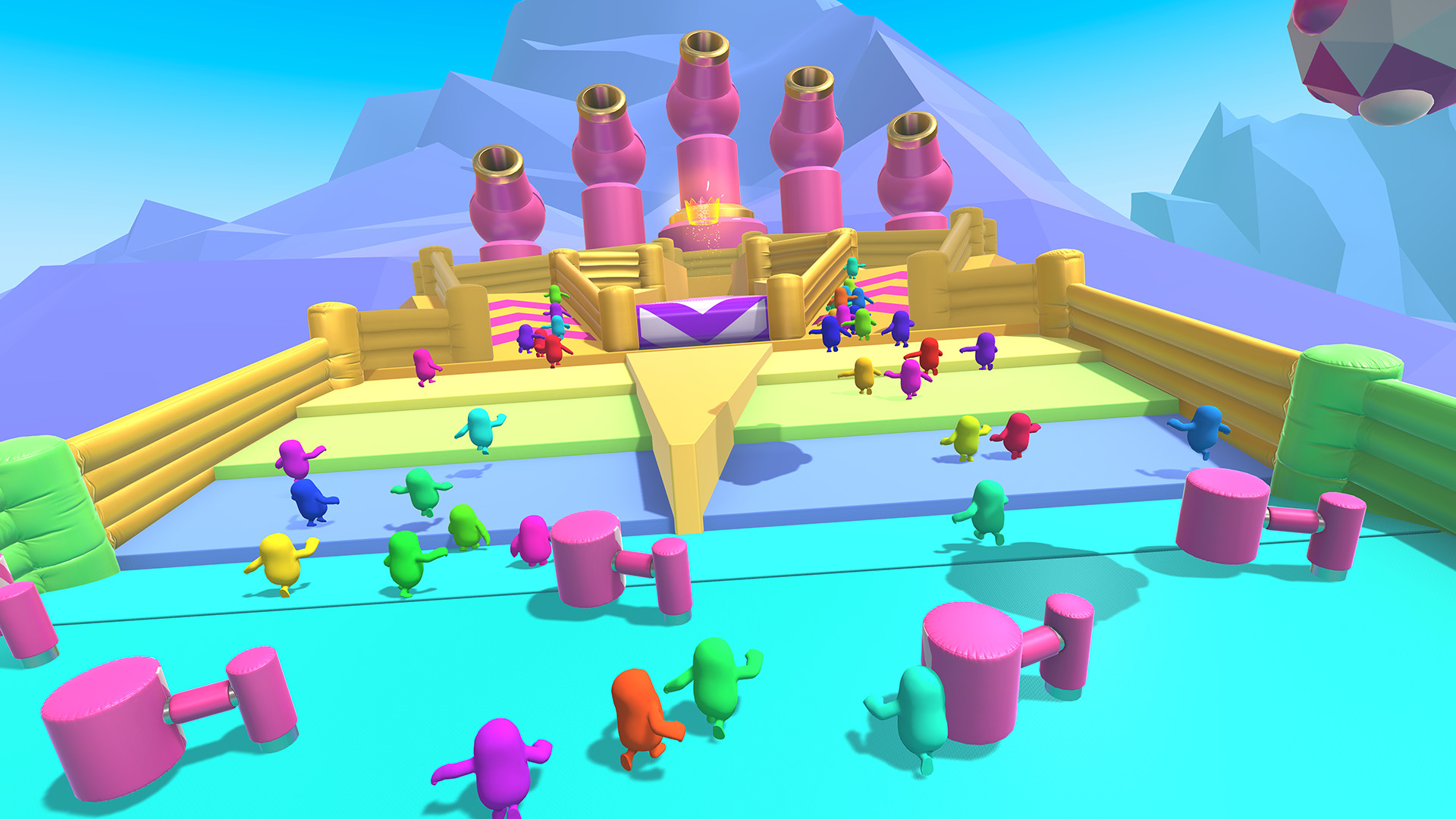
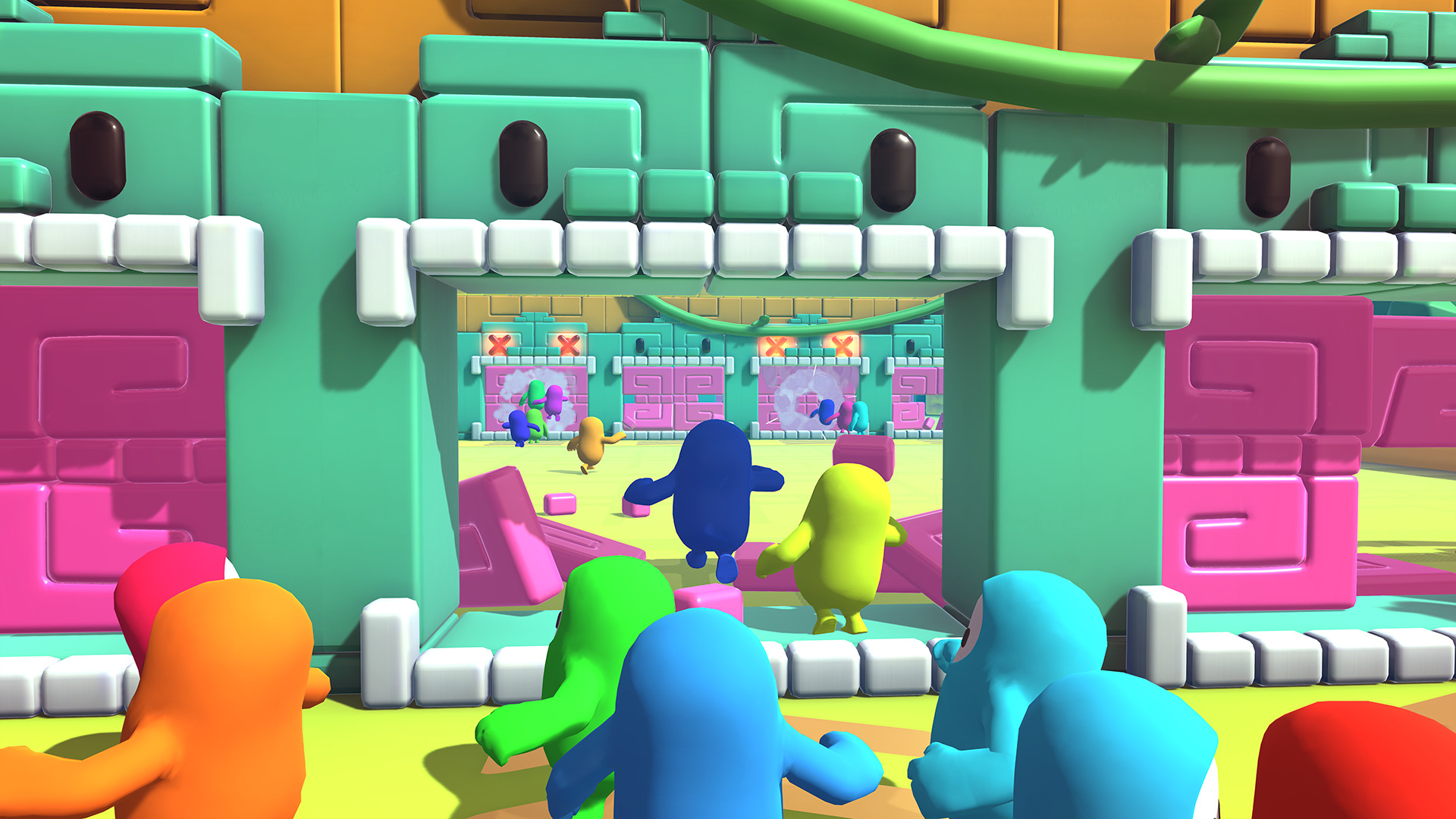
In Fall Guys, you take control of a little marshmallow looking creature who can only run, dive and grab onto things. Using the few moves at your disposal, you wade through several rounds of platforming challenges and obstacles with up to 59 other people in order to qualify for the next round. It can be a chaotic mess at times, but I mean that in the best way possible.
Fall Guys – Devolver Digital
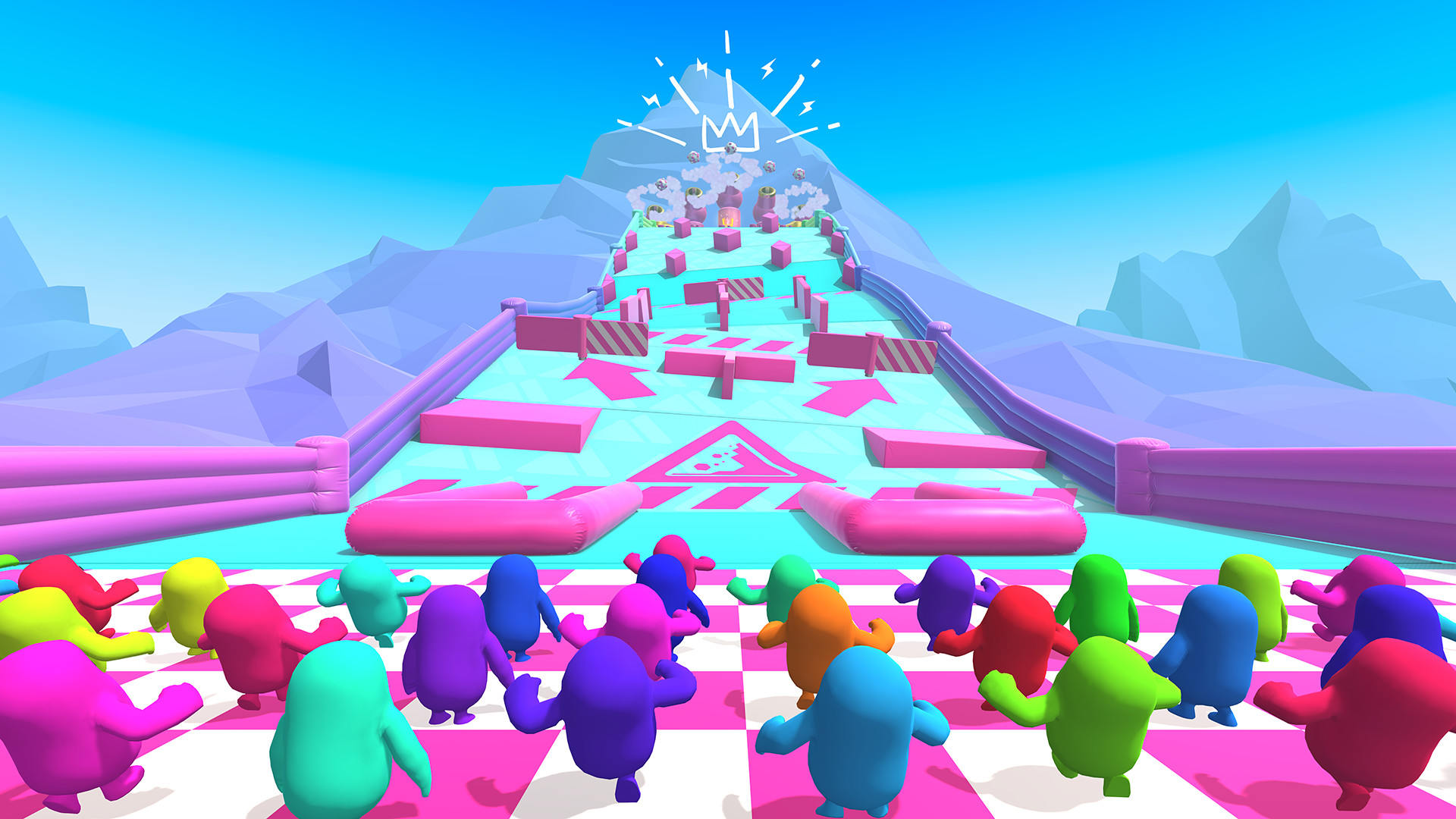
All of the levels I saw were very clearly inspired from shows like Wipeout, Ninja Warrior and Most Extreme Elimination Challenge, all of which are filled with plenty of hazards and obstacles that you need to overcome. I feel it’s important to remind you once more that you are doing this alongside 59 other people, which intentionally leads to some comical physics-based shenanigans. Succeed at enough of these challenges before your opponents and you’ll end up at an equally obstacle-filled level that has a crown at the end of it. Latch onto that crown and congratulations, you’re the big winner.
I’ll be completely honest here and say that I broke my own rule with Gut Check and played less than an hour of Fall Guys, but not because I disliked it. I actually really dig what Fall Guys is doing, catering to both my love of wacky physics and marshmallows. Yet despite being extremely in my wheelhouse, it just feels like a game without legs. Some games blow up in popularity and get to enjoy a long lifespan because of it like Rocket League or even Overwatch, but Fall Guys doesn’t seem like it has the depth or variation to keep things fresh and interesting for very long. It’s simply a game that was fun to play through until I won… which I did… the first time I played it.
Fall Guys – Devolver Digital
I don’t say that in an attempt to brag or anything because I was genuinely shocked it happened as well. I never really excelled at any level to the point where I felt like I was deserving of the coveted crown, but I just kind of lucked my way into it regardless. Two key things happened to me during my one-shot championship run that made all the difference.
The first thing felt a lot like I was cheating. Not every level in Fall Guys is based around individual success, with some levels grouping folks into teams and squaring off against one another. During one of these team levels we were tasked with essentially playing keep-away where we had to grab a tail off the back of an opponent and don it ourselves. With that tuft of fur firmly above my ass, I had to avoid my other competitors till the end of the round to score a point. That’s when the wacky physics of Fall Guys broke, and a spinning baton caught me in just the right position to clip me through the boundary of the map with no way back inside. So there I was in a white void, donning a beautiful tail and a slight amount of guilt attributed to the fact that I had inadvertently cheated in a competitive multiplayer game. Time eventually ran out, my team won under dubious conditions and we all progressed onward.
Fall Guys – Devolver Digital
The next thing that happened came at the very end of the final level. After navigating through falling rocks, spinning batons, swinging hammers and more, I followed the path and several other marshmallow people up towards the golden crown. The crown hovered between two platforms that you’d have to jump from in order to snag it in mid air. It also bobbed up and down to make it a little dicier for everyone involved. I watched about a dozen people in front of me mistime that jump and fall into the chasm below. So instead of leaping frantically like dope I just kind of stood there for a bit, unhampered until the crown was in my reach and I was able to snag it.
I won my first match of Fall Guys and I felt like I really shouldn’t have. It felt like a fluke from top to bottom, but I won the whole damn thing and in return I was granted some cosmetic items and the feeling that I had beaten the entirety of Fall Guys. With a little bit of patience and a ton of luck however I got to feel the “thrill” of winning, which was less of a feeling of accomplishment and more a feeling of suspicion, like I was going to get in trouble for winning it all by accident.
I can’t see a lot of people sticking with Fall Guys because it just doesn’t seem like the kind of game you can really get better at. No matter how good at platforming you are, you’re still vulnerable to the obstacles in the level as well as the other players themselves. I’m not trying to diminish the fun I had with Fall Guys because it left me with a sense of fondness towards it, but failed to hook me in a way that would make me want to break my undefeated streak. I bet they’ll hang my jersey in the rafters for this victory someday.
I’ll never forget the first time I played Dungeons & Dragons. It was a few summers ago and one of our friends offered to run us through a single session campaign, otherwise known as a one-shot. It was a ton of fun and is the event I attribute to getting me hooked on the game. But there’s one thing that will always stand out to me most about that experience, and that was when we finished the game and our DM pulled me aside and said, “Ari, I play with a lot of people and I can tell when they’re hooked, and you’ve got it.”
That single phrase always stood out to me because of just how accurate it was. He saw something in myself that I never thought would be there, and even as he said it, I thought he was full of shit and just stroking my ego a bit. Maybe he was, maybe he wasn’t. Regardless of his intent, he was a thousand percent right.
In the past few weeks, I’ve heard his voice echo in my mind louder and more frequently than ever. That probably has a lot to do with the amount of Dungeons & Dragons related purchases I’ve made in that time, a trend that tragically shows no sign of slowing up.
I’ve bought so many fucking dice and I have no idea why. Even before the pandemic, all of the games I played were online, so why the hell did I buy a ton of plastic dice along with a fancy set of metallic ones? Why did I buy a dice rolling box? Why did I buy several digital rule books and modules, and then also buy their physical editions as well?
Because I need them.
Every time I hear my friend’s voice in my head, reminding me that “I’ve got it,” I can’t help but feel like he cursed me. Right there and then, in the middle of our mutual friend’s kitchen, my DM cursed me to an eternity of buying books filled with adventures I will never experience and dice that I’ll never roll.
One day in the future when we’re allowed to congregate once again, I’d like to believe I will actually make use of these physical items that now occupy my bookshelves. But the odds are these will just be items that I’ll be pissed about having to transport when I inevitably move away from here. I just hope that I don’t start buying miniatures next. Like, yeah they’re cool and you can paint them to look like your characters and stuff… Yeah, definitely don’t want to buy those little guys.
Have you ever seen a trailer for a game and immediately knew it wasn’t for you? This happens to me consistently, and all it usually takes is a trailer or screenshot for me to see the mechanics at play to know a game isn’t for me. While I try to keep an open mind about every game, it’s a challenge for me to look at certain mechanics or genres and still feel compelled to play it despite what the critical reception is.
There’s been a lot of great games that have already come out this year, but I honestly haven’t played most of them because of this inherent bias I have against certain mechanics. It isn’t a qualitative judgement about the game or the mechanic in question, it’s just something I know won’t jive with me.
I guess you could just chalk it up to personal taste and knowing that every game isn’t made with me in mind, but sometimes I feel like I’m doing myself a great disservice from not giving these games a fair shake. That’s why I wanted to do a deeper dive into the elements and genres that immediately rebuff me, and try to get to the bottom of why that might be the case.
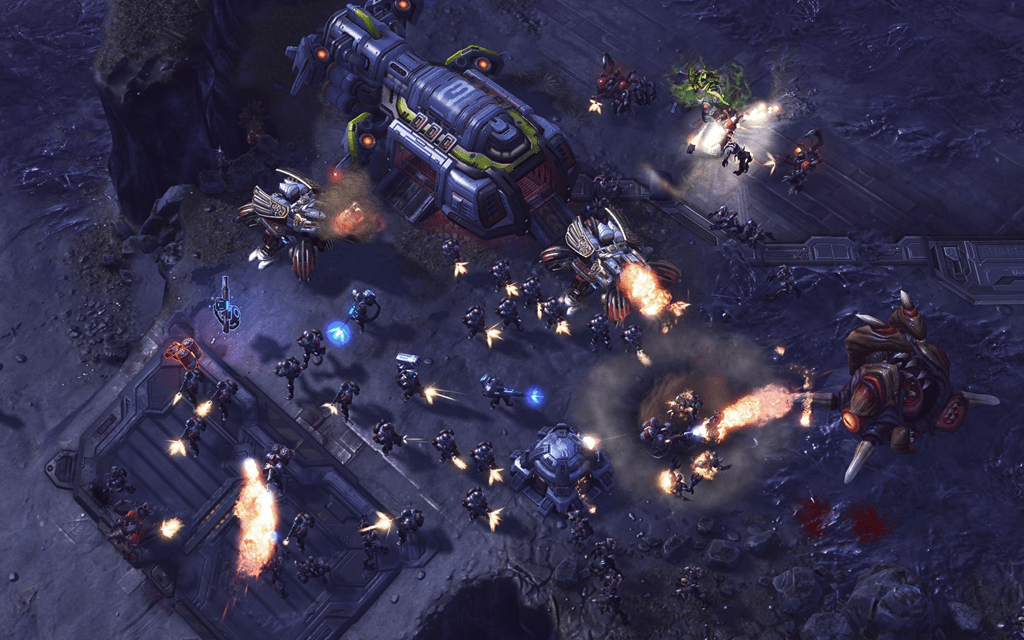
Starcraft 2 – Blizzard Entertainment
STRATEGY & TACTICS
It’s weird to start this list off with something so broad and nebulous as “tactics,” but allow me to make my case. There are phenomenal tactics games out there that people have raved about for years that I’ll never play. Games like the X-Com series, Starcraft, and even the Divinity series all seem so interesting from a distance, but rebuff me the second I get a little too close. It’s hard to nail down exactly what it is about these games that’s kept me away, but honestly it’s less about an inner conflict with the mechanics themselves and more about me being incapable of properly strategizing a coherent plan of attack in these kinds of games.
Quite frankly, I’m miserable at these games to the point where they just feel overwhelming. Usually I end up walking away from these games feeling like an idiot because I’m just so bad at applying foresight to these combat encounters. There’s also the issue of learning the internal mechanics that make things work in these games. For instance, when I played Divinity: Original Sin II, not only was I having trouble figuring out a good plan of attack, but I was also trying to learn what spells and attacks were effective against the enemies and the environment. It felt like I was learning two games at the same time and failing at both.
Divinity: Original Sin 2 – Larian Studios
I’m not great at strategizing in general, which is why real-time strategy games like Starcraft and Warcraft never appealed to me. My only tactic is to build my army as fast as I can and click on enemy troops and buildings in the hopes something happens that I like. There’s also a lot of plate spinning in these games, where I’ll have to contend with a multi-pronged attack plan, while managing the defenses at my base, while making sure troop and supply production lines are working and so on and so forth. It’s a lot for me to focus on at once, and I inevitably fail miserably at each of them whenever I try to play one of these games.
There is one glaring potential exception to this however. At some point in the next few weeks, Baldur’s Gate III is supposed to enter early access. Now, I’m incredibly excited for the game for numerous reasons, but the main one at this point is because I know the inner working mechanics it’s going to be using. It’s running off of the Dungeons & Dragons 5e rule set, something I’ve become very familiar with over the years. It’s led to me looking at Baldur’s Gate III as less of a strategy or tactics game, and more of a way to play D&D by myself. There’s a lot of mental gymnastics going on in my head to make me feel at peace with Baldur’s Gate III, and I completely acknowledge that.
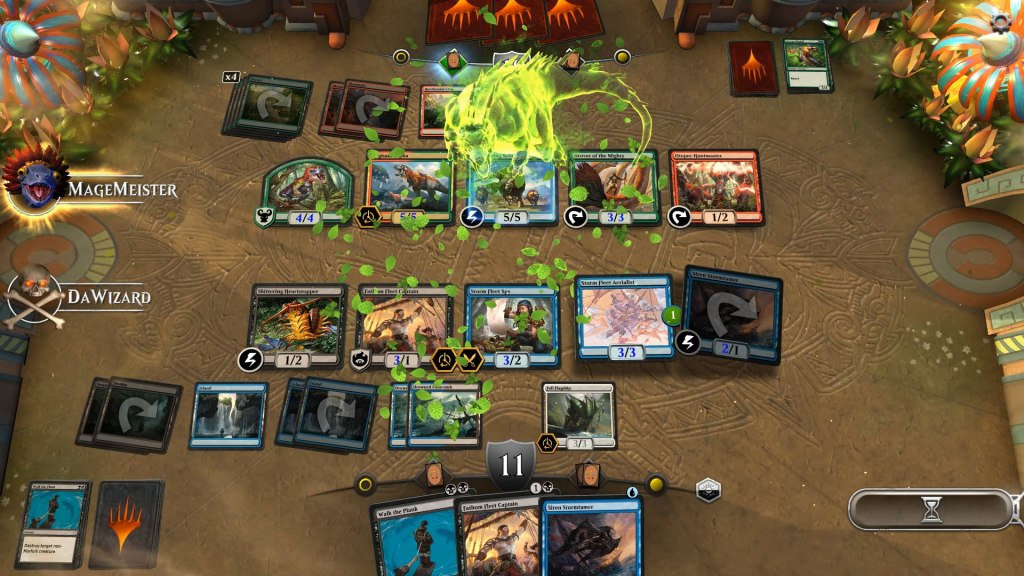
Magic: The Gathering Arena – Wizards of the Coast
DECK BUILDING
Like most kids in the 90’s, I was a big fan of Pokemon and would consume everything it touched, from the show, the games, the toys, and of course the cards. The thing is, despite owning a ton of the cards and organizing them into a nice binder, I never actually did anything with them. I’ve never once actually played Pokemon as a card game before. I just wanted cool little pictures of them to collect.
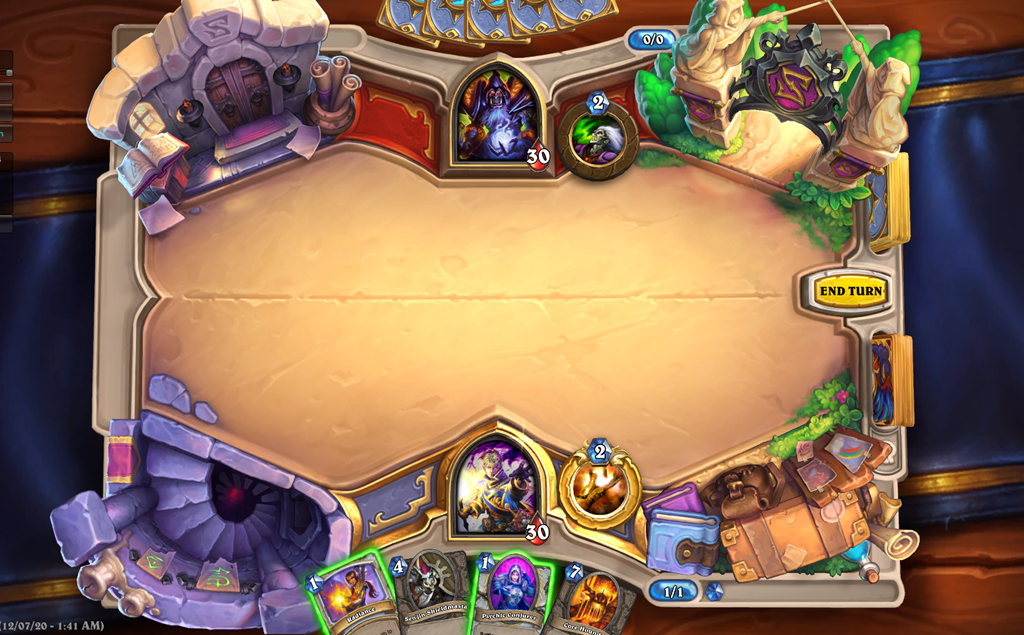
That mentality has shifted as I’ve gotten older, but not in the direction of actually playing card collecting games (CCG) whatsoever. I’ve moved in the other direction, away from collecting cards and even further away from playing CCGs. There is something incredibly boring to me about building a deck of cards filled with spells, monsters and other stuff, and playing against other people with it. I’ve had people try to get me into Hearthstone and other games before, but I just don’t have the patience for any of them.
Hearthstone – Blizzard Entertainment
The CCG genre is incredibly popular and beloved by so many people, and I’m not trying to take anyone’s enjoyment of these games away from them. Focusing on games like this are extremely difficult for me because of just how slow and methodical they inherently are. You’re supposed to take your time and strategize, but as we’ve discovered earlier, I’m bad at that.
You might ask, “why not learn to play them so you can get better?” A good question to be sure, but I’ve only got so much time on this planet, that I’d rather not try to force a square block in a round hole for more of it than I already have to. CCGs are great fun for the people who can focus and really wrap their minds around them. Hell, my Discord channel is currently filled with Magic: The Gathering Arena optimal deck links and people constantly playing it. While I’d love to be able to engage my friends on this topic, I know it just won’t happen and I’ll end up just grousing about how much I dislike everything about CCGs to them.
Outlast 2 – Red Barrels
HORROR
To be completely honest, I don’t know why people enjoy the horror genre in any aspect, whether it be games, movies, TV shows, or even going to haunted houses on Halloween. I don’t like any of it, and it’s because I don’t enjoy being scared. Nothing about the emotion of fear seems fun to me at all, and I don’t get how some people are so eager to get frightened.
I get that some people get a great adrenaline rush out of a scare, or can appreciate a nice haunted tone in a movie or game or whatever, but I’m not one of those people. To me, fear was something I wanted to avoid and steer clear of as best I could. I don’t enjoy feeling on edge, I don’t admire the artistic talent it took to evoke that spooky tone, I just don’t like any of it.
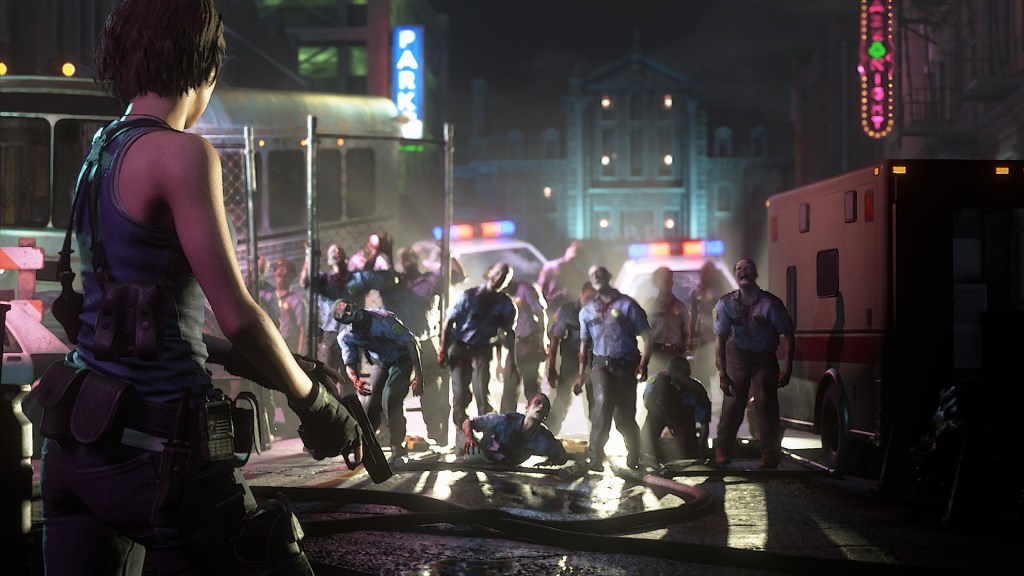
Resident Evil 3 Remake – Capcom
Call me a coward or whatever, but fear was just never something I actually wanted to experience. That’s why when people clamor about the latest Resident Evil game or talk about the masterpiece that P.T. was, I can’t even begin to have that conversation with them. They might be stellar games through and through, appealing to everything a horror fan wants, but to me they’re just an expensive way to feel uncomfortable and have nightmares.
Once again, you can enjoy and praise the horror genre all you want, but none of it is going to make me willingly pay money to be scared. We haven’t even talked about games that like to throw in a jump scare in it just to shake things up. Bioshock Infinite had one of those and I’m still angry at it for including it.
Final Fantasy VII Remake – Square Enix
JRPGs
If I’m being honest here, JRPGs combine two things I’m really not that crazy about into one package that I don’t have any reverence for. As far as anime goes, I think I’ve enjoyed maybe one or two of them in my life, and they’re pretty mainstream if I’m being honest. I know that people really enjoy anime, and I’m not here to take that away from you because I truly believe that certain anime media can be really cool, particularly in the badass fight scenes that I’ve seen posted online. Anime can be cool is what I’m saying.
But the other half of that equation, the turn-based RPG part of it? That’s the part that I can’t handle as much. In my life, I’ve played part of one Final Fantasy game, and watched a childhood friend blast through large sections of Final Fantasy VII when it came out. Both of those experiences were pretty agonizing for me. And I know it’s unfair to target the Final Fantasy series here, but they’re one of the few touchstones I have in this genre of games. I never had the urge to play anything in this genre, so I’m well aware that there might be something that I might find interesting somewhere out there.
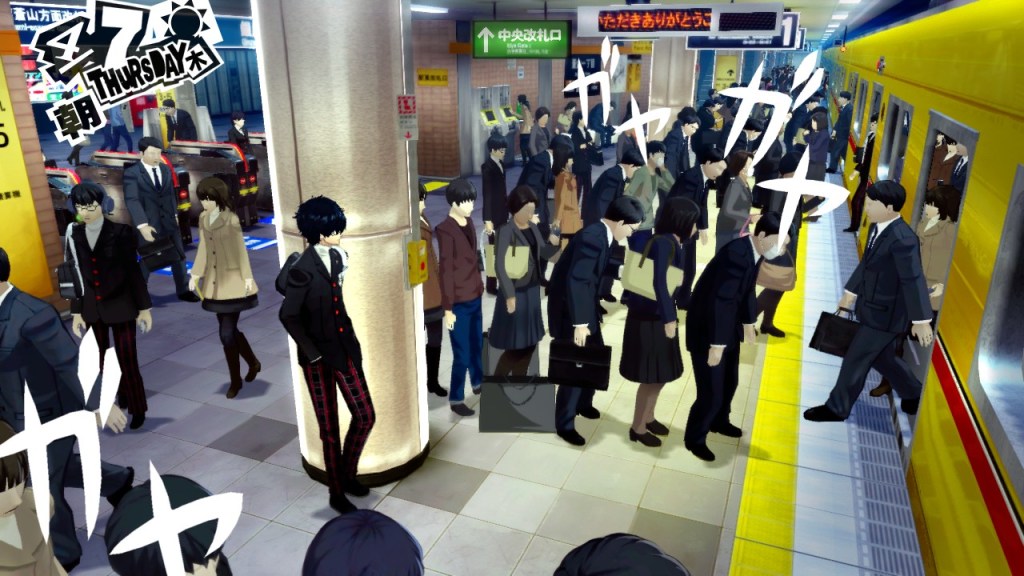
Persona 5 – Atlus
Similar to my issues with tactics and strategy games, I’m just a poor planner when it comes to gaming… and probably everything else in my life. So making sure I’ve got the right party members, items and buffs never really appealed to me in video games. I used to point to the fact that taking turns in combat made no sense to me, but that’s a pretty juvenile argument that I no longer use especially considering my recent reverence for D&D.
The reasons I won’t play those games today has changed significantly since I was younger, but they basically boil down to the fact that a lot of JRPGs are way too long and dense for me. Those games usually have so much going on in them that I can’t keep up. It’s the same way I feel about intense classic RPGs like the old Fallout games or last year’s Disco Elysium. They’re highly regarded games that I just don’t have the patience for.
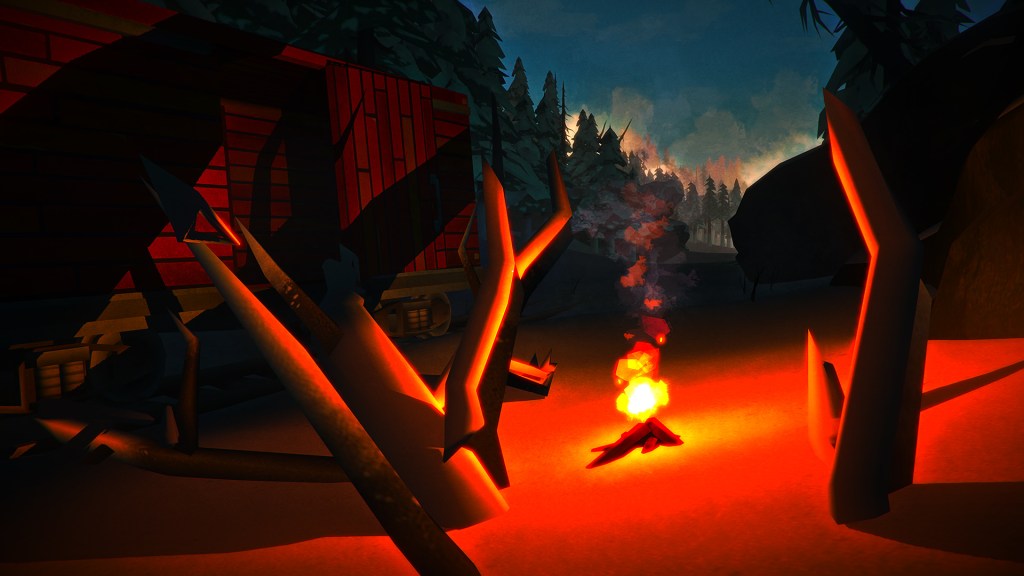
The Long Dark – Hinterland Studio
PLATE SPINNING
There’s the concept of “plate spinning,” or the idea that you need to manage and keep tabs on a lot of moving parts at once. I notice this mostly in survival games where you need to worry about your food, thirst, stamina, temperature and so on. Both this and time limits feel like two sides of the same coin that I want to just throw into a storm drain.
Sometimes these mechanics are intrusive and steal the focus away from anything else in the game. When that happens, a switch flips in my head that instructs me to stop any forward progression and just hoard everything I can find for the next few hours. Maybe that’s how you’re supposed to play the game, but it just feels like paranoia-fueled busy work to me.
Minecraft – Mojang
There are some exceptions to this rule however, and it only occurs when a game isn’t too intrusive about it. For instance, Minecraft has a hunger and stamina meter, but it’s such an afterthought that you really don’t need to do much aside from carry a few steaks on you at all times. The ‘survival’ portion of the survival mode in Minecraft mostly applies to you not dying in whatever monster-filled chasm you inevitably arrive at.
Even Red Dead Redemption II had some light survival mechanics that were easy to fulfill. If you find yourself in town, you might as well snag a hot meal and a bath and refill your dwindling meters. Both of those last for days as well, and you’re never really in danger of starving to death or passing out from exhaustion. It’s that kind of light touch approach that I can deal with when it comes to plate spinning, but games that are designed around your ability to multitask efficiently just stress me out.
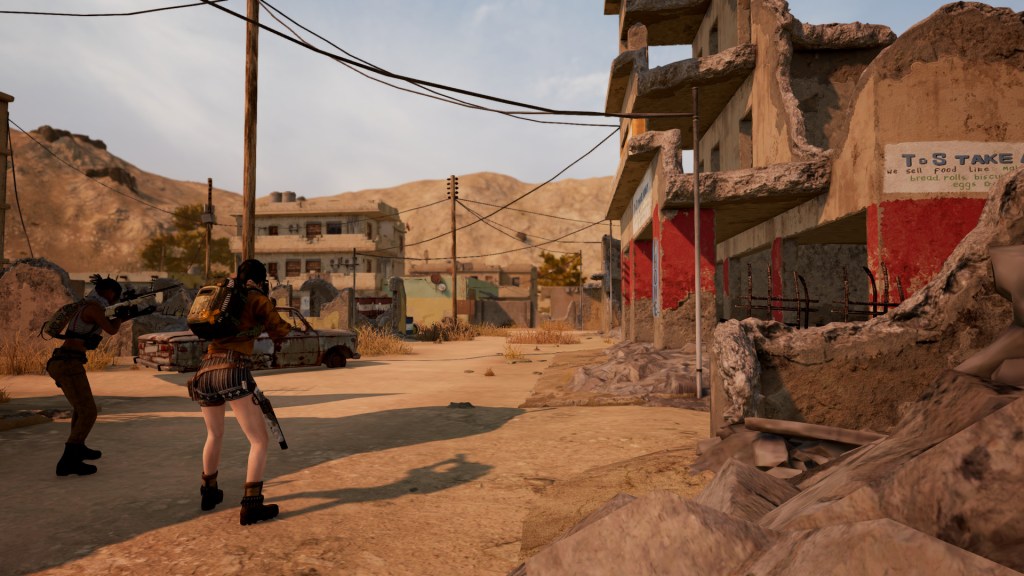
PLAYERUNKNOWN’S Battlegrounds – PUBG Corporation
BATTLE ROYALES
Remember back in 2017 when we could go places and do stuff but ultimately decided to stay inside and play PLAYER UNKNOWN’S Battlegrounds instead? I do. In fact, I played a whole lot of PUBG, to the point where it started to get tiring which ultimately led to me falling off of it about a year later. It was a marginally better time.
But now if you asked me to play a battle royale game with you, I’d probably find any excuse I could to avoid doing so. I don’t necessarily have anything against the genre itself, but I have played enough of one of the most popular ones out there to have had my fill with the genre entirely.
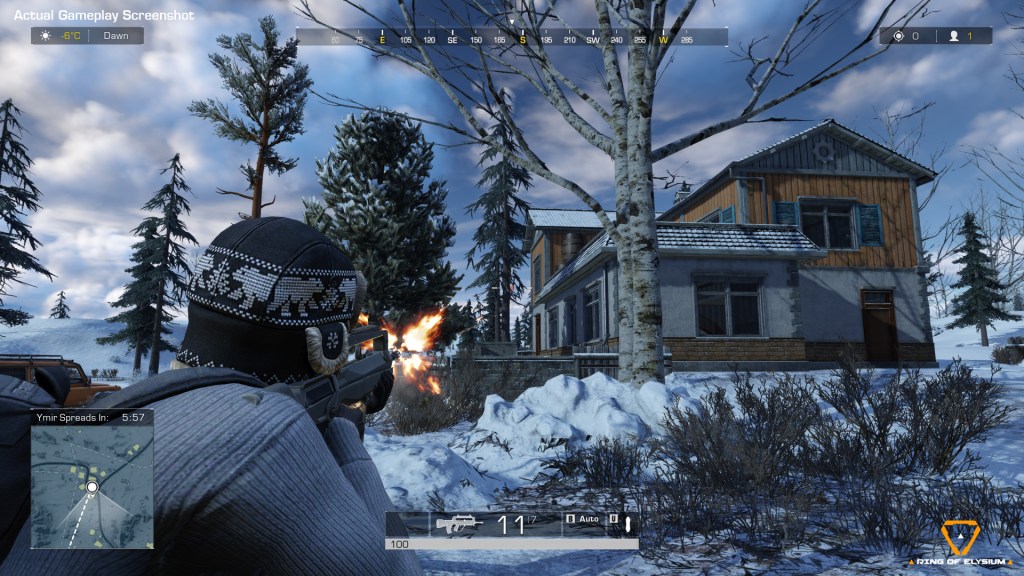
Ring of Elysium – Aurora Studio
This feeling was cemented when I tried to play Fortnite a few times, and bounced off of it almost immediately. From PUBG, to Fortnite, to Apex Legends, Ring of Elysium, Radical Heights and The Culling, I’ve played a lot of these games, and I think I’ve had my fill of the entire concept itself.
These games can still offer up a lot of entertainment and satisfaction, but they can also be sources of immense anxiety and stress. I’ll never forget the tension that would fill the air when you’d hear a gunshot ring out in the distance during a round of PUBG. Hell, everything in PUBG was incredibly tense when I think about it. The sound of a car, the sight of already opened doors, the literal ring of death that’s slowly closing in on you, it was all designed to be stress inducing.
Stress inducing as it was though, it was a lot of fun. But I just don’t think I need that in my life at this point. I like having stakes in games, I like tense moments, but battle royales seem to luxuriate and bask in these moments to the point of sensory overload for me.
A lot of what I’ve talked about here are just some personal examples of things that turn me off when looking into new games. They’re not value judgements or statements about the product itself or the people who actually enjoy them, they’re just my personal proclivities and nothing more.
Something also interesting to note is that just about everything I’ve listed here plays into my personal issues with anxiety and attention span. It’s weird how you can know all these various facts about yourself, but not be able to see how they’re all intertwined until you actually write them out and try to find a connective thread.
Ultimately I’d like to impress upon you that liking these things is totally valid and I want you to keep enjoying whatever it is you’re playing. If everyone felt the same way as I did, then these games wouldn’t be made anymore because people would stop buying them. The world is filled with different people with different tastes, and while some of these mechanics and genres aren’t for me, I celebrate the people who garner enjoyment from them in my place.
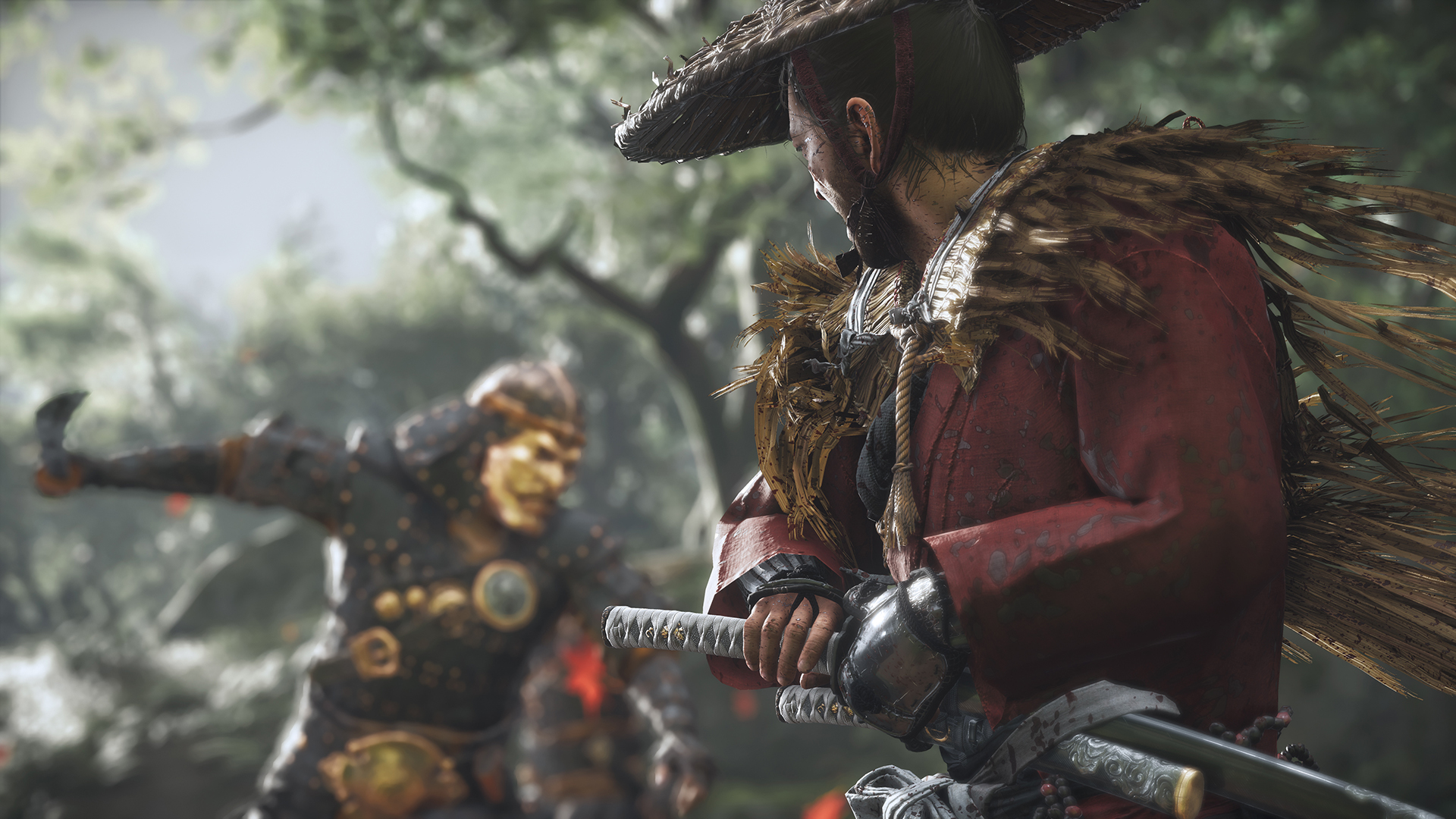
I went into Ghost of Tsushima knowing very little about what the game was outside of it being an open world action-adventure game set during a Mongol invasion of Japan during the 1270’s. A cool premise to be sure, but a cool premise alone wasn’t able to change the fact that I wasn’t having much fun with the game itself.
I really wanted to like Ghost of Tsushima. From its initial pitch to the various trailers and snippets of news that led up to its release, I was under the impression that this would be something I could sink a lot of time into. By all accounts, there was a lot of the game to experience, but the general consensus was that very little of it was worth the time investment. But I wanted to experience it for myself because I was very much in the mood for a big and bombastic action game. Instead I got Ghost of Tsushima, a sigh in video game form.
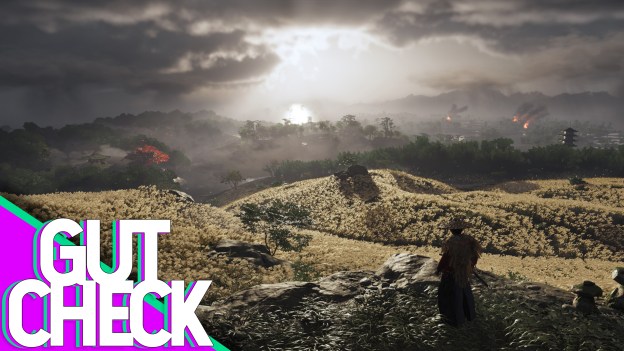
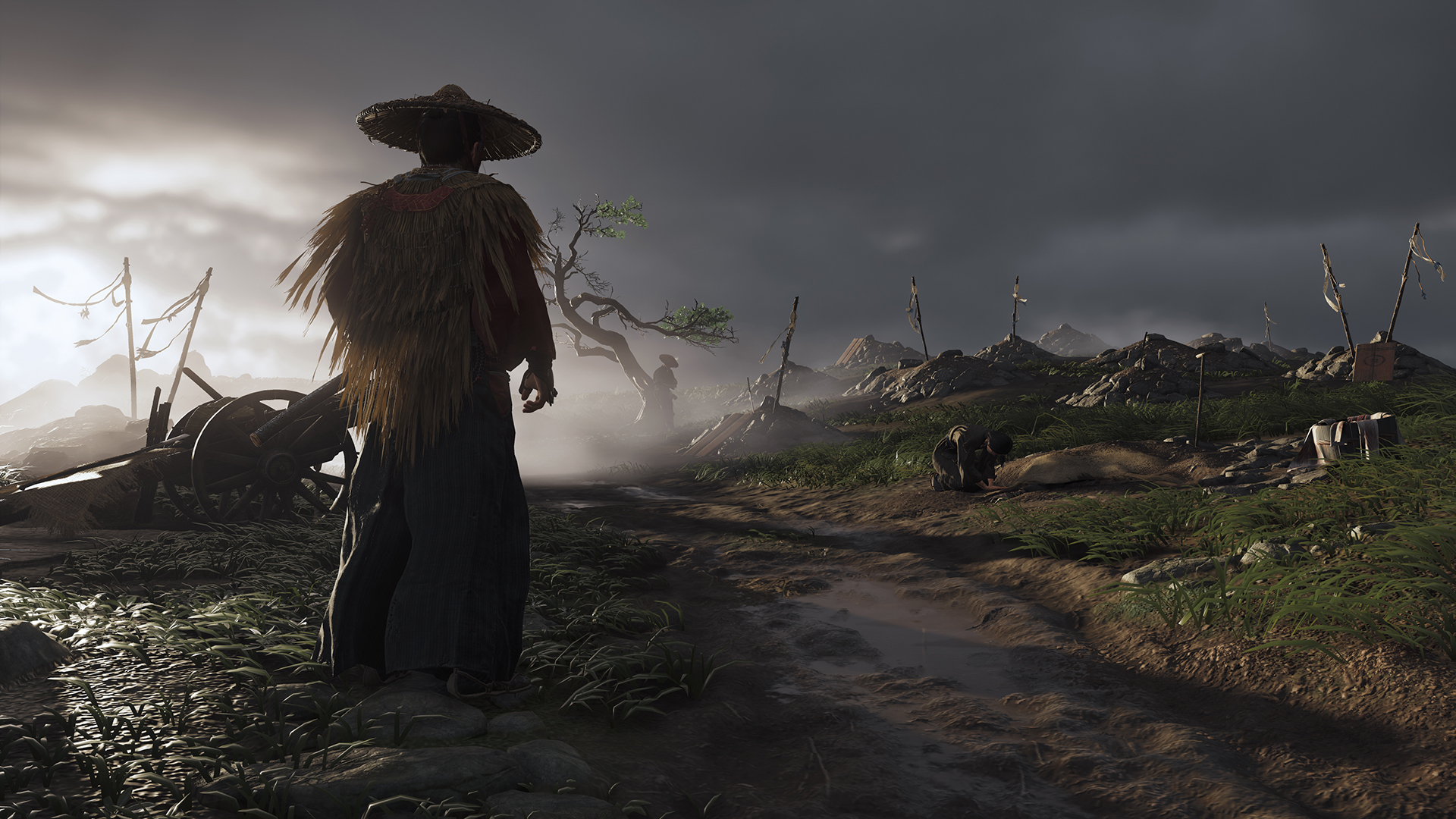
You might look at screenshots or trailers for the game and think, “wow, that’s a beautiful game,” and you wouldn’t be wrong. Riding through a field of flowers and over the rolling hills of cherry blossom trees is objectively beautiful in Ghost of Tsushima. The art direction is fantastic and deserves to be applauded without a doubt. But once you start moving around and interacting with the world, that’s when you see the cracks start to show.
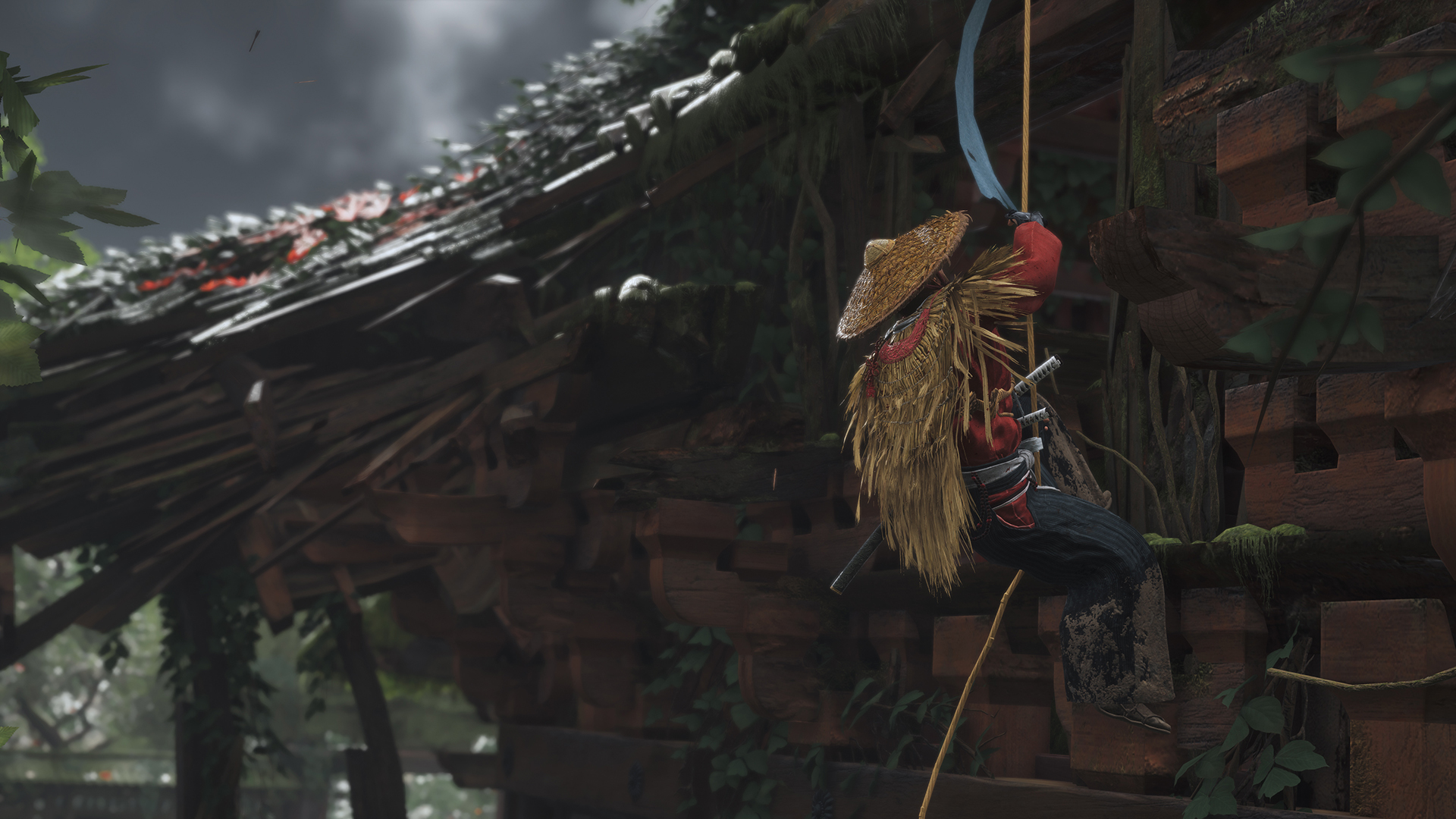
Standing in stark contrast to the beauty of the world were the rough and jagged animations in Ghost of Tsushima. Nothing seems to flow together in a natural way, ultimately making navigating the world look and feel clunkier than you’d like. Multiple times I found myself getting caught up on walls, being slid across the ground by roving NPCs, and unnaturally snapping into static animations while trying to climb or duck under obstacles.
But janky animation isn’t the end of the world. The real issues crop up in the playing of the game itself, particularly when using the camera. Now there are bad cameras that fail to adjust to a player’s position, or a broken one that just doesn’t follow the action when you need it to, but I’ve never had a camera in an open world game vehemently disregard my inputs in the brazen way that the one in Ghost of Tsushima does. The camera often tries to force a cinematic angle that isn’t particularly helpful when you’re barreling down the road on your horse and just want to see what’s ahead of you. While annoying, it isn’t the end of the world.
However, the camera exhibits borderline game-breaking behavior during combat encounters, when you’re desperately trying to create space between you and the ever charging hordes of enemies. The camera will often rotate into awkward angles if you happen to back into an object, making the concept of keeping your enemies on screen more of a chore than it needs to be. This could all be alleviated to some extend with a competent lock-on mechanic, but Ghost of Tsushima lacks a functional targeting system.
You are regularly surrounded by groups of enemies, something that other games might use as an opportunity to let you hit a button or click a stick so you can individually lock-on to an opponent. Ghost of Tsushima opts for something slightly different and objectively worse. You have a sort of soft lock-on where you gently nudge the camera to focus on an enemy, and that will “lock-on” to them. Except it doesn’t work and you’ll just end up swinging wildly at nothing until some dick with a spear stabs you through your sternum. I hate this camera with a passion, and it’s one of the main reasons I don’t like Ghost of Tsushima.
I can’t really talk about too much of what to expect from the later hours of Ghost of Tsushima considering I’ve only played maybe two hours of it, but I feel like I’ve already hit my limit with it. A lot of people have said the the opening hour or so is by far the weakest portion of the game, but that fact is usually followed up with the revelation that very little of the game’s content is interesting or unique. While I don’t have first hand experience to speak on it definitively, based on what I’ve played thus far, neither the gameplay, missions, nor story have been particularly engaging or worth returning to.
Early in the game almost every action you take is interrupted by a cut-scene that goes on way too long, or a flashback training sequence that also overstays its welcome. The story seems fine so far, but it has had no emotional weight or impact on me at all, which ultimately seems to be the overarching theme with Ghost of Tsushima. It doesn’t really excel at anything, and more often than not it just feels deflating and disappointing.
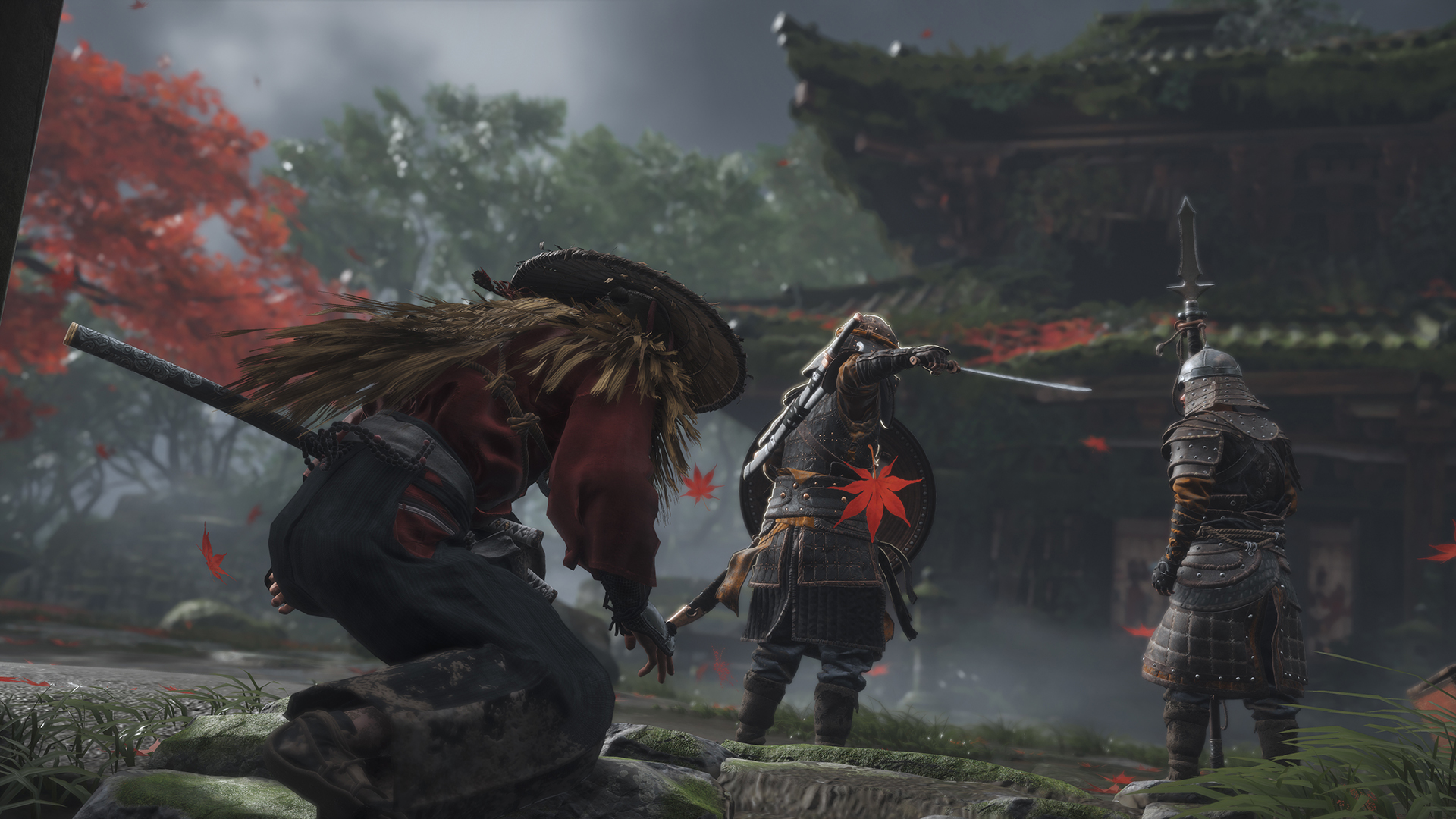
That being said, it’s a lot of fun to get into sword fights with people in Ghost of Tsushima. The combat is deliberate in a way that can feel incredibly rewarding when executed correctly, and utterly deflating when you mistime something. It would be a lot better if it had a traditional lock-on mechanic, but as it stands it’s rewarding when you aren’t overcome with frustration from the incompetent camera. There’s also a “standoff” mechanic which, while not revolutionary, is certainly interesting. It’s basically the “anti-stealth” mechanic, where you march right up to a group of bad guys and challenge them to a duel. What happens next is you basically have to time a button release to one-hit kill your opponent, but I still thought it was pretty cool the few times I did it.
I can’t really speak to the stealth aspects of the game though, because you’re severely limited in the early hours of the game with what you can actually do. It seemed okay I suppose, but it wasn’t anything worth gushing over. Coincidentally that’s exactly how I feel about the everything in Ghost of Tsushima.
But that’s Ghost of Tsushima in a nutshell. It’s an okay game that has some pretty rough edges. It’s one of those games that I couldn’t recommend anyone rush out and buy at full price, but on a big enough discount I might. Maybe Ghost of Tsushima just makes a really miserable first impression and needs more time to really be appreciated. But I just don’t think I have that kind of patience in me for a game that just feels sloppy.











 The Bonus World